Aardwolf
Proteles cristata
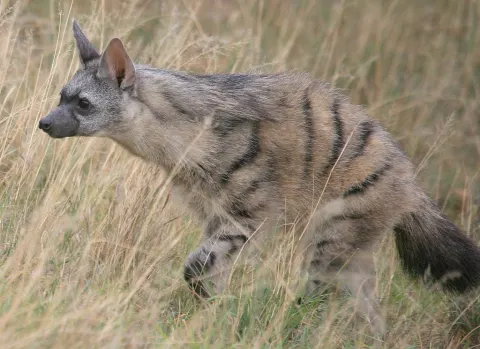
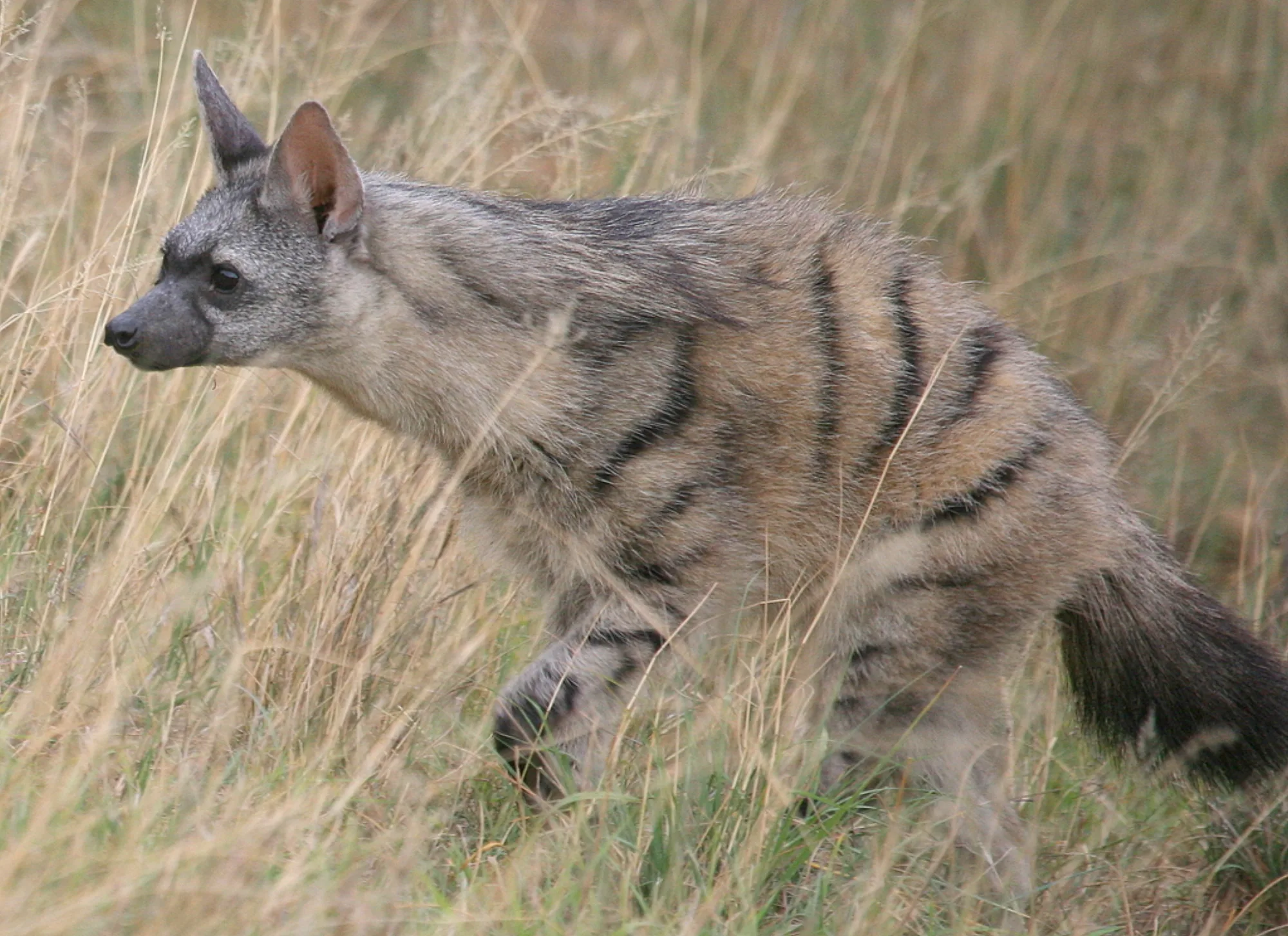
A shy member of the hyena family, the Aardwolf has a slender muzzle, yellowish fur with black vertical stripes, and a long mane running along its neck and back. Its lower legs are black, its ears are large, and its bushy tail has a black tip. Smaller and slimmer than a striped hyena, it stands about 40 to 50 cm at the shoulder. When confronted, it can raise its mane to look bigger.
Aardwolves live in two separate populations, one in Southern Africa and the other in East and Northeast Africa, with none in the miombo forests between them. They favour open, dry plains and bushland, including grasslands and savannahs where their termite food occurs, and avoid mountains. Usually nocturnal, they sleep in burrows by day and emerge after dark, although they sometimes feed by day during the coldest winter periods. They generally forage alone, finding termites by sound and scent and licking them from the ground with a sticky tongue. They leave the mound and some of its colony intact, and may return to familiar nests months later. Other insects and larvae also feature in their diet.
Pairs share a territory with their young, using dens that may be abandoned burrows or rock crevices. Breeding usually takes place in autumn or spring, depending on location, and two to five cubs are born during the rainy season. The cubs spend their first 6-8 weeks in the den with their parents and begin supervised foraging after 3 months. Some people persecute aardwolves because they wrongly believe they hunt livestock, while elsewhere the animals are sometimes killed for their fur. Dogs and insecticides also kill them.
Written from the English Wikipedia article Aardwolf (CC BY-SA 4.0).
- Records
- 14
- Countries
- 3
- Atlas places
- 5
These are open occurrence records, so they show where people looked for and recorded the Aardwolf as much as where it lives. Cells are up to 25 km across, and every location is generalised to its cell.
Generalised encounter areas, not exact locations. Each shape is a grid cell coloured by how likely the species is there.
- Very likelySouth Africa25 km zone · medium confidence · 14 records · updated 80 days ago
- PossibleNamibia25 km zone · low confidence · 0 records · updated 80 days ago
- UncommonBotswana25 km zone · low confidence · 0 records · updated 80 days ago
Conservation status not assessed here yet, so every location is generalised to its grid cell.