Tui
Prosthemadera novaeseelandiae
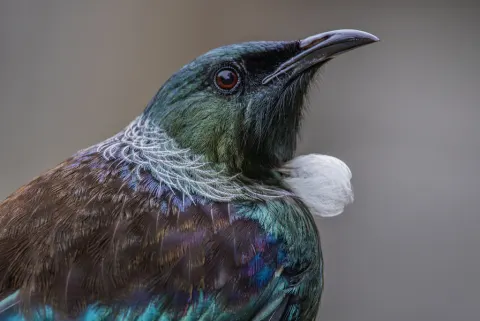
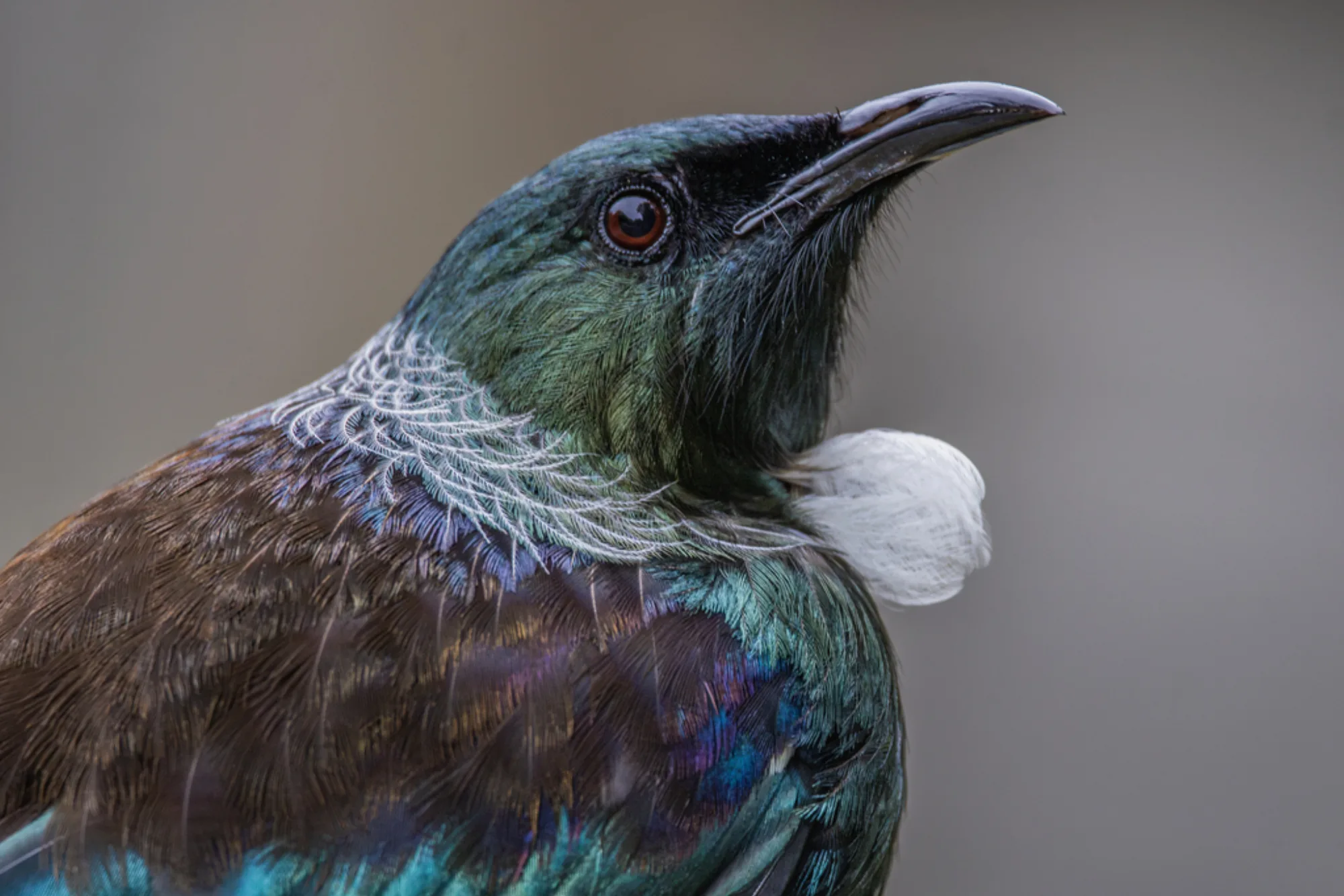
Look for a white throat tuft on the Tui, a medium-sized New Zealand honeyeater whose plumage can appear black at first glance. Closer up, its feathers show blue, green and bronze colours, with brown on the back and flanks and an iridescent sheen that changes with the light. A small white wing patch adds another mark. Its calls are individual and varied, mixing bell-like notes with clicks, creaks, cackles and wheezes; it may also sing at night, especially around a full moon.
Tui occur across New Zealand, from the Kermadec Islands to the Auckland Islands, including the main islands and the Chathams. They favour low-altitude broadleaf forest but also use small forest remnants, regrowth, exotic plantations and leafy suburbs. Usually seen alone, in pairs or small family groups, they gather in larger numbers where food is plentiful. Nectar is their usual food, with fruit and insects eaten frequently and seeds and pollen occasionally. They are important pollinators of plants including flax and kōwhai, and may chase bellbirds away from a flowering flax plant. Males can defend a favoured feeding tree aggressively, flapping loudly and chasing other birds.
Breeding behaviour is especially noticeable in early spring, during September and October, when birds may climb steeply before dropping into a dive. The female does most of the nest building and incubates the usual clutch of four eggs for 14 days. Both parents feed the chicks, which leave the nest after around 20 days, and continue feeding them for another couple of weeks. Habitat destruction and introduced predators have caused substantial declines since European settlement. Possums eat eggs and chicks, while cats, stoats and rats also pose threats; common mynas compete for food and sometimes take eggs. Some populations have recovered, particularly where livestock removal has allowed vegetation to grow back.
Written from the English Wikipedia article Tūī (CC BY-SA 4.0).
- Records
- 216,711
- Countries
- 1
- Atlas places
- 10
- Fiordland National Park· New Zealand
- Mount Aspiring National Park· New Zealand
- Catlins Conservation Park· New Zealand
- Abel Tasman National Park· New Zealand
- Tongariro National Park· New Zealand
- Paparoa National Park· New Zealand
- Westland Tai Poutini National Park· New Zealand
- Aoraki / Mount Cook National Park· New Zealand
- Arthur's Pass National Park· New Zealand
- Rakiura National Park· New Zealand
These are open occurrence records, so they show where people looked for and recorded the Tui as much as where it lives. Cells are up to 25 km across, and every location is generalised to its cell.
Generalised encounter areas, not exact locations. Each shape is a grid cell coloured by how likely the species is there.
- Very likelyNew Zealand25 km zone · high confidence · 216711 records · updated 86 days ago
Conservation status not assessed here yet, so every location is generalised to its grid cell.