Cozumel Raccoon
Procyon pygmaeus
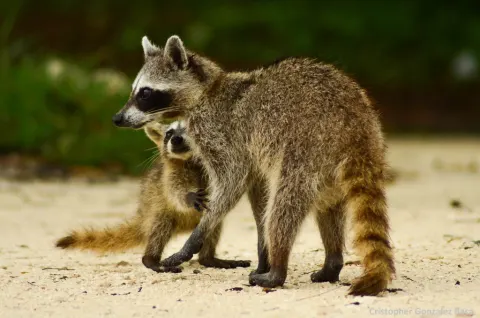
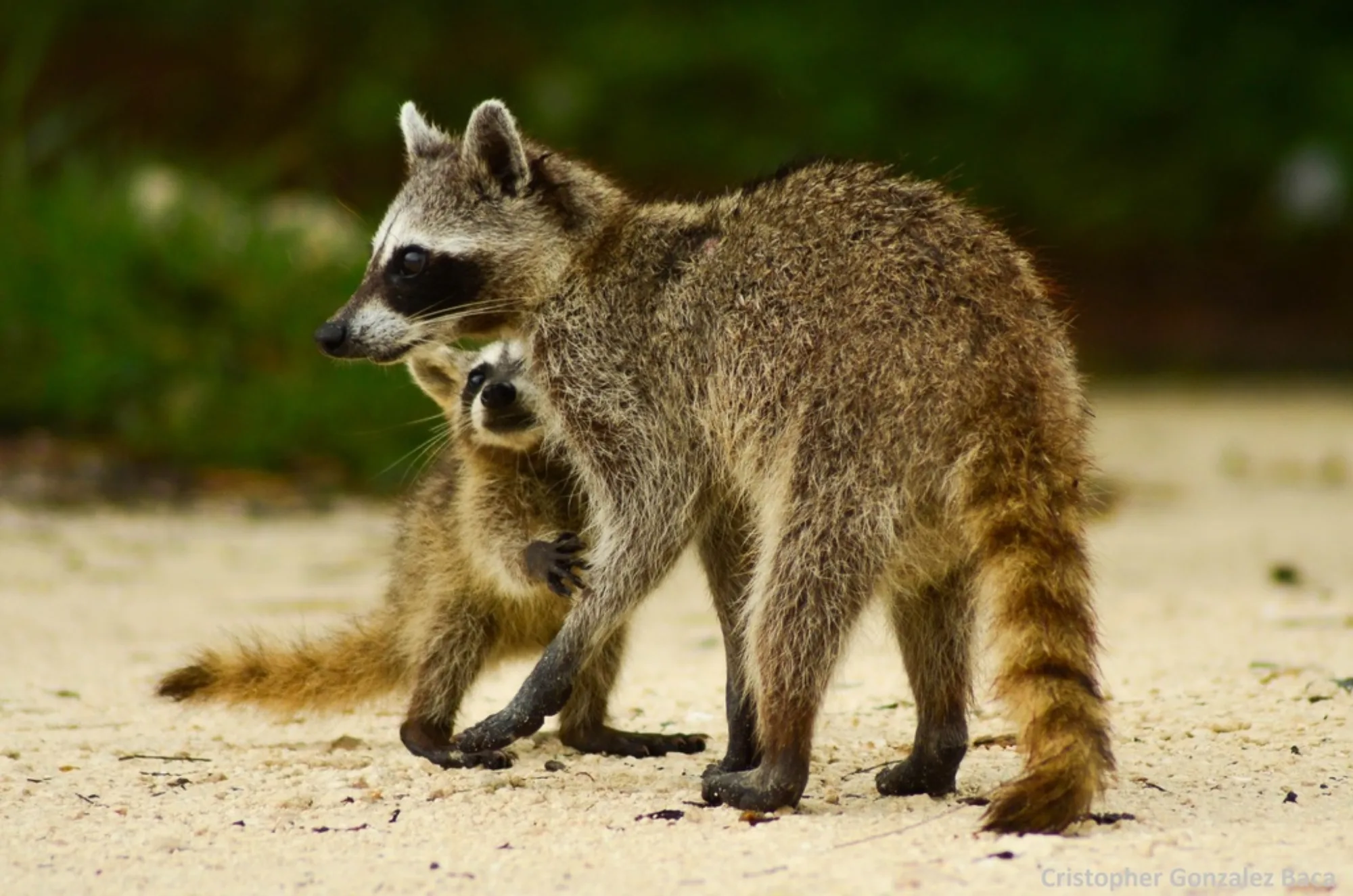
Look for a small raccoon with a black mask, a rounded snout and a yellowish tail marked with six or seven dark rings. The Cozumel Raccoon has buff-grey fur across its upper body, paler legs and underparts, and a white muzzle and chin. Males also have a bright orange patch on the back of the neck. Adults measure 58 to 82 centimetres in total, including the tail, and weigh 3 to 4 kilograms. This island species lives only on Cozumel, off Mexico's Yucatan Peninsula. It lives chiefly among mangroves and sandy wetlands at the northwestern tip, but has been recorded in nearby farmland and semi-evergreen forest, as well as Punta Sur ecological park in the south.
Mostly active at night, these raccoons are usually solitary, though mothers and cubs may sometimes form family groups. Activity peaks between sunset and 4:00 AM, and movements vary with habitat quality and human disturbance. They eat crabs, fruit, frogs, lizards and insects, with crabs making up 44% to 50% of the diet. Fruit becomes more prominent in the dry season, while crabs are eaten more often in the wet season. Females appear to give birth mainly between November and January, and may have a second litter in summer.
Tourism development threatens the coastal and mangrove habitat on which the raccoons depend, with deforestation, road expansion and fragmented habitat adding pressure. Raccoons also scavenge human food waste, which can expose them to contaminants and change their foraging behaviour. Hurricanes can kill young animals and reduce local numbers, while cats and dogs can transmit diseases. Their small range and low genetic diversity leave the population especially exposed to environmental change and disease.
Written from the English Wikipedia article Cozumel raccoon (CC BY-SA 4.0).
- Records
- 18
- Countries
- 1
No atlas park has a record of the Cozumel Raccoon in or around it yet.
These are open occurrence records, so they show where people looked for and recorded the Cozumel Raccoon as much as where it lives. Cells are up to 25 km across, and every location is generalised to its cell.
Generalised encounter areas, not exact locations. Each shape is a grid cell coloured by how likely the species is there.
- Very likelyMexico25 km zone · medium confidence · 18 records · updated 80 days ago
Conservation status not assessed here yet, so every location is generalised to its grid cell.