Crab-eating Raccoon
Procyon cancrivorus
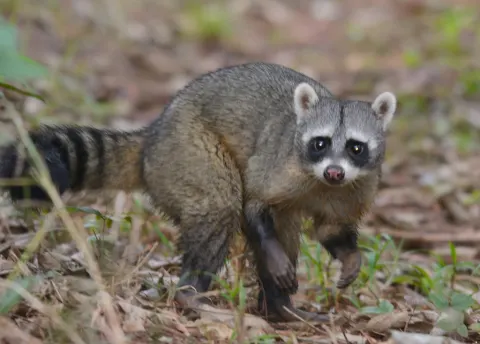
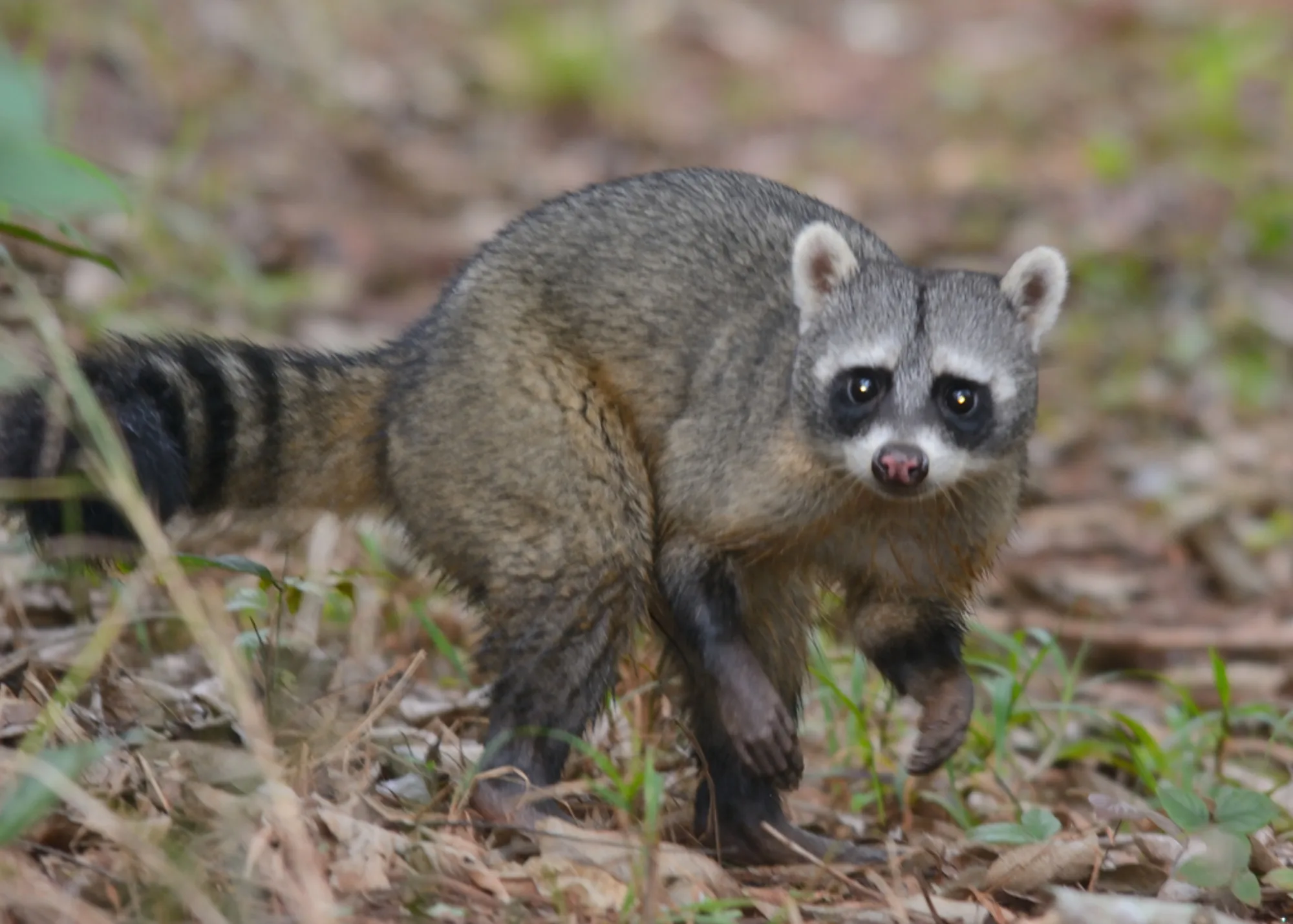
A dark mask around the eyes and a bushy, ringed tail give the Crab-eating Raccoon a familiar raccoon appearance. Its short fur and slender build give it a slimmer, smaller-looking profile than its common raccoon cousin, though they are similar in size. The head and body measure 41 to 80 cm, with a tail of 20 to 56 cm. Males are usually larger than females.
Native to marshy and jungle regions of Central and South America, it ranges from Costa Rica south through much of South America east of the Andes, reaching northern Argentina and Uruguay. It also occurs in Trinidad and Tobago. It usually lives close to water, especially streams, lakes and rivers, but is sometimes found in evergreen forest or on the plains. Rainforest sightings are rare. In Panama and Costa Rica, where its range overlaps with that of the common raccoon, it is found along inland rivers and streams. It adapts less readily to people than the common raccoon and is much less likely to occur in human environments.
Usually solitary and active at night, it spends much of its time on the ground but also spends a significant amount of time in trees. Its varied diet includes crabs, lobsters, crayfish and shellfish, along with fish, insects, small turtles, turtle eggs, fruit, nuts and vegetables. Breeding takes place between July and September, and females give birth in crevices, hollow trees or abandoned nests. A litter contains two to seven kits, with three the average. Females become more territorial while caring for their young and do not tolerate other raccoons nearby.
Written from the English Wikipedia article Crab-eating raccoon (CC BY-SA 4.0).
- Records
- 569
- Countries
- 11
- Atlas places
- 4
These are open occurrence records, so they show where people looked for and recorded the Crab-eating Raccoon as much as where it lives. Cells are up to 25 km across, and every location is generalised to its cell.
Generalised encounter areas, not exact locations. Each shape is a grid cell coloured by how likely the species is there.
- Very likelyArgentina25 km zone · medium confidence · 266 records · updated 80 days ago
- Very likelyFrench Guiana25 km zone · medium confidence · 164 records · updated 80 days ago
- Very likelyColombia25 km zone · medium confidence · 75 records · updated 80 days ago
- Very likelyEcuador25 km zone · medium confidence · 14 records · updated 80 days ago
- LikelyBrazil25 km zone · medium confidence · 37 records · updated 80 days ago
- LikelyUruguay25 km zone · medium confidence · 7 records · updated 80 days ago
- LikelyParaguay25 km zone · medium confidence · 3 records · updated 80 days ago
- LikelyVenezuela25 km zone · medium confidence · 3 records · updated 80 days ago
- PossibleCosta Rica25 km zone · low confidence · 0 records · updated 80 days ago
- UncommonBolivia25 km zone · low confidence · 0 records · updated 80 days ago
Conservation status not assessed here yet, so every location is generalised to its grid cell.