White Bellbird
Procnias albus
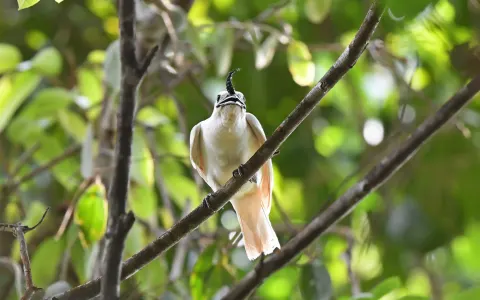
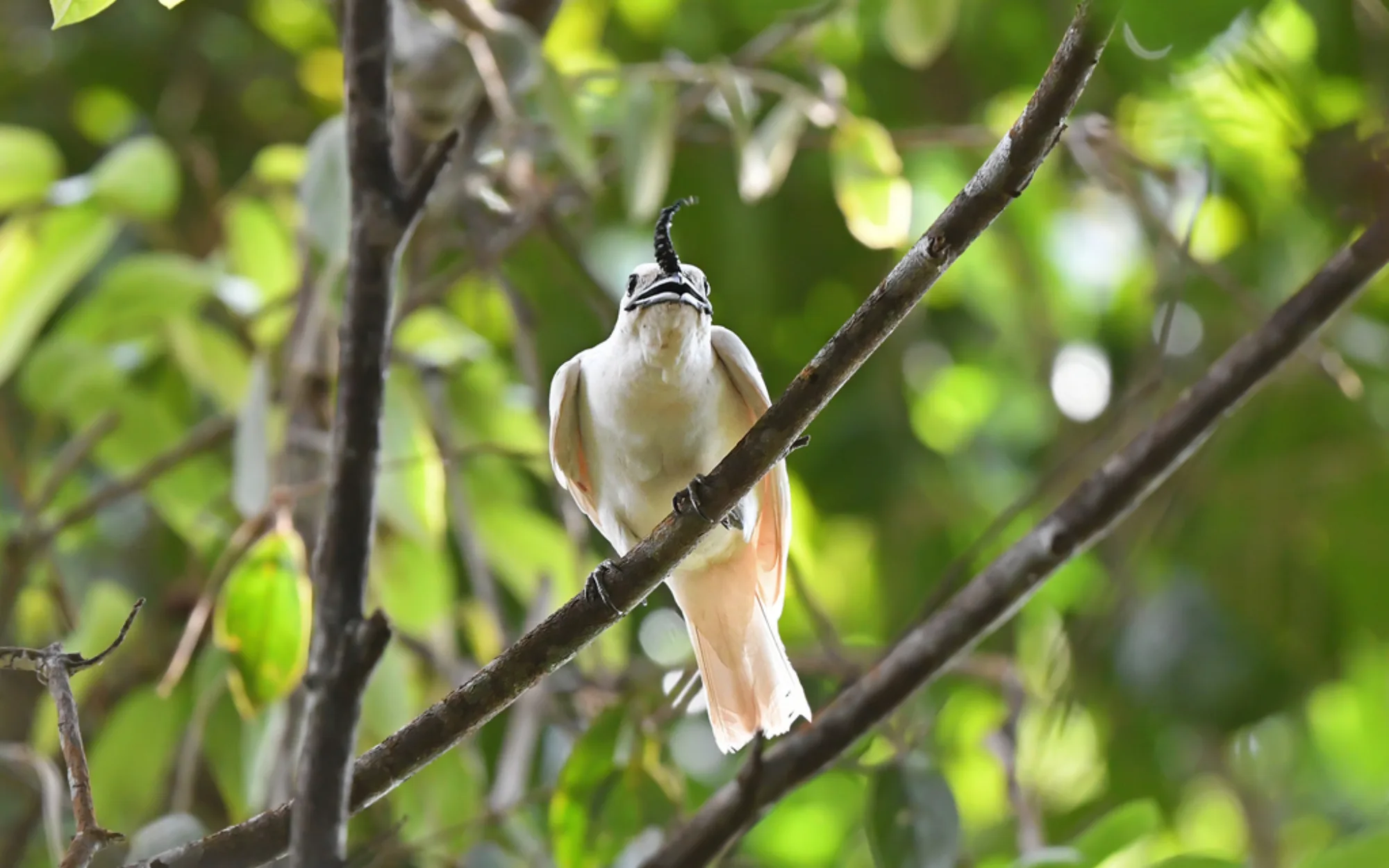
A white shape calling from a treetop may be a male White Bellbird, a cotinga about 27 to 29 cm long. Adult males of the widespread subspecies have entirely white plumage and a black wattle hanging from the base of the bill. Females look different, with olive-green heads, backs, wings and tails, and yellow underparts marked with olive streaks. Young birds resemble females, while males take a year or more to develop their white plumage and wattle. The bird can be difficult to observe and is generally uncommon and thinly distributed, although singing birds can be conspicuous and very locally common.
Its range extends from eastern Venezuela across the Guianas, with scattered locations in northern Brazil and a separate population in southeastern Pará. A small population also lives in southern Venezuela's Amazonas state, and the species has reached Trinidad as a vagrant. It lives mainly in lowland humid forest, though it also occurs on Venezuelan tepui slopes. Some birds move between elevations with the breeding and non-breeding seasons, and the species also wanders beyond its core range. White Bellbirds apparently eat only fruit, usually taking it during a short flight from a perch and swallowing it whole before regurgitating the seeds.
The breeding season appears to run from February to June, though nesting behaviour remains poorly known. One source describes a sparse nest on open branches, containing one or two eggs. Males display from treetops, giving calls that can reach 125 dB(A) at an equivalent distance of 1 m. The population is believed to be decreasing, but no immediate threats have been identified.
Written from the English Wikipedia article White bellbird (CC BY-SA 4.0).
- Records
- 1,719
- Countries
- 5
No atlas park has a record of the White Bellbird in or around it yet.
These are open occurrence records, so they show where people looked for and recorded the White Bellbird as much as where it lives. Cells are up to 25 km across, and every location is generalised to its cell.
Generalised encounter areas, not exact locations. Each shape is a grid cell coloured by how likely the species is there.
- Very likelyVenezuela25 km zone · high confidence · 951 records · updated 80 days ago
- Very likelyBrazil25 km zone · high confidence · 427 records · updated 80 days ago
- Very likelyGuyana25 km zone · high confidence · 207 records · updated 80 days ago
- Very likelyFrench Guiana25 km zone · medium confidence · 74 records · updated 80 days ago
- LikelySuriname25 km zone · medium confidence · 60 records · updated 80 days ago
Conservation status not assessed here yet, so every location is generalised to its grid cell.