Rock Hyrax
Procavia capensis
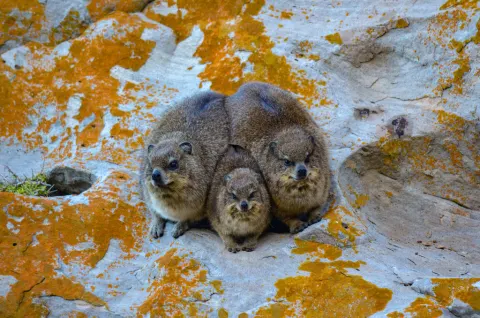
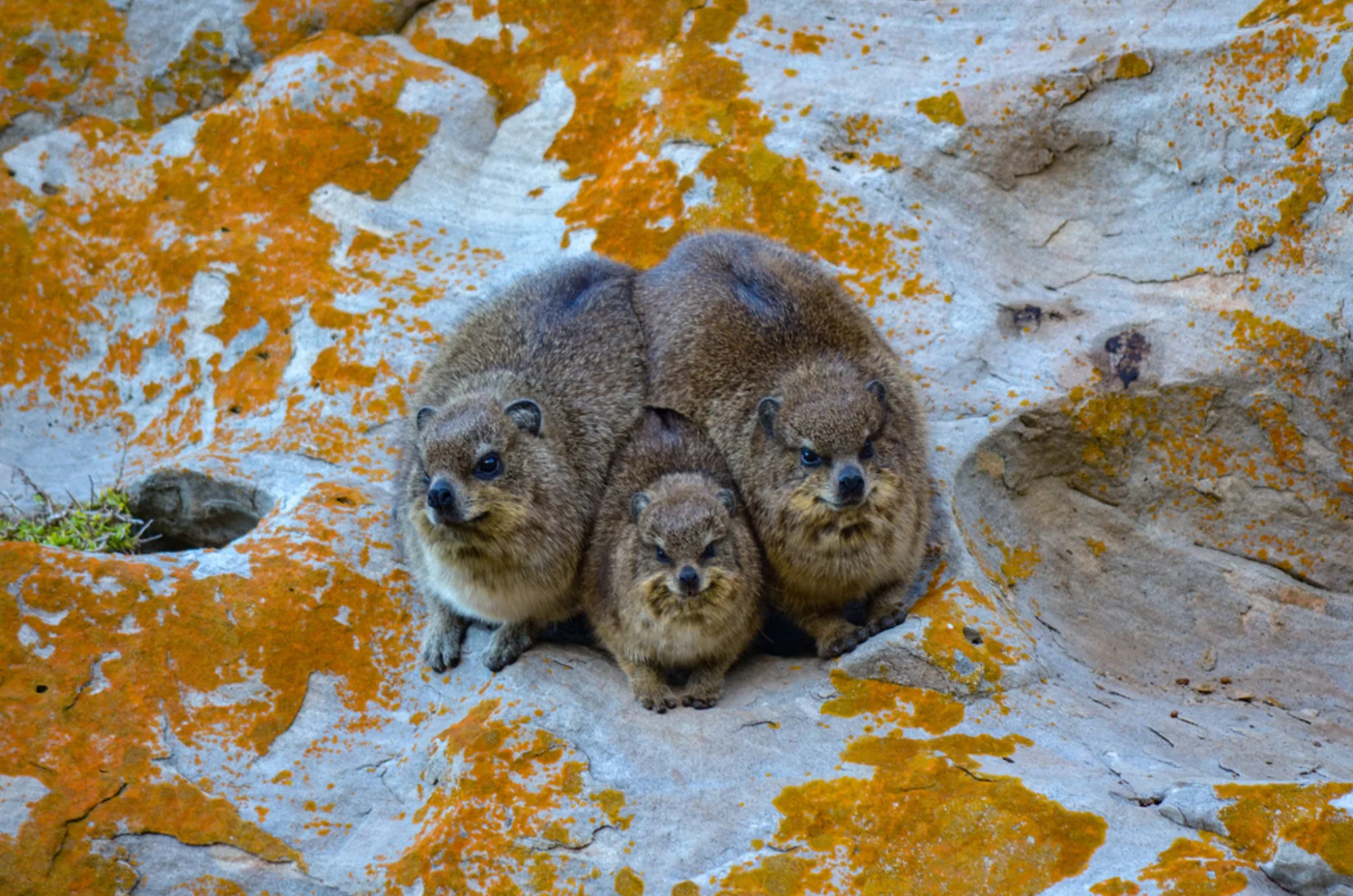
Look for the Rock Hyrax among rocks and crevices, where it can retreat from predators. This squat, heavily built animal has thick grey-brown fur, a pointed head, rounded ears and long black whiskers. Its coat can be dark brown in wetter places or light grey in the desert, and adults reach about 50 cm in length.
Rock hyraxes occur widely across sub-Saharan Africa, as well as in parts of North Africa and the Middle East. They make homes in suitable cavities in rock and soil, and can live at elevations up to 4,200 m. On Mount Kenya, a larger, longer-haired population lives among moraines in the alpine zone. They spend roughly 95% of their time resting and can often be seen basking, sometimes piled together. Activity is usually greatest in the morning and evening, though it varies with season and climate. Groups typically contain 10 to 80 animals and forage together, with sentries watching for danger. An alarm call sends the animals hurrying back to refuge.
Their varied diet includes broad-leafed plants and Lobelia, as well as insects and grubs. They can also climb trees and enter gardens to feed on leaves. Females give birth to two to four well-developed young after a gestation of 6 to 7 months. The young have open eyes and a full coat at birth, and can eat solid food after two weeks. Predators in Africa include leopards, caracals, pythons, hawks and owls; Verreaux's eagle is a specialist hunter of hyraxes.
Written from the English Wikipedia article Rock hyrax (CC BY-SA 4.0).
- Records
- 355
- Countries
- 22
- Atlas places
- 29
- Namib-Naukluft· Namibia
- Kruger National Park· South Africa
- Kunene / Kaokoveld· Namibia
- Table Mountain National Park· South Africa
- Etosha National Park· Namibia
- Serengeti National Park· Tanzania
- Ai-Ais/Richtersveld Transfrontier Park· Namibia
- Augrabies Falls National Park· South Africa
- Dorob National Park· Namibia
- Garden Route National Park· South Africa
- Lake Nakuru National Park· Kenya
- Pilanesberg National Park· South Africa
- uKhahlamba-Drakensberg Park· South Africa
- Waterberg Plateau Park· Namibia
- West Coast National Park· South Africa
- Aberdare National Park· Kenya
- Addo Elephant National Park· South Africa
- Hardap Game Park· Namibia
- Hell's Gate National Park· Kenya
- Karoo National Park· South Africa
- Kidepo Valley National Park· Uganda
- Madikwe Game Reserve· South Africa
- Mapungubwe National Park· South Africa
- Matobo National Park· Zimbabwe
- Mount Kenya National Park· Kenya
- Mountain Zebra National Park· South Africa
- Ngorongoro Conservation Area· Tanzania
- Skeleton Coast· Namibia
- Tsau ǁKhaeb (Sperrgebiet) National Park· Namibia
These are open occurrence records, so they show where people looked for and recorded the Rock Hyrax as much as where it lives. Cells are up to 25 km across, and every location is generalised to its cell.
Generalised encounter areas, not exact locations. Each shape is a grid cell coloured by how likely the species is there.
- Very likelySouth Africa25 km zone · medium confidence · 124 records · updated 80 days ago
- Very likelyIsrael25 km zone · medium confidence · 72 records · updated 80 days ago
- Very likelyNamibia25 km zone · medium confidence · 55 records · updated 80 days ago
- Very likelyAlgeria25 km zone · medium confidence · 41 records · updated 80 days ago
- Very likelyPalestinian Territories25 km zone · medium confidence · 22 records · updated 80 days ago
- Very likelyTanzania25 km zone · medium confidence · 8 records · updated 80 days ago
- Very likelyMauritania25 km zone · medium confidence · 4 records · updated 80 days ago
- LikelyKenya25 km zone · medium confidence · 14 records · updated 80 days ago
- LikelySouth Sudan25 km zone · medium confidence · 4 records · updated 80 days ago
- LikelyUganda25 km zone · medium confidence · 3 records · updated 80 days ago
Conservation status not assessed here yet, so every location is generalised to its grid cell.