Palm Cockatoo
Probosciger aterrimus
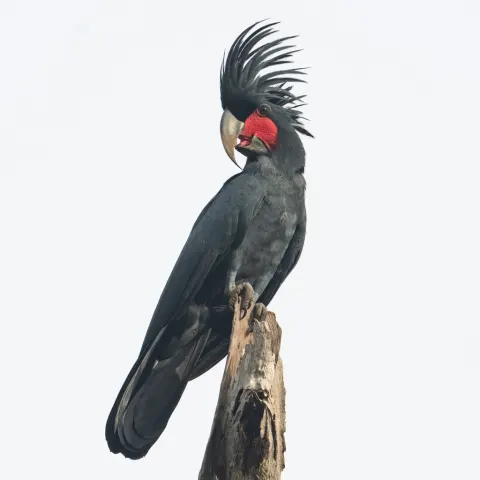
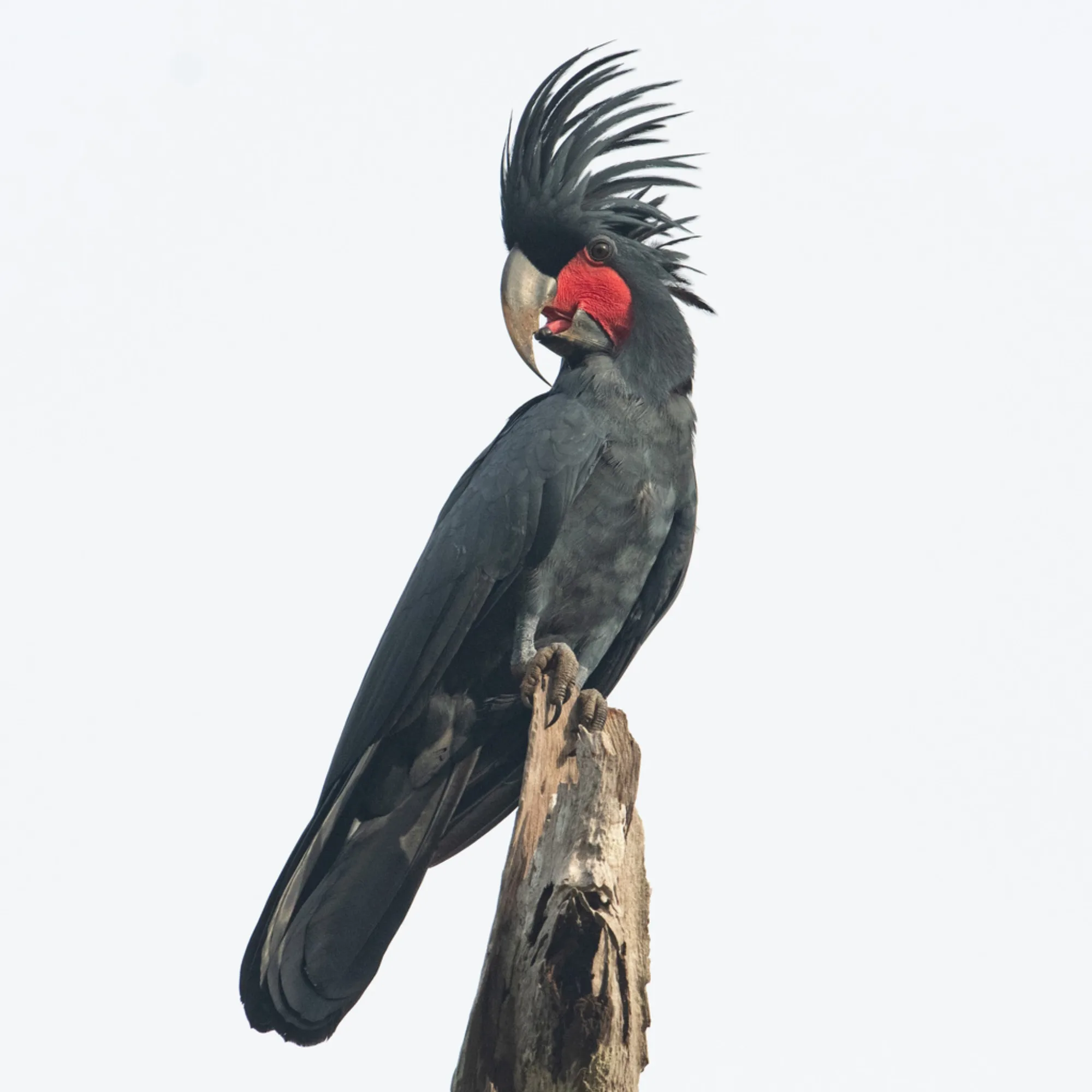
With its tall crest, powerful hooked black bill and bright red cheek patches, the Palm Cockatoo is a distinctive sight. This large parrot is smoky grey to black and measures 55 to 60 cm in length. Its cheek patches can shift in colour if it becomes excited or alarmed. It lives in New Guinea, the Aru Islands and Queensland's Cape York Peninsula, using rainforest and woodland. Near Sorong in West Papua, it is sometimes seen in trees beside roads.
Palm Cockatoos often feed early in the day, mostly eating fruit from wild pandanus palms and nuts from kanari trees. They also eat other fruits and seeds, including those of the nonda and cocky apple trees. They do not usually feed in flocks: one to six birds are generally seen feeding together. Birds may gather shortly after sunrise in open woodland or at the rainforest edge, then return to separate roosts at night. Males use sticks or seed pods to drum against dead wood in a loud territorial display. After drumming, a male sometimes breaks the tool into pieces for nest lining.
Breeding takes place in tree hollows, and both parents care for the young. Palm Cockatoos lay only one egg every second year, and their breeding success is low. On Cape York, habitat destruction, particularly from bauxite mining around Weipa, and changes to fire regimes threaten the bird. It is also hunted traditionally in New Guinea and is sought after for the pet trade.
Written from the English Wikipedia article Palm cockatoo (CC BY-SA 4.0).
- Records
- 4,486
- Countries
- 6
No atlas park has a record of the Palm Cockatoo in or around it yet.
These are open occurrence records, so they show where people looked for and recorded the Palm Cockatoo as much as where it lives. Cells are up to 25 km across, and every location is generalised to its cell.
Generalised encounter areas, not exact locations. Each shape is a grid cell coloured by how likely the species is there.
- Very likelyAustralia25 km zone · high confidence · 3078 records · updated 81 days ago
- Very likelyPapua New Guinea25 km zone · high confidence · 1334 records · updated 81 days ago
- LikelyHong Kong SAR China25 km zone · medium confidence · 29 records · updated 81 days ago
- LikelySingapore25 km zone · medium confidence · 19 records · updated 81 days ago
- LikelyIndonesia25 km zone · medium confidence · 18 records · updated 81 days ago
- PossibleThailand25 km zone · medium confidence · 8 records · updated 81 days ago
Conservation status not assessed here yet, so every location is generalised to its grid cell.