Largetooth Sawfish
Pristis pristis
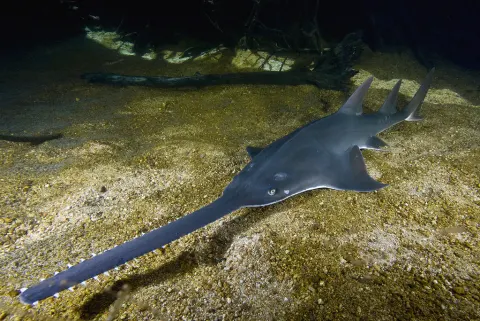
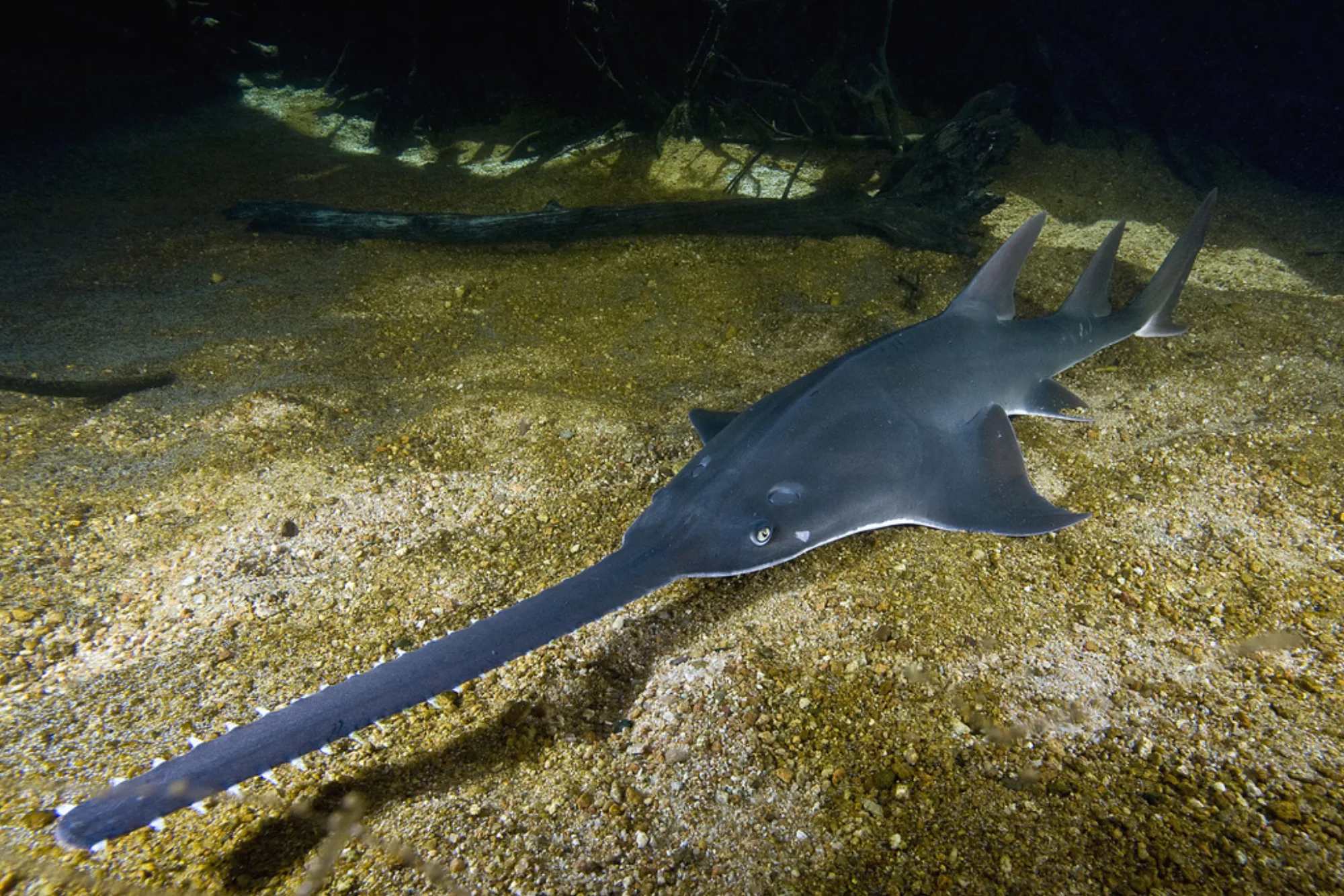
A long, tooth-edged saw gives the Largetooth Sawfish its distinctive outline. Its upper body is generally grey to yellowish-brown, sometimes with yellow-tinged fins, while the underside is greyish or white. Freshwater individuals can take on a reddish colour. Most are much smaller than the largest recorded specimen, with a typical length of 2 to 2.5 m. The saw is relatively broad, with 14 to 24 evenly spaced teeth on each side.
This fish occurs in tropical and subtropical coastal regions and also travels into freshwater. Adults are found mainly in estuaries and the sea, usually in water less than 10 m deep, over sand, mud or silt. It has disappeared from much of its former range, although Australia retains a relatively healthy population. It also survives in the East Pacific off Central America, Colombia and northern Peru, while the Amazon estuary probably holds the largest remaining Atlantic population. Sawfish feed on fish, molluscs and crustaceans, using their saw to disturb the bottom in search of food or slash at groups of fish. In captivity they can swim backwards and leap clear of the water.
Breeding is seasonal, and females can produce a litter every 1 to 2 years. The young are probably born near river mouths before moving into freshwater, where they spend their first 3 to 5 years. Overfishing is the main threat, compounded by habitat loss. Their saws make them especially liable to become caught in fishing nets, while their fins and saws are valuable and their meat is eaten.
Written from the English Wikipedia article Largetooth sawfish (CC BY-SA 4.0).
- Records
- 878
- Countries
- 2
- Atlas places
- 1
These are open occurrence records, so they show where people looked for and recorded the Largetooth Sawfish as much as where it lives. Cells are up to 25 km across, and every location is generalised to its cell.
Generalised encounter areas, not exact locations. Each shape is a grid cell coloured by how likely the species is there.
- Very likelyAustralia25 km zone · high confidence · 878 records · updated 80 days ago
- UncommonUnited States25 km zone · low confidence · 0 records · updated 80 days ago
Conservation status not assessed here yet, so every location is generalised to its grid cell.