Fishing Cat
Prionailurus viverrinus
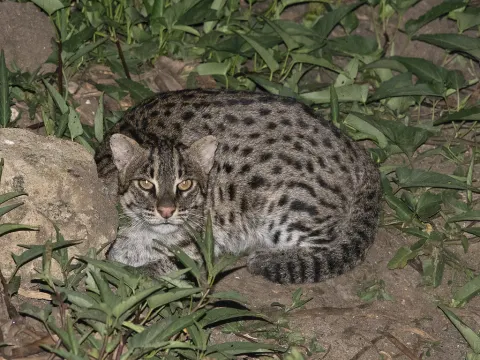
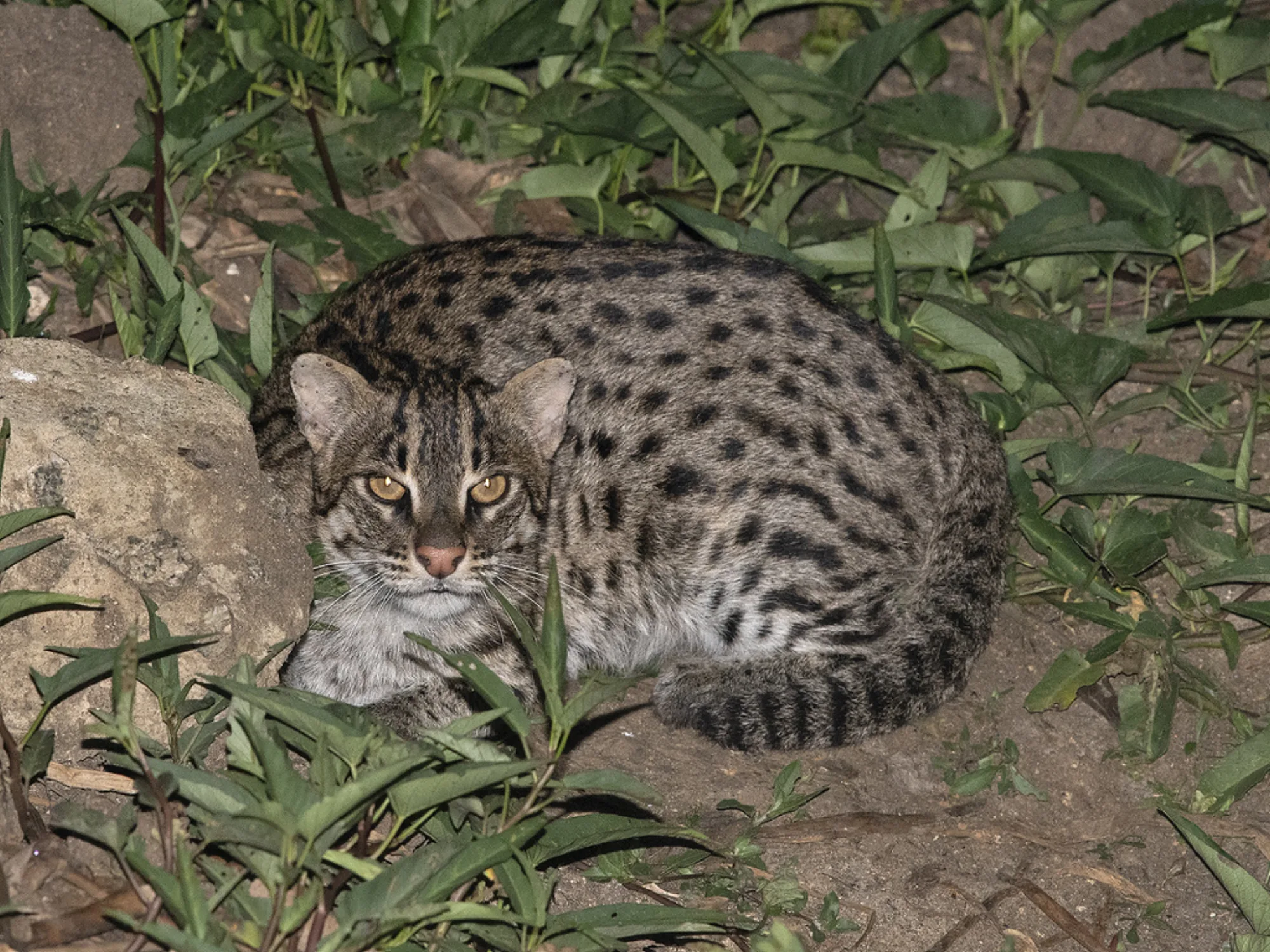
Stocky and muscular, the Fishing Cat is roughly double the size of a typical house cat. Its yellowish-grey or tawny fur is patterned with black spots and lines, while its ears are short, rounded, and marked with a white spot on the back. This species is unique for its partly webbed paws and claws that do not fully retract. Its dense, layered coat acts as a thermal barrier, allowing it to swim long distances or dive underwater.
These cats are found across South and Southeast Asia, primarily in wetlands with thick vegetation. They inhabit environments ranging from freshwater swamps and oxbow lakes to salty tidal creeks and mangrove forests. Within these areas, they hide in reed beds, tall grasslands, and shrublands. Though they are mostly active at night, they are often seen hunting along the edges of watercourses, where they wait for prey to approach before grabbing it from the shallow water.
Fish makes up the majority of their diet, supplemented by birds, rodents, insects, and snakes. They are solitary animals that mark their home ranges with scent. In the wild, kittens are usually born in March and April, moving independently by one month old. Today, these cats face severe pressure from the destruction of wetlands for farming and human settlements. They are also threatened by pollution, the over-exploitation of fish stocks, and being killed by local people who sometimes mistake them for tiger cubs.
Written from the English Wikipedia article Fishing cat (CC BY-SA 4.0).
- Records
- 2
- Countries
- 4
- Atlas places
- 0
These are open occurrence records, so they show where people looked for and recorded the Fishing Cat as much as where it lives. Cells are up to 25 km across, and every location is generalised to its cell.
Generalised encounter areas, not exact locations. Each shape is a grid cell coloured by how likely the species is there.
- Very likelyBangladesh50 km zone · medium confidence · 1 record · updated 4 days ago
- LikelySri Lanka50 km zone · medium confidence · 1 record · updated 4 days ago
- LikelyPakistan50 km zone · low confidence · 0 records · updated 4 days ago
- PossibleIndia50 km zone · low confidence · 0 records · updated 4 days ago