Flat-headed Cat
Prionailurus planiceps
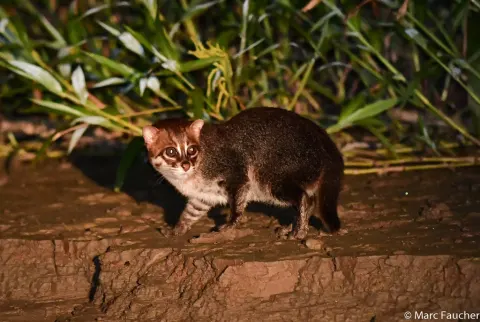
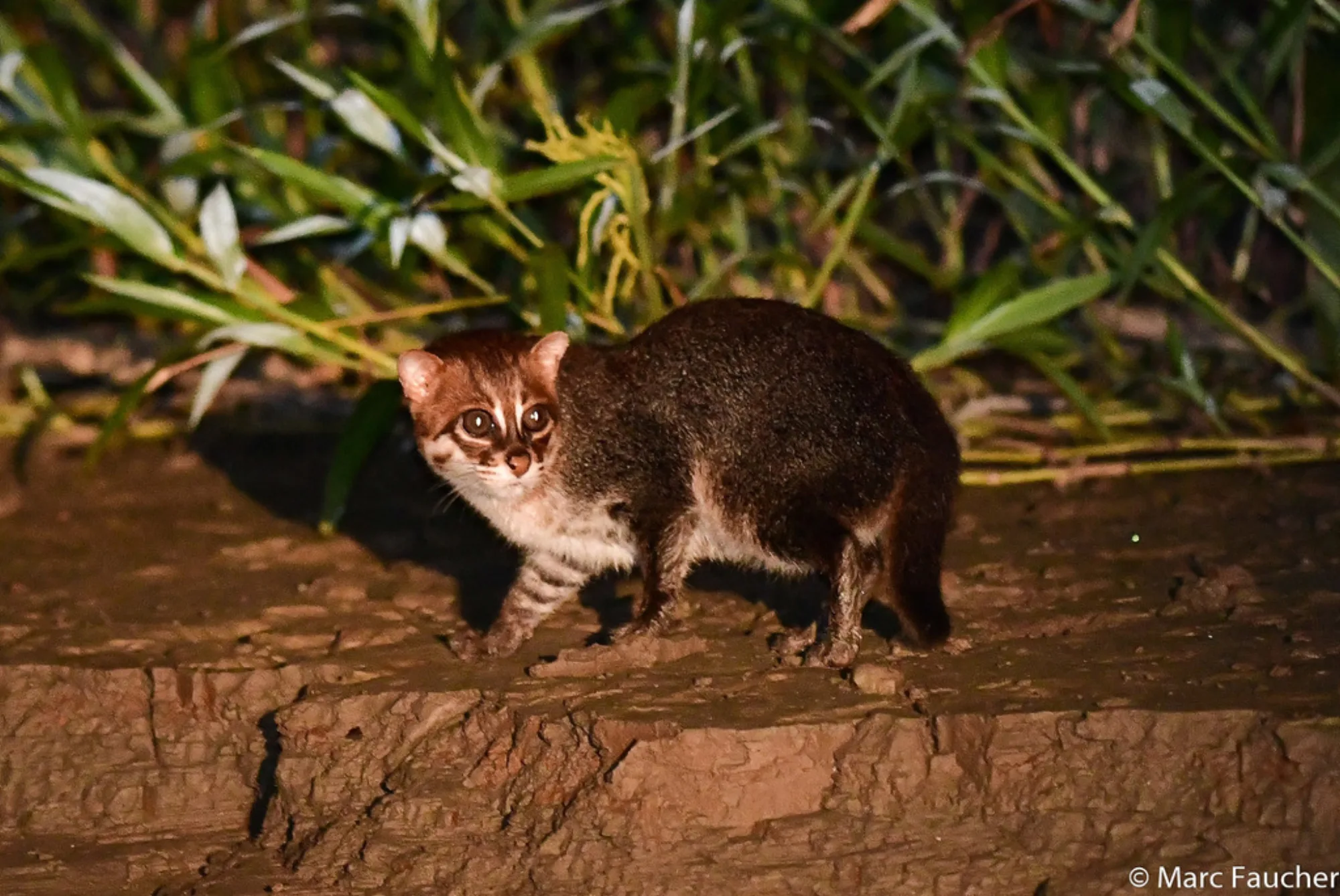
This small wild cat is distinguished by its elongated head and rounded ears. Its slender body, reaching 41 to 50 cm in length, is covered in short reddish-brown fur on top, while the underbelly is a mottled white. For the traveller, its most striking features are the two pale streaks running between the eyes and its unusually large, sharp teeth. Webbing between the toes helps it navigate muddy ground, and its claws do not fully retract, leaving them partially visible.
Native to Sumatra, Borneo, and the Thai-Malay Peninsula, the Flat-headed Cat is a specialist of lowland wetlands. It is typically found near rivers and coastal regions, particularly in peat and freshwater swamp forests. While it was once feared extinct in Thailand, recent camera trap sightings have confirmed its presence in the far south. It is a secretive animal that lives in dense vegetation, often active at night or during the twilight hours of dawn and dusk.
Fish and frogs make up the bulk of its diet, though it also hunts for crustaceans, rats, and chickens. These cats are known to submerge their heads to catch aquatic prey and may carry their catch away from the bank to prevent it from escaping back into the water. The species is currently threatened by the widespread destruction of its habitat as wetlands are cleared for settlements, agriculture, and oil palm plantations. Water pollution, overfishing, and accidental trapping also pose significant risks to its survival.
Written from the English Wikipedia article Flat-headed cat (CC BY-SA 4.0).
- Records
- 0
- Countries
- 1
- Atlas places
- 0
These are open occurrence records, so they show where people looked for and recorded the Flat-headed Cat as much as where it lives. Cells are up to 25 km across, and every location is generalised to its cell.
Generalised encounter areas, not exact locations. Each shape is a grid cell coloured by how likely the species is there.
- Very likelyMalaysia50 km zone · low confidence · 0 records · updated 4 days ago