Blue Shark
Prionace glauca
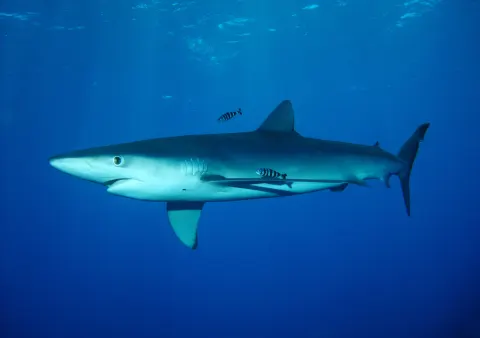
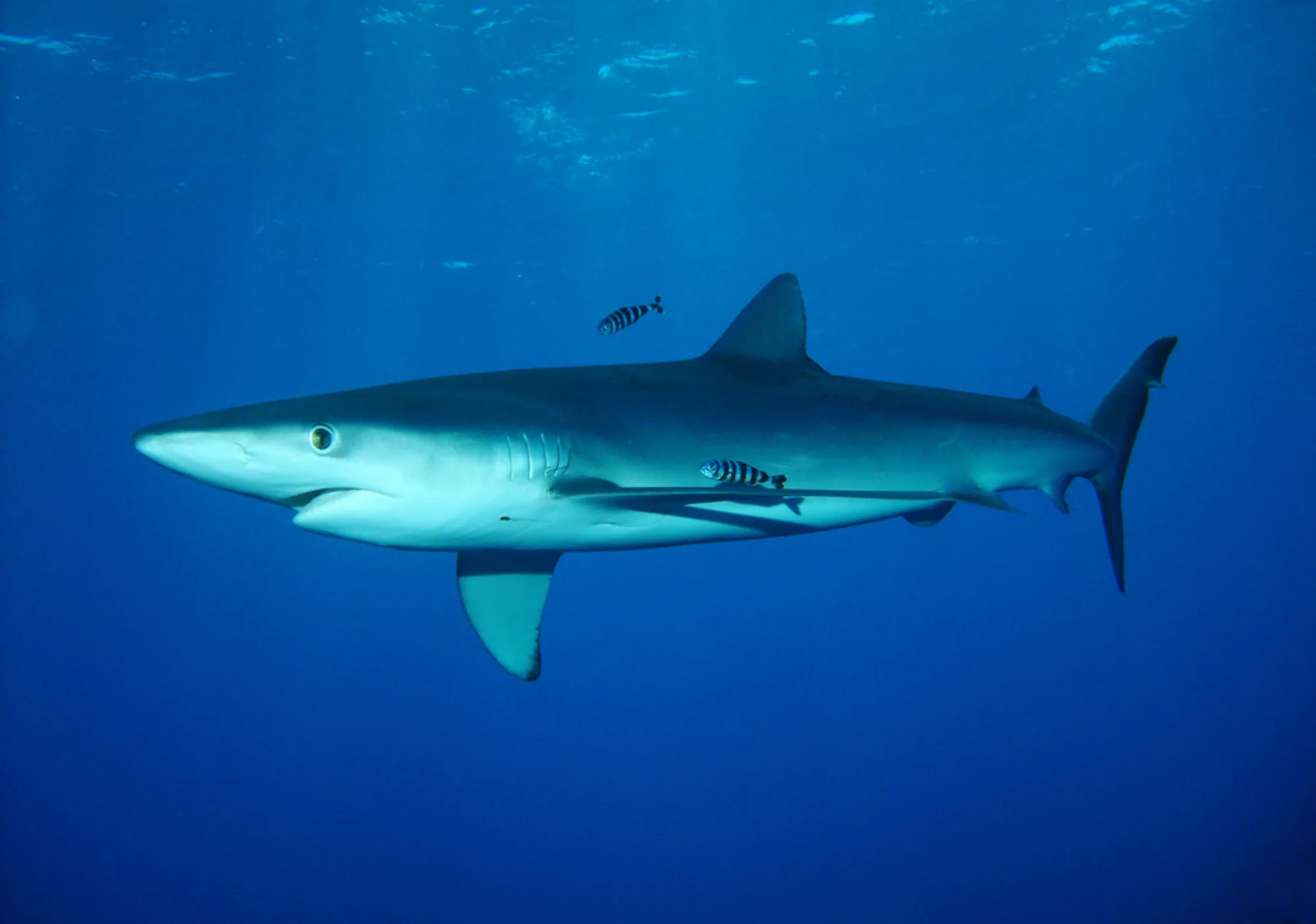
Slender and light-bodied, the Blue Shark has long pectoral fins and a striking pattern of deep blue across its back, paler blue along its sides and white underneath. It averages around 3.1 m in length, though large specimens can reach 3.8 m. A traveller in temperate seas may encounter one near shore, where divers can observe it, while in tropical waters it lives at greater depths. It ranges through deep temperate and tropical oceans worldwide, from the surface to about 350 m, and occurs off every continent except Antarctica.
Blue sharks favour cooler water and make long migrations, including journeys from New England to South America. Generally slow-moving, they can swim very quickly, and are most active at night, especially in the early evening. Squid are their most important prey, but they also eat fish, other ocean animals and carrion. They have been observed working together to herd prey into a concentrated group, making it easier to feed. Females give birth to 4 to 135 pups after a pregnancy of 9 to 12 months, and the young develop independently in nursery areas away from adults. Females may return to particular sites to give birth.
Larger sharks, including great whites and tiger sharks, can prey on young or small blue sharks, while orcas have also been reported hunting them. Fishing is another major pressure: large numbers are caught unintentionally on longlines and in nets. Their meat is eaten or used for fishmeal, their skin is made into leather, and their fins and liver are also used. They are sometimes pursued as game fish for their speed and beauty.
Written from the English Wikipedia article Blue shark (CC BY-SA 4.0).
- Records
- 84,691
- Countries
- 15
- Atlas places
- 3
These are open occurrence records, so they show where people looked for and recorded the Blue Shark as much as where it lives. Cells are up to 25 km across, and every location is generalised to its cell.
Generalised encounter areas, not exact locations. Each shape is a grid cell coloured by how likely the species is there.
- Very likelyUnited States25 km zone · high confidence · 71647 records · updated 80 days ago
- Very likelyCanada25 km zone · medium confidence · 11308 records · updated 80 days ago
- Very likelyNew Zealand25 km zone · medium confidence · 637 records · updated 80 days ago
- Very likelyUnnamed area25 km zone · medium confidence · 540 records · updated 80 days ago
- Very likelyFrance25 km zone · medium confidence · 235 records · updated 80 days ago
- Very likelyGreenland25 km zone · medium confidence · 170 records · updated 80 days ago
- Very likelyGhana25 km zone · medium confidence · 42 records · updated 80 days ago
- Very likelyAustralia25 km zone · medium confidence · 35 records · updated 80 days ago
- Very likelyUnited Kingdom25 km zone · medium confidence · 28 records · updated 80 days ago
- Very likelyPortugal25 km zone · medium confidence · 9 records · updated 80 days ago
Conservation status not assessed here yet, so every location is generalised to its grid cell.