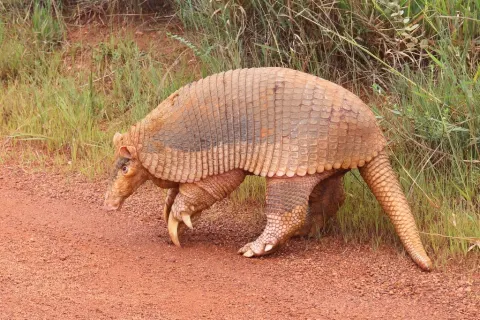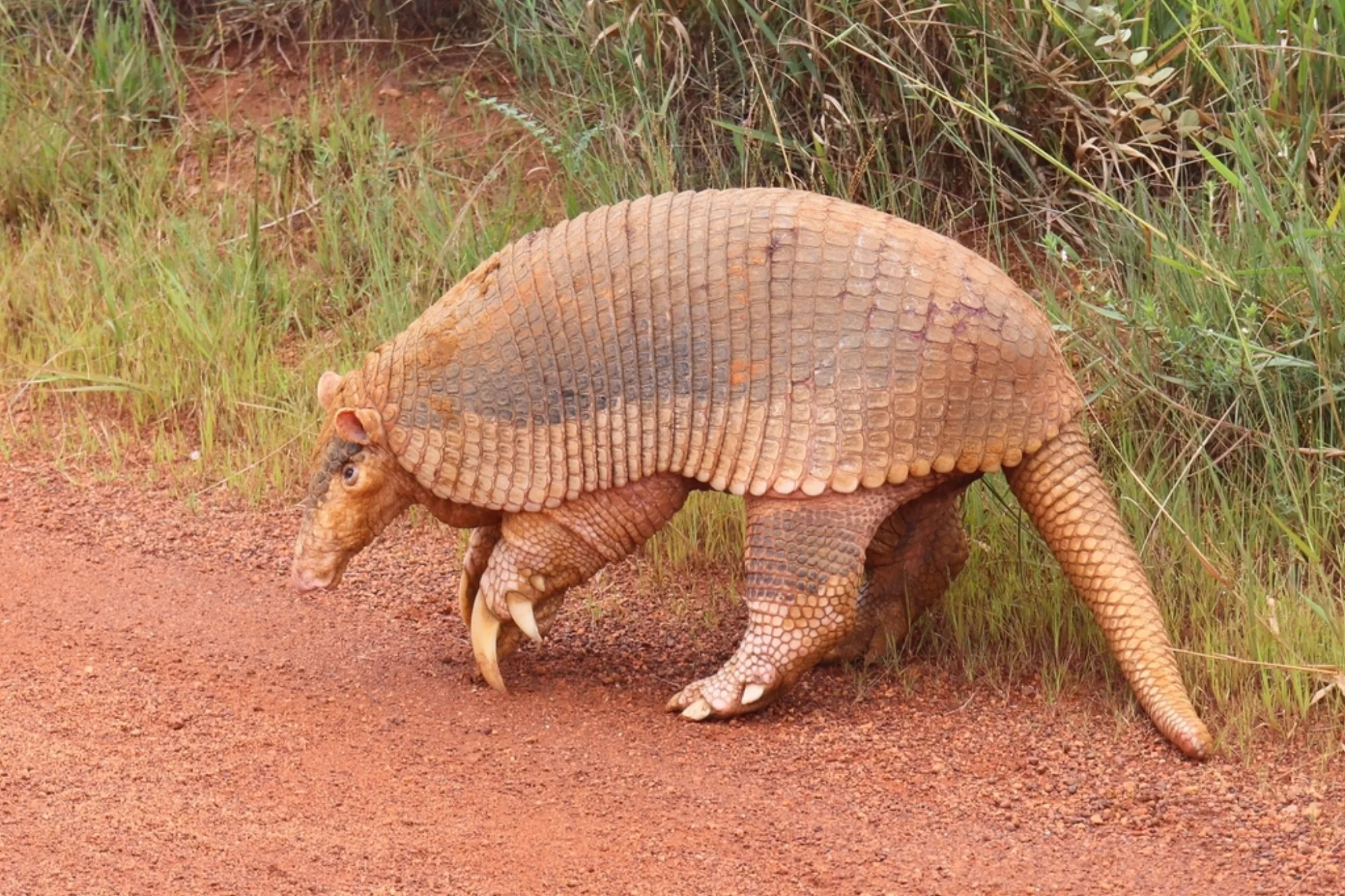
Giant Armadillo
Priodontes maximus
Armoured in dark brown, with a yellowish stripe along each side and a pale head, the Giant Armadillo is the largest living armadillo. Its body has 11 to 13 hinged bands, with another three or four around the neck, and its long front claws include a curved third claw that can reach 22 cm. Adults typically weigh 18.7 to 32.5 kg and measure 75 to 100 cm in body length, with a further 50 cm of tail.
This solitary animal lives on the eastern side of the Andes across much of northern South America, reaching the northernmost provinces of Argentina, though it is absent from eastern Brazil and Paraguay. It favours open country, including cerrado grasslands, and also lives in lowland forests. Nocturnal and locally rare, it spends the day underground in large burrows, which it also uses to escape predators. Other mammals, reptiles and birds have been observed using its burrows too, including the short-eared dog.
The armadillo uses its front claws to dig for food and tear into termite mounds. Termites make up most of its diet, which also includes carrion, small vertebrates and invertebrates such as spiders, worms and ants. Its breeding life remains poorly understood: pregnancy lasts about five months, and evidence suggests females give birth only once every three years. Young are thought to be weaned at about seven to eight months, while mothers may seal burrow entrances to protect younger offspring. Hunting for food, capture for illegal trade and forest loss all threaten the species, despite legal protection in several countries. Captured animals invariably die during transport or in captivity, according to reports.
Written from the English Wikipedia article Giant armadillo (CC BY-SA 4.0).
- Records
- 9
- Countries
- 3
- Atlas places
- 2
These are open occurrence records, so they show where people looked for and recorded the Giant Armadillo as much as where it lives. Cells are up to 25 km across, and every location is generalised to its cell.
Generalised encounter areas, not exact locations. Each shape is a grid cell coloured by how likely the species is there.
- Very likelyEcuador25 km zone · medium confidence · 9 records · updated 81 days ago
- Very likelyColombia25 km zone · low confidence · 0 records · updated 81 days ago
- UncommonBrazil25 km zone · low confidence · 0 records · updated 81 days ago
Conservation status not assessed here yet, so every location is generalised to its grid cell.