Miller's Langur
Presbytis canicrus
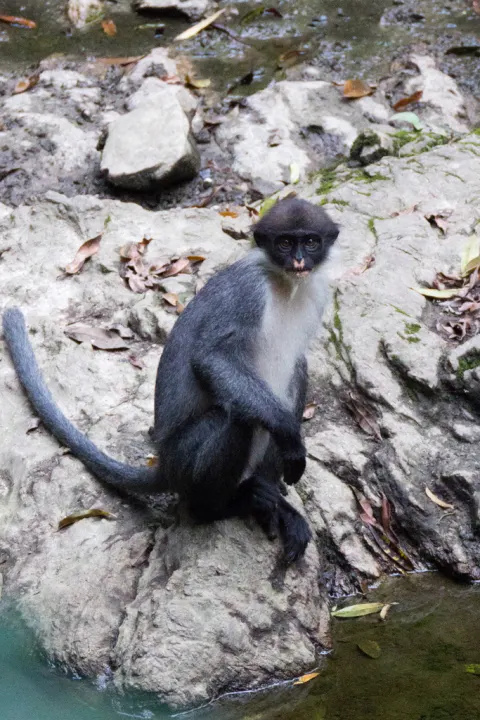
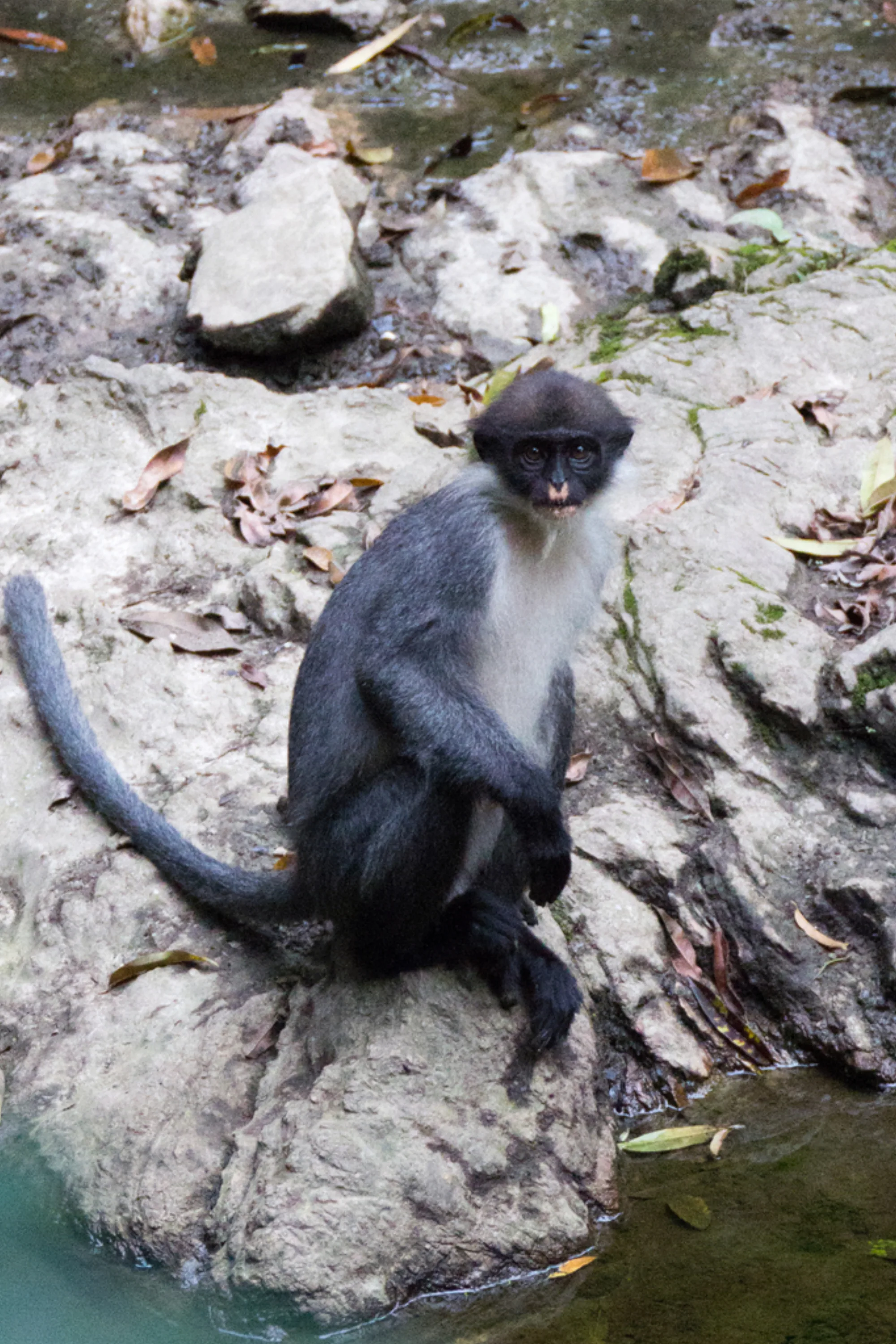
Found only in the province of East Kalimantan on the island of Borneo, Miller's Langur is a rare leaf monkey with a distinctive grizzled appearance. Adult monkeys have grey fur on their backs and a white underside, topped with a brown crown on their heads. Their faces are marked by a black upper section and a white U-shaped patch beneath the nose. These primates are medium-sized, with bodies measuring up to 56 centimetres and tails that can reach 84 centimetres. Newborns look quite different, appearing white with a black cross pattern on their backs.
Travellers must look into the mid to upper canopy of dipterocarp rainforests to spot these arboreal creatures. They are active during the day and often live in groups of eight, though family sizes range from 5 to 12 individuals. While a single adult male typically leads a group, other males live solitary lives. Their diet consists mostly of young leaves and shoots, supplemented by unripe fruit, seeds, and flowers. They are also known to visit salt licks, sometimes alongside maroon leaf monkeys.
Once feared extinct until a rediscovery in 2012, this species faces severe pressure from the loss and fragmentation of its forest home. Hunting is another major threat, as the monkeys are killed for food and for bezoar stones found in their digestive tracts. These stones are used as charms or for their supposed medicinal qualities. Although the langur is protected by Indonesian law, the use of an outdated scientific name in legal documents may limit the effectiveness of these protections.
Written from the English Wikipedia article Miller's langur (CC BY-SA 4.0).
- Atlas places
- 0
These are open occurrence records, so they show where people looked for and recorded the Miller's Langur as much as where it lives. Cells are up to 25 km across, and every location is generalised to its cell.
No encounter zones yet
Where and when you can expect to see Miller's Langur is calculated from observation density. No zones have been computed for this species yet.