Gilbert's Potoroo
Potorous gilbertii
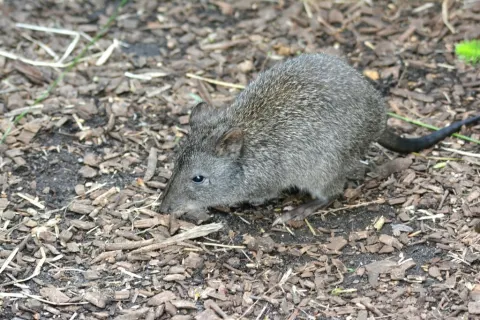
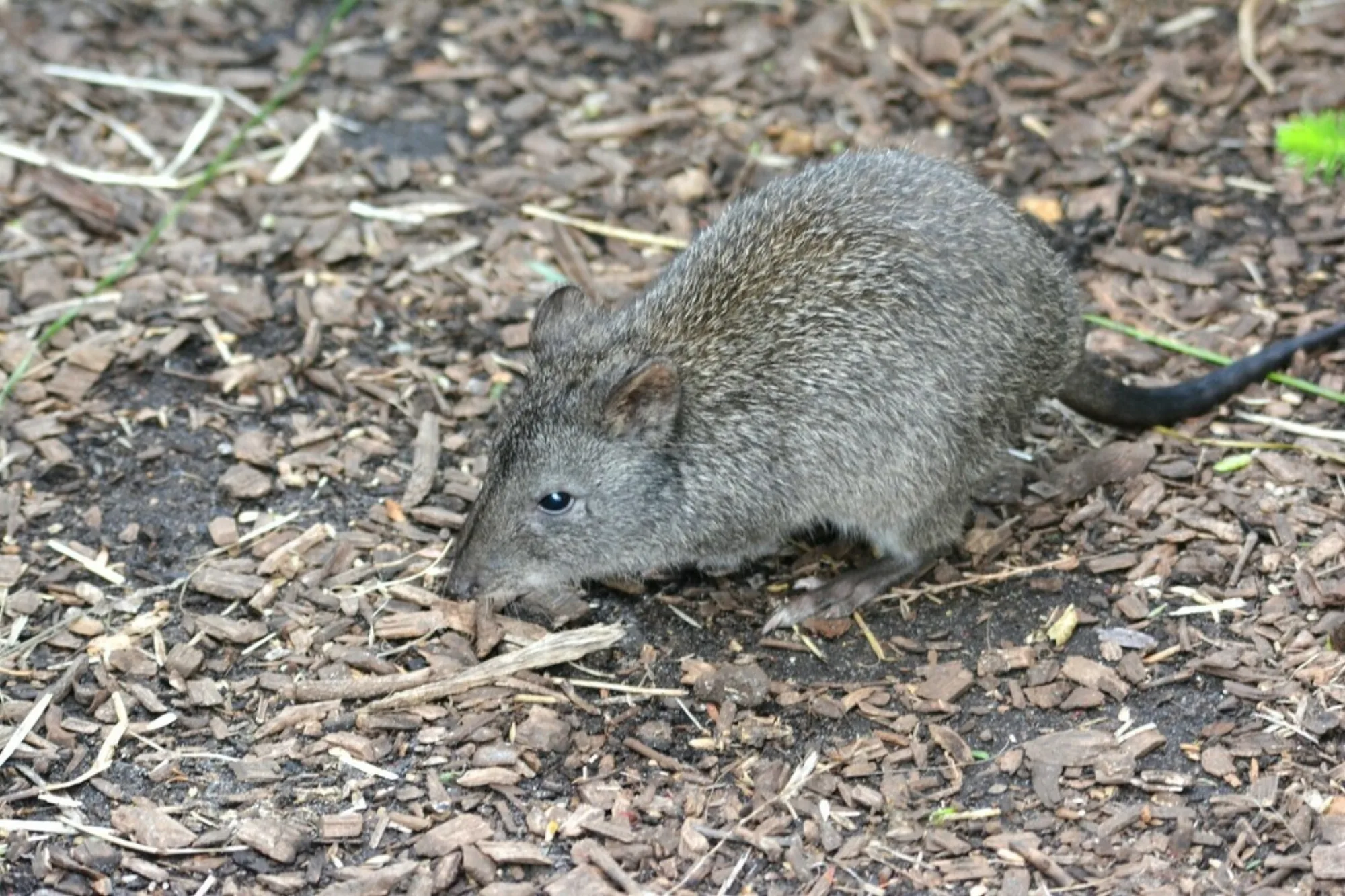
Gilbert's Potoroo is a rare marsupial found in south-western Western Australia. This small, nocturnal creature has a long, downward-curving snout and ears that are almost hidden by its thick fur. Its coat is rufous brown on top and light grey underneath, providing insulation. Adults weigh between 708 and 1,205 g, with a head and body length of about 250 mm. They use sharp claws on their front feet to dig for their primary food source, which consists of multiple species of underground, truffle-like fungi. After eating, they help the environment by spreading fungal spores through their droppings.
Historically widespread, the species is now restricted to a few specific locations on the southern coast. The only naturally occurring group lives in the Two Peoples Bay Nature Reserve, specifically on the slopes of Mount Gardner. Here, they inhabit valleys filled with dense bushes that reach heights between 1.5 and 2.0 m. These areas have not seen fire for over 50 years, as the animals require long-unburnt vegetation. To protect the species, small populations have been moved to Waychinicup National Park and the predator-free environments of Bald Island and Middle Island.
Life for these marsupials revolves around the safety of thick undergrowth, where they stay hidden during the day. Females can raise two young per year, though they only carry one at a time. The population remains extremely small, with only about 100 individuals estimated to exist in 2018. They face several dangers, including large bushfires that destroy their limited habitat. Additionally, they are threatened by diseases like cryptococcosis and predation by native carpet pythons in certain areas.
Written from the English Wikipedia article Gilbert's potoroo (CC BY-SA 4.0).
- Atlas places
- 0
These are open occurrence records, so they show where people looked for and recorded the Gilbert's Potoroo as much as where it lives. Cells are up to 25 km across, and every location is generalised to its cell.
No encounter zones yet
Where and when you can expect to see Gilbert's Potoroo is calculated from observation density. No zones have been computed for this species yet.