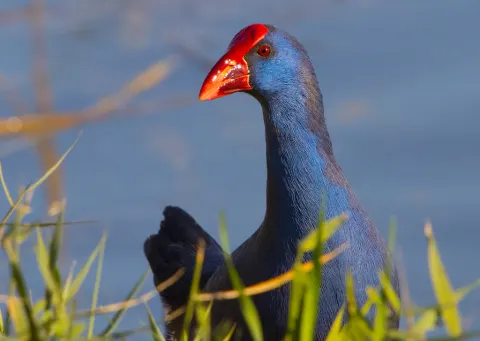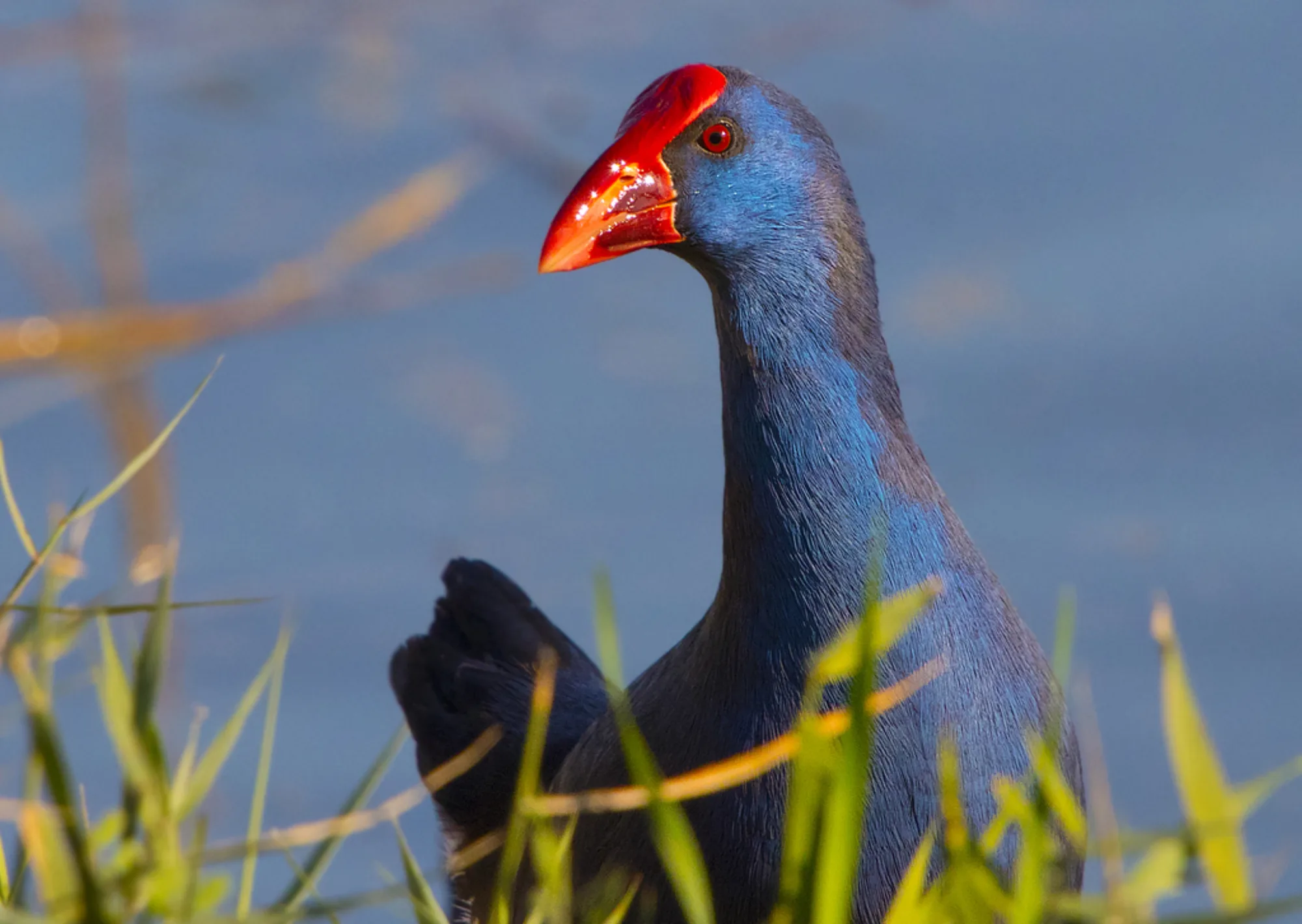
Purple Swamphen
Porphyrio porphyrio
A chicken-sized rail with large feet, bright plumage and a red bill, the Purple Swamphen is easy to recognise across its native range. Its loud, quick calls sound like bleats and hoots, and become especially frequent during the breeding season. It lives in wetlands across Spain, Portugal, south-eastern France, Sardinia and Sicily, as well as Morocco, Algeria and Tunisia. Spain holds the largest population. Look for it around swamps, lake edges and damp pastures, particularly in wet areas with high rainfall. Where it is not persecuted, it can become tame enough to be readily seen in towns and cities.
Often found in pairs or larger communities, swamphens clamber through reeds in search of tender shoots and other plant matter. They also eat eggs, ducklings, small fish and invertebrates, including snails. The bird often holds its food in one foot as it eats. Although clumsy in flight, it can travel long distances through the air and is a good swimmer. Breeding is generally seasonal, often coinciding with peak rainfall or, in more temperate places, summer. Pairs build a substantial nest of woven reeds on floating debris or among matted reeds, just above the water. Both parents incubate the speckled eggs, and the downy black chicks can leave the nest soon after hatching. Parents and other group members feed the young at first, before the chicks begin feeding themselves.
Habitat loss and hunting caused a drastic decline during the early 20th century. Protection and reintroductions have helped the bird recover, though it remains rare and local in Portugal. In some places, swamphens live in rice fields, where damage to the crop can bring them into conflict with farmers.
Written from the English Wikipedia article Western swamphen (CC BY-SA 4.0).
- Records
- 124,708
- Countries
- 6
- Atlas places
- 2
These are open occurrence records, so they show where people looked for and recorded the Purple Swamphen as much as where it lives. Cells are up to 25 km across, and every location is generalised to its cell.
Generalised encounter areas, not exact locations. Each shape is a grid cell coloured by how likely the species is there.
- Very likelySpain25 km zone · high confidence · 62913 records · updated 80 days ago
- Very likelyAustralia25 km zone · high confidence · 38309 records · updated 80 days ago
- Very likelyPortugal25 km zone · high confidence · 12536 records · updated 80 days ago
- Very likelyFrance25 km zone · high confidence · 10016 records · updated 80 days ago
- Very likelyMorocco25 km zone · high confidence · 708 records · updated 80 days ago
- LikelyItaly25 km zone · high confidence · 226 records · updated 80 days ago
Conservation status not assessed here yet, so every location is generalised to its grid cell.