Norman's Lampeye
Poropanchax normani
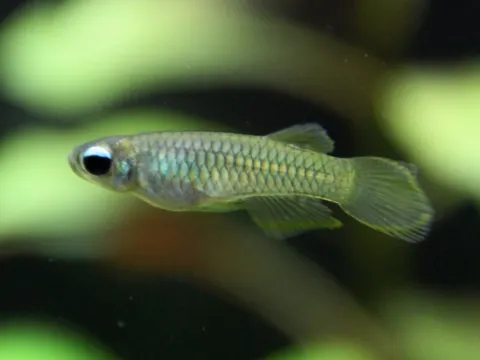
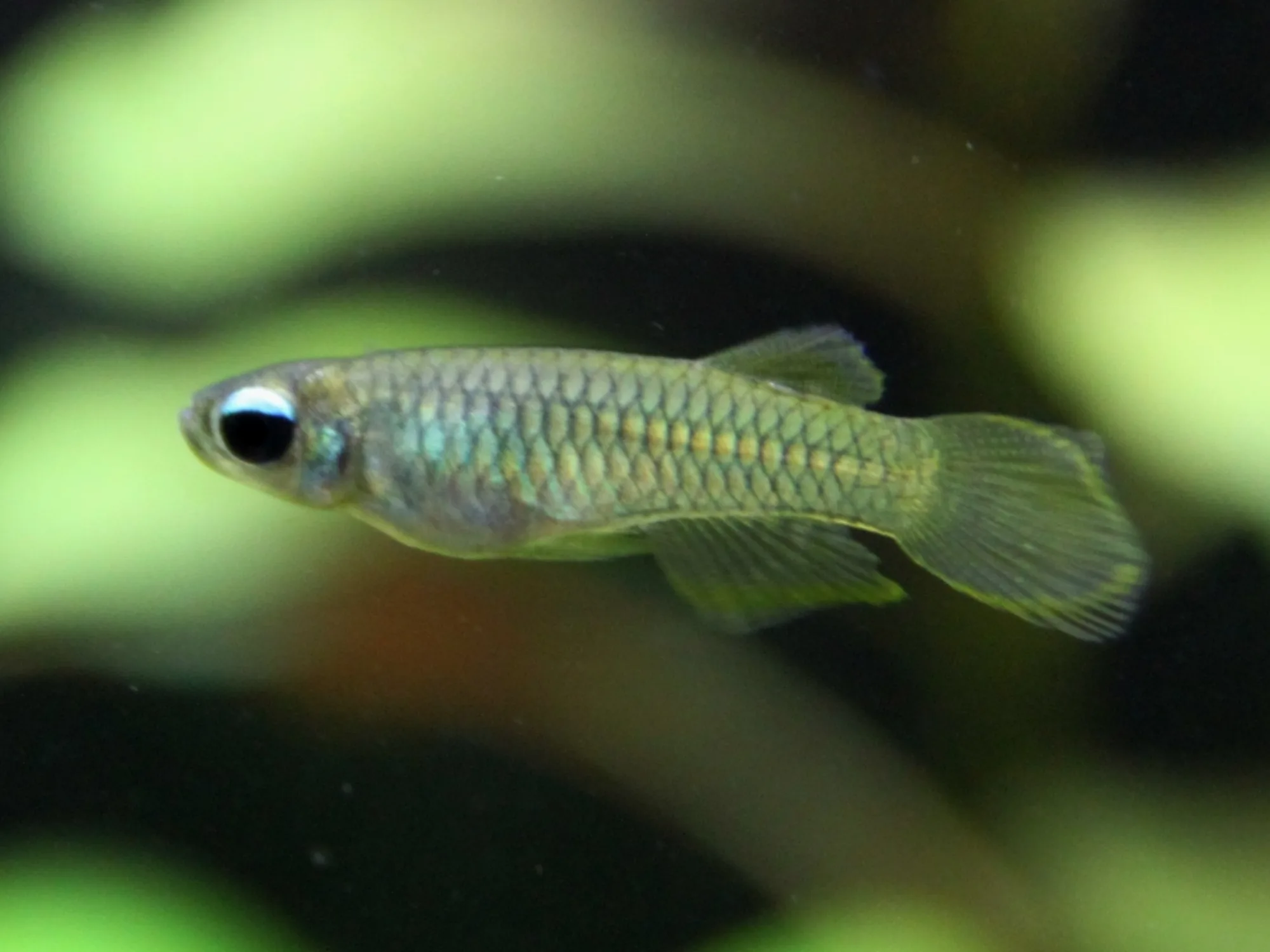
This small African fish reaches a maximum length of 4 centimetres and is easily recognized by its distinctive eyes, which are about 1.5 to 2 times the length of its head. The Norman's Lampeye has a pale body with a bluish tint and yellow outlines on its scales and rounded fins. While it looks similar to some relatives, this species is distinguished by its specific yellow and blue bicolor pattern. It is a surface-oriented fish with a mouth positioned near the top of its head, an adaptation for its life in vegetated waters.
These fish are the most widespread of the African lampeyes, ranging across Central and Western Africa from Senegal to Sudan. They inhabit a wide variety of freshwater environments, including lakes, swamps, and large rivers, and have even been found in the Central Saharan Lakes. They prefer slow-moving or brackish waters where they can be observed at the surface. These are shoaling fish with a lifespan of 3 to 4 years. They reproduce by laying small eggs that sink to the bottom and use sticky filaments to attach to structures.
As omnivores, they feed on organic plant matter, small crustaceans, and aquatic invertebrates like mosquito larvae. They are active feeders during the day, with adults consuming significantly more than juveniles. Although they are highly adaptable, these fish face potential threats from the aquarium trade if improper practices impact local ecosystems. Additionally, because they often live in shallow water, they are vulnerable to the effects of drought and extreme weather conditions driven by climate change.
Written from the English Wikipedia article Poropanchax normani (CC BY-SA 4.0).
- Records
- 3
- Countries
- 1
- Atlas places
- 0
These are open occurrence records, so they show where people looked for and recorded the Norman's Lampeye as much as where it lives. Cells are up to 25 km across, and every location is generalised to its cell.
Generalised encounter areas, not exact locations. Each shape is a grid cell coloured by how likely the species is there.
- Very likelyBenin25 km zone · medium confidence · 3 records · updated 1 day ago
Conservation status not assessed here yet, so every location is generalised to its grid cell.