Bornean Orangutan
Pongo pygmaeus
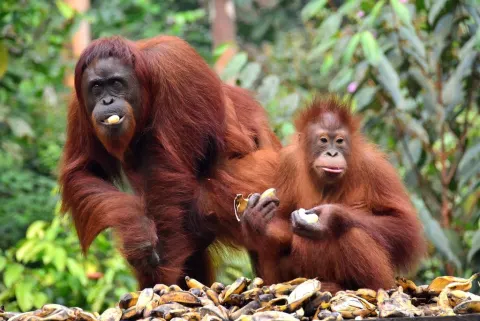
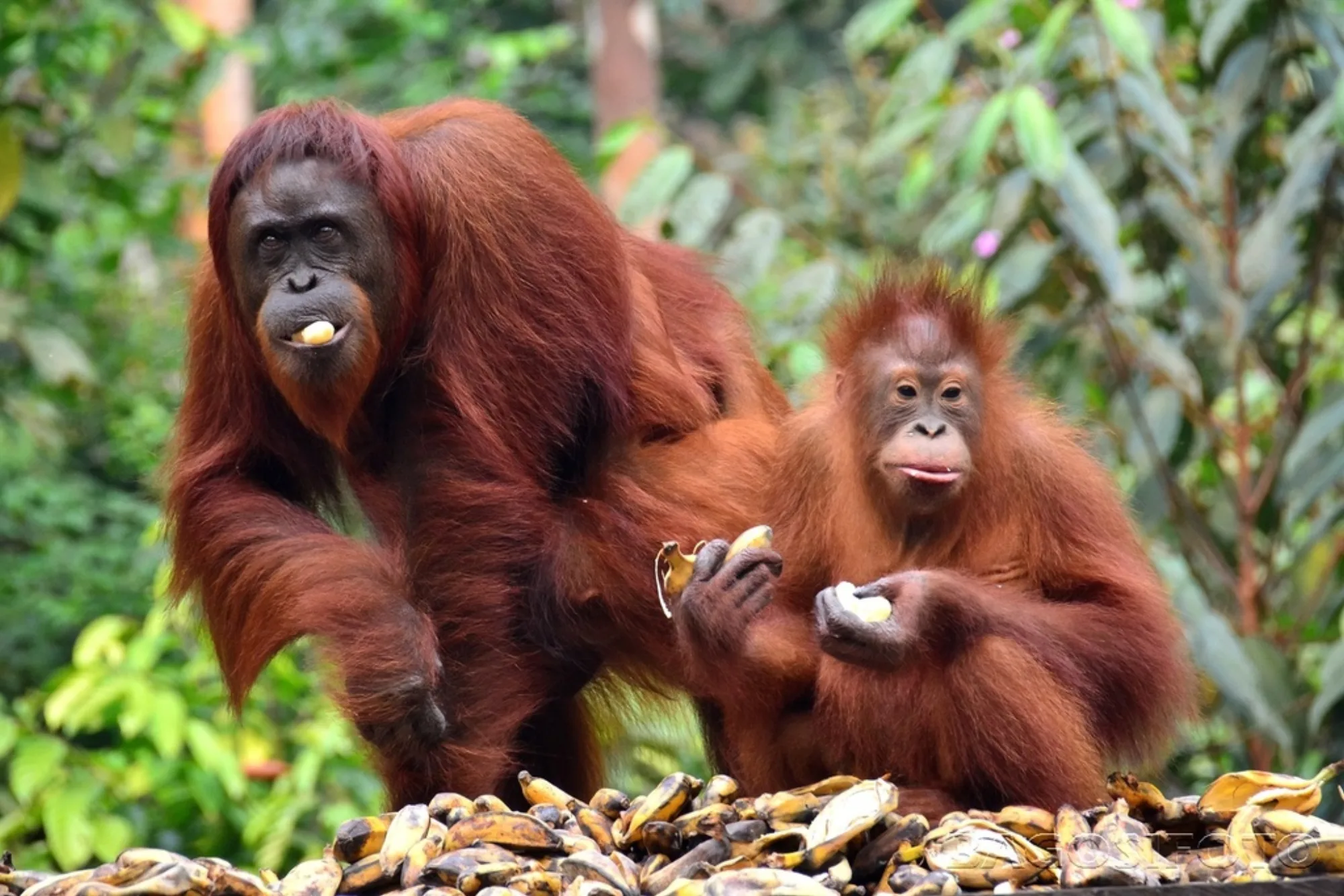
A shaggy reddish coat and exceptionally long arms make the Bornean Orangutan (Pongo pygmaeus) distinctive among the apes of Borneo, the only island where it occurs. Its arms can reach 1.5 m, and its hands and feet can grasp branches. Males are larger than females and develop prominent cheek pads; they also have a more pronounced beard and moustache. This tree-dwelling ape lives in lowland and mountain rainforests, reaching elevations of 1,500 m. Its range is patchy across the island, including parts of Malaysian Borneo and Indonesian Kalimantan, with few animals remaining in the southeast.
Bornean orangutans move through the treetops in both mature and regrowing forests, travelling considerable distances in search of fruiting trees. They are largely solitary, though individuals with overlapping ranges sometimes meet briefly. They build nests for rest by day or night, weaving leaves and branches into a foundation and adding leafy material. Young orangutans learn this skill by watching their mothers. Their varied diet includes wild figs, seeds, flowers, leaves, honey, insects and bird eggs, while fruit and water collected in tree holes provide water. Mothers generally give birth at about 14 to 15 years of age, and their young usually remain dependent until around seven years old.
Forest destruction, hunting and the expansion of palm oil plantations threaten their survival. Fires used to clear land for plantations destroy habitat and have also killed orangutans. Young animals are captured for the pet trade, usually after their mothers have been killed. Changes in rainfall have also reduced food availability, making it harder for orangutans to get the nutrients needed for breeding.
Written from the English Wikipedia article Bornean orangutan (CC BY-SA 4.0).
- Records
- 3
- Countries
- 2
- Atlas places
- 2
These are open occurrence records, so they show where people looked for and recorded the Bornean Orangutan as much as where it lives. Cells are up to 25 km across, and every location is generalised to its cell.
Generalised encounter areas, not exact locations. Each shape is a grid cell coloured by how likely the species is there.
- Very likelyMalaysia25 km zone · medium confidence · 2 records · updated 80 days ago
- Very likelyIndonesia25 km zone · medium confidence · 1 record · updated 80 days ago
Conservation status not assessed here yet, so every location is generalised to its grid cell.