Sumatran Orangutan
Pongo abelii
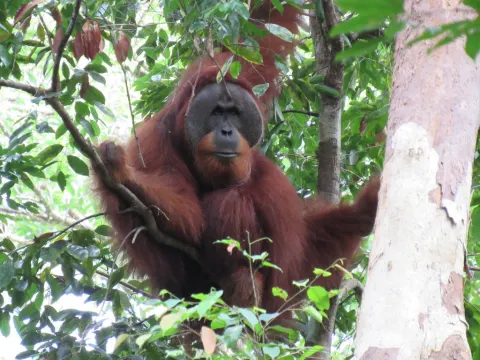
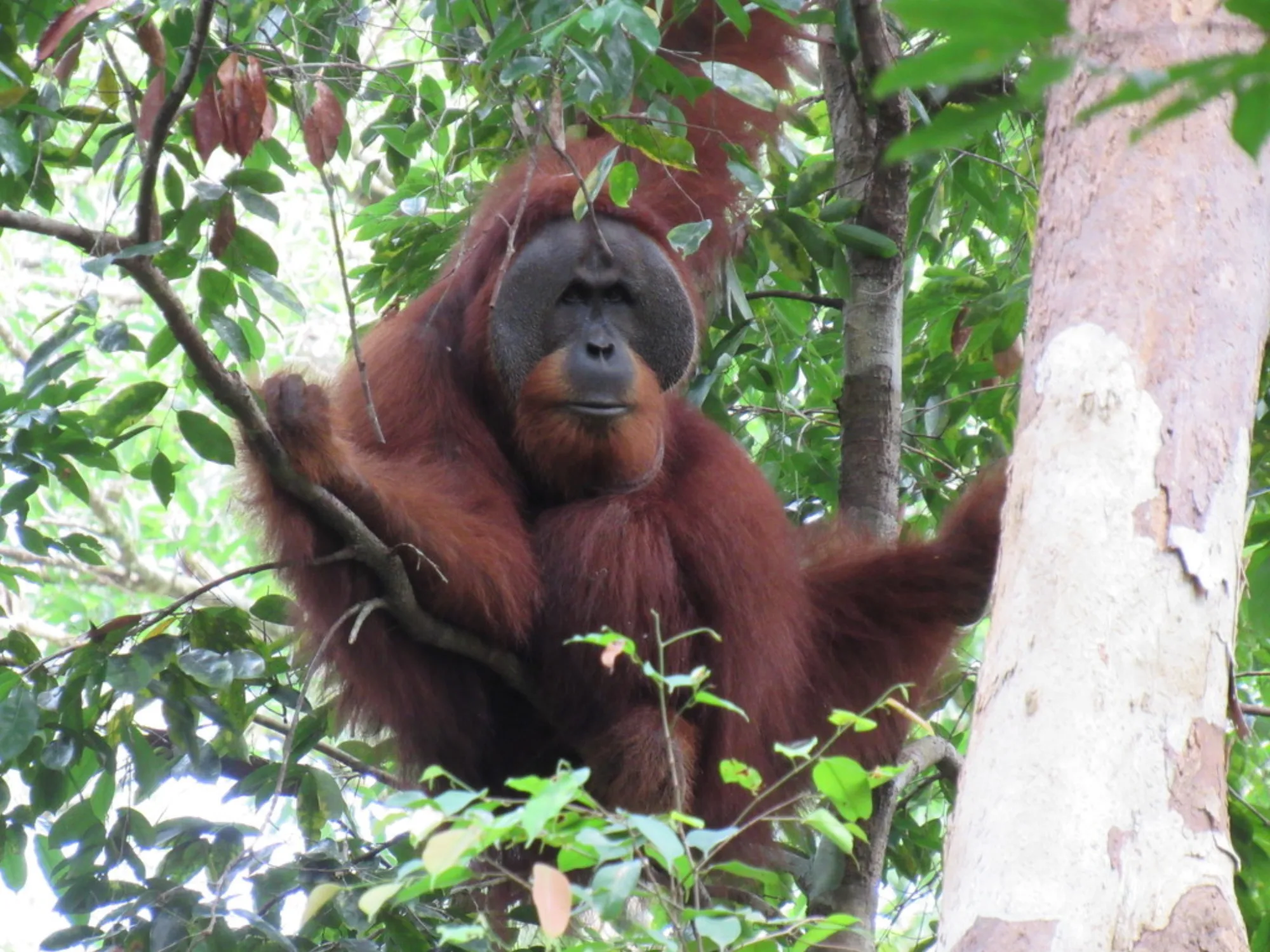
Long, pale red hair and a slender build help distinguish the Sumatran Orangutan (Pongo abelii) from its Bornean relative; it also has a longer face. Males grow to about 1.7 m tall and 90 kg, while females average 90 cm and 45 kg. Found only in northern Sumatra, it lives in forests including those around Lake Toba and in Gunung Leuser National Park. It also inhabits swamps, including Suaq Balimbing, where wild orangutans have been observed using tools. As fruit availability changes with the seasons, orangutans move among forests at low, middle and high elevations.
Moving slowly through the trees, they use several supports to steady themselves on flexible branches. Their communities are loosely organised, and groups gather to feed when fig trees carry abundant fruit. Fruit is central to their diet, with figs and jackfruit among their preferred foods, while ants, termites and crickets also feature. They eat leaves, bark and flowers too, and occasionally take bird eggs or small vertebrates. At Suaq Balimbing, orangutans have been seen using sticks to extract termites and honey, and to make Neesia fruit safe to eat. Useful tools may be kept, sometimes accumulating into collections. Infants travel with their mothers, depend heavily on them for food and sleep in their nests; young orangutans continue to associate with their mothers as they grow. The average interval between births is 9.3 years.
Logging, conversion of forest to farmland and oil palm plantations, and roads all threaten their habitat. Forest clearance and fragmentation also disrupt their seasonal movements in search of fruit. Occasional hunting reduces their numbers, and farmers may kill orangutans that damage or take crops.
Written from the English Wikipedia article Sumatran orangutan (CC BY-SA 4.0).
- Records
- 47
- Countries
- 1
- Atlas places
- 1
These are open occurrence records, so they show where people looked for and recorded the Sumatran Orangutan as much as where it lives. Cells are up to 25 km across, and every location is generalised to its cell.
Generalised encounter areas, not exact locations. Each shape is a grid cell coloured by how likely the species is there.
- Very likelyIndonesia25 km zone · medium confidence · 47 records · updated 80 days ago
Conservation status not assessed here yet, so every location is generalised to its grid cell.