Black Crappie
Pomoxis nigromaculatus
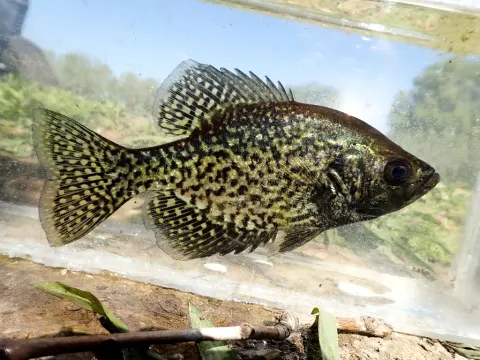
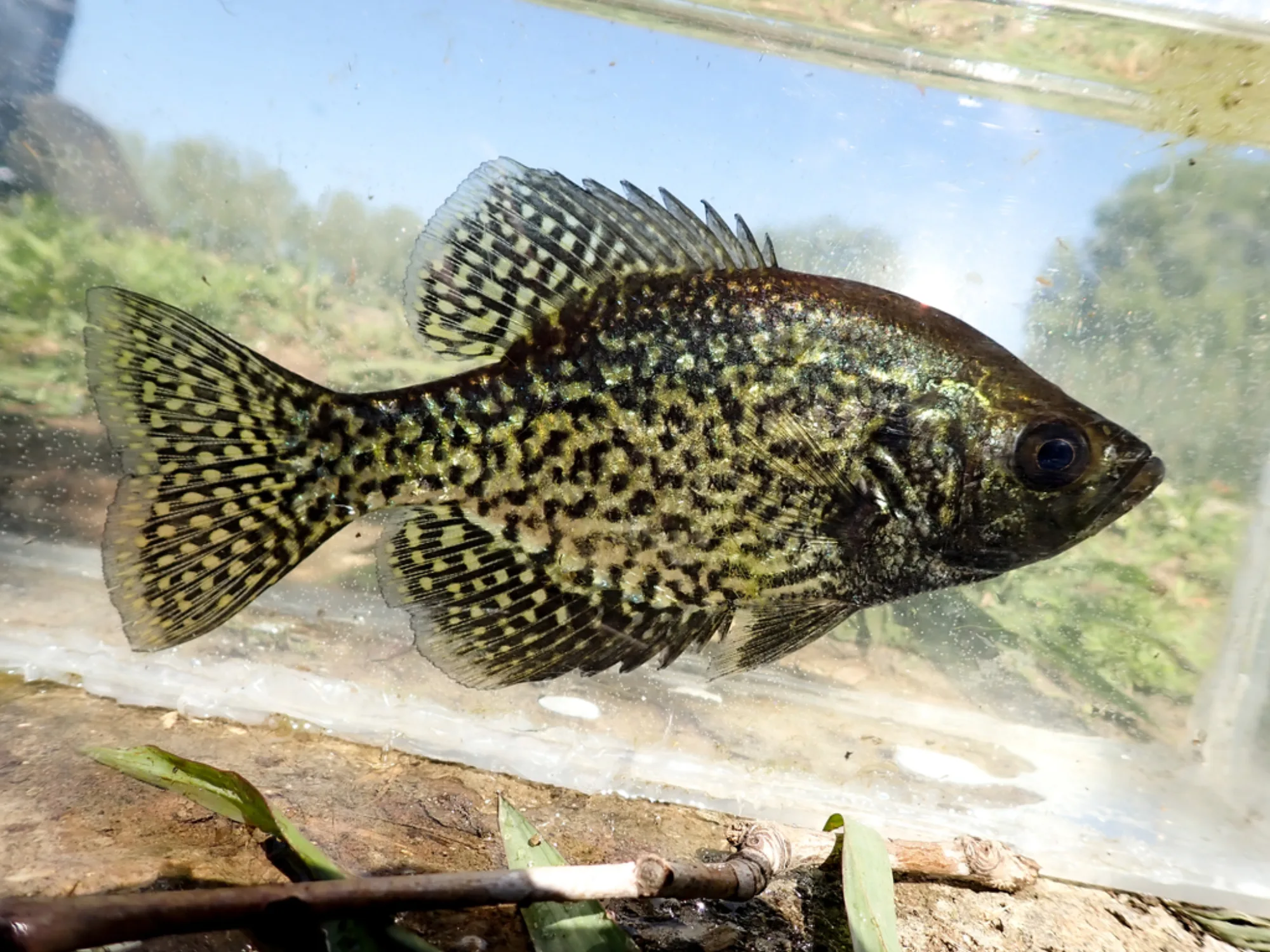
A silvery-grey to green fish with a deep, flattened body, the Black Crappie carries irregular black blotches across its sides and rows of dark spots on its fins. It resembles the white crappie in size, shape and habits, but has darker markings. Crappies are typically 10 to 20 cm long, with large mouths that reach below the eye.
Native to North America, the fish is thought to have originated in the eastern United States and Canada, although widespread transplants make its original range uncertain. By 2005, populations were present throughout the 48 contiguous US states, and introduced populations also occur in Mexico and Panama. Look for it in clear, still or slow water in lakes and reservoirs, as well as borrow pits and sheltered pools along large rivers. It favours submerged timber or aquatic vegetation for cover, and places with sandy or muddy bottoms.
Crappies search for food in the early morning and again between around midnight and 2 am. Smaller fish eat plankton and tiny crustaceans, while larger ones take small fish as well as minnows. Adults also eat insects, insect larvae and crustaceans, with their diet changing according to habitat, food supply and competition. Spawning takes place in spring and early summer, when males build nests in shallow, sheltered water, often near shore and vegetation. The male guards the nest until the eggs hatch, usually after two to three days, and the young remain there for several more days before moving into sheltered shallows. Black crappies can become so numerous that their populations have negative consequences for themselves and other fish; permanent damage to their fishery or environment is also a concern.
Written from the English Wikipedia article Black crappie (CC BY-SA 4.0).
- Records
- 39,105
- Countries
- 1
No atlas park has a record of the Black Crappie in or around it yet.
These are open occurrence records, so they show where people looked for and recorded the Black Crappie as much as where it lives. Cells are up to 25 km across, and every location is generalised to its cell.
Generalised encounter areas, not exact locations. Each shape is a grid cell coloured by how likely the species is there.
- Very likelyUnited States25 km zone · high confidence · 39105 records · updated 80 days ago
Conservation status not assessed here yet, so every location is generalised to its grid cell.