Bluefish
Pomatomus saltatrix
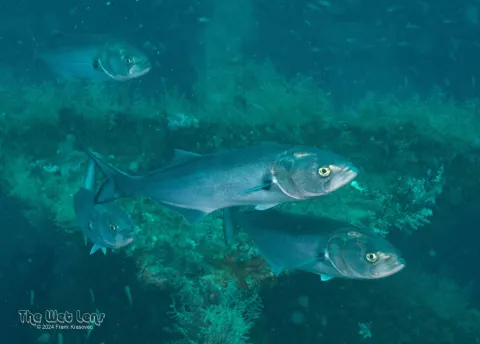
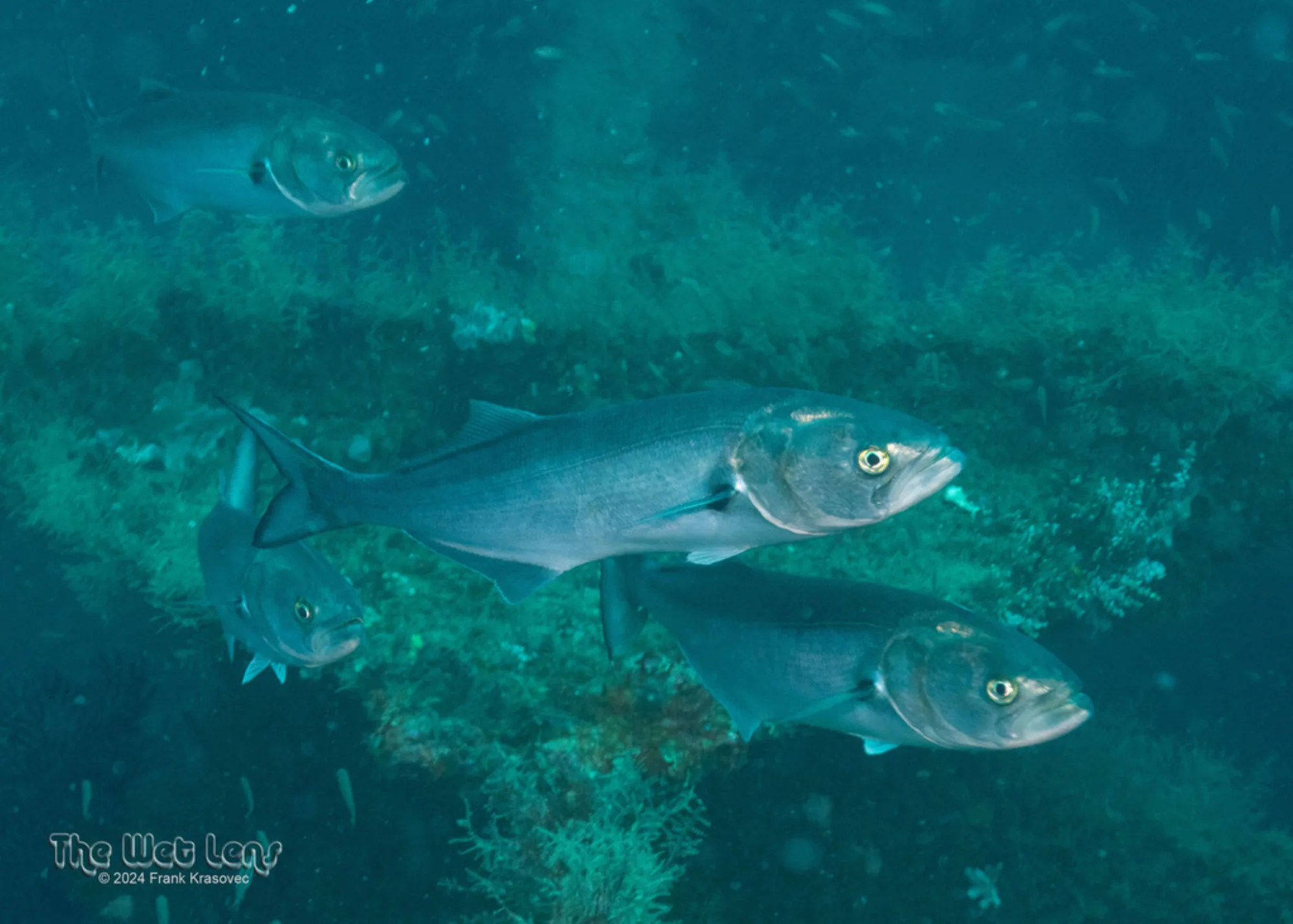
With its broad, forked tail and blue-green back fading to a white belly, the Bluefish is a marine fish built for life in open water. Its sharp, knife-edged teeth are all much the same size. Adults are typically 30 to 60 cm long, although the maximum reported length is 130 cm. In Australia and New Zealand it is called tailor, while in South Africa it is also known as elf or shad.
Bluefish occur in tropical, subtropical and temperate seas around much of the world. They use coastal waters above continental shelves, areas near surf beaches and rocky headlands, and also enter estuaries and brackish water. At times they leave the coast and travel in schools across open water. Along the eastern United States, they move north from Florida in spring and head south again in autumn. In Australia, young fish occupy large bays and estuaries, while adults favour rocky headlands and beaches.
Adults swim fast and hunt in loose groups, pursuing schools of smaller fish. Their prey varies with place and season and includes sardine-like fish, anchovies, shrimp and squid. They sometimes chase bait into shallow surf, where their attacks churn the water in a feeding frenzy known as a bluefish blitz. Bluefish breed in spring and summer; the fry eat zooplankton and are largely carried by currents. Larger predators take bluefish throughout their lives, with sharks, tuna and dolphins among those that eat both juveniles and adults. People catch bluefish for sport and food, and widespread overfishing has put pressure on the species. Fisheries management has generally stabilised its population, while catch limits and public awareness efforts may be reducing pressure on some regional stocks.
Written from the English Wikipedia article Bluefish (CC BY-SA 4.0).
- Records
- 2,994
- Countries
- 14
- Atlas places
- 2
These are open occurrence records, so they show where people looked for and recorded the Bluefish as much as where it lives. Cells are up to 25 km across, and every location is generalised to its cell.
Generalised encounter areas, not exact locations. Each shape is a grid cell coloured by how likely the species is there.
- Very likelyUnited States25 km zone · medium confidence · 2493 records · updated 80 days ago
- Very likelyAustralia25 km zone · medium confidence · 246 records · updated 80 days ago
- Very likelyMozambique25 km zone · high confidence · 94 records · updated 80 days ago
- Very likelySouth Africa25 km zone · medium confidence · 48 records · updated 80 days ago
- Very likelyMauritania25 km zone · medium confidence · 21 records · updated 80 days ago
- LikelyBrazil25 km zone · medium confidence · 31 records · updated 80 days ago
- LikelyMexico25 km zone · medium confidence · 20 records · updated 80 days ago
- LikelyColombia25 km zone · medium confidence · 15 records · updated 80 days ago
- PossibleArgentina25 km zone · medium confidence · 5 records · updated 80 days ago
- PossiblePortugal25 km zone · medium confidence · 5 records · updated 80 days ago
Conservation status not assessed here yet, so every location is generalised to its grid cell.