Saithe
Pollachius virens
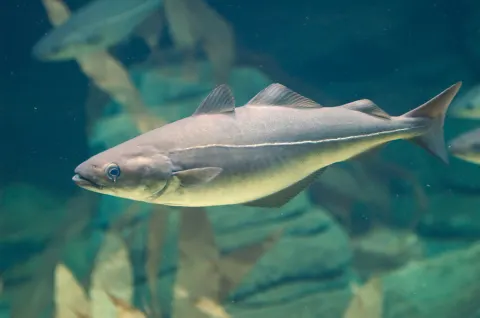
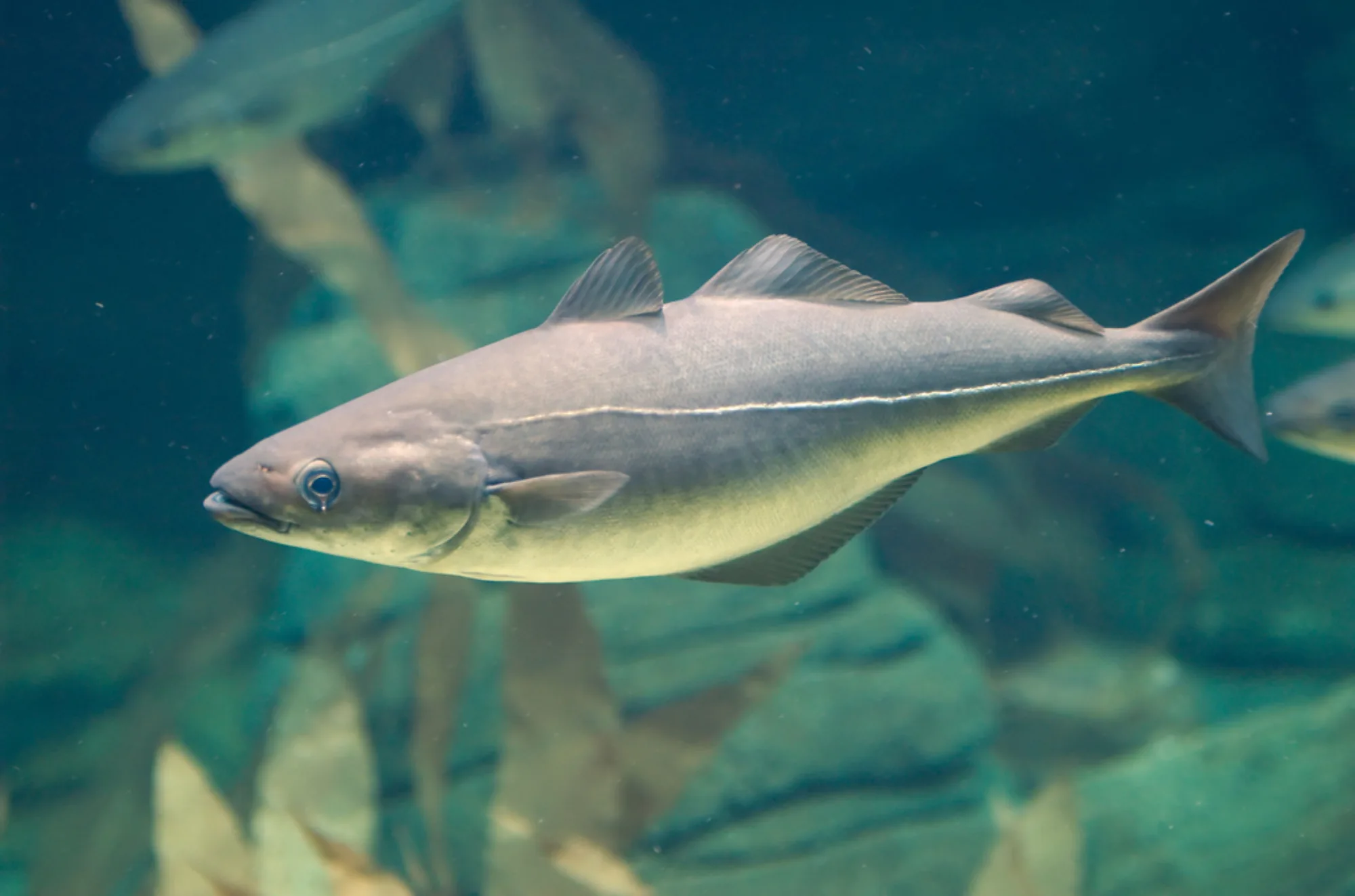
Bright silver sides and a very dark green back help distinguish the Saithe, a marine fish also known in Britain as coalfish or coley. Its upper and lower jaws are roughly equal in length, giving its head a different profile from that of Pollachius pollachius, which has a longer lower jaw. A straighter line along the side is another distinguishing feature. Adults typically grow to 100 to 120 centimetres and can live for 16 to 20 years, although fish as long as 130 cm and weighing up to 32 kg have been caught. In Scotland and northern England, young fish may be called cuddies or podleys.
Saithe are common in northern parts of the Atlantic, with a range that includes the Bay of Biscay. Young fish tend to stay near shore, especially around rocks, before moving into deeper water as they grow. They often gather around fish farms, where they eat salmon feed that passes through the cage nets. Saithe reach maturity at 4 to 9 years and spawn in batches; depending on her size, a female produces between 500 thousand and 9 million eggs. Fishing takes place throughout the year, using gear including trawlers, long lines and gill nets, and Saithe are often caught alongside other fish such as cod and whiting. Major eastern Atlantic fishing grounds include the Barents Sea, waters around Iceland and the Faeroe Islands, and the North Sea and Celtic Sea. Eastern Atlantic landings fluctuated around 300,000 to 700,000 tonnes during 1980 to 2017, while the western Atlantic commercial catch fluctuated around 5,000 to 45,000 tonnes a year between 1980 and 2018. The assessed eastern and western Atlantic stocks are harvested sustainably.
Written from the English Wikipedia article Pollachius virens (CC BY-SA 4.0).
- Records
- 95,059
- Countries
- 6
No atlas park has a record of the Saithe in or around it yet.
These are open occurrence records, so they show where people looked for and recorded the Saithe as much as where it lives. Cells are up to 25 km across, and every location is generalised to its cell.
Generalised encounter areas, not exact locations. Each shape is a grid cell coloured by how likely the species is there.
- Very likelyCanada25 km zone · high confidence · 84705 records · updated 80 days ago
- Very likelyNorway25 km zone · high confidence · 5819 records · updated 80 days ago
- Very likelySweden25 km zone · high confidence · 3254 records · updated 80 days ago
- Very likelyUnited States25 km zone · high confidence · 546 records · updated 80 days ago
- Very likelyUnited Kingdom25 km zone · high confidence · 423 records · updated 80 days ago
- Very likelyNetherlands25 km zone · high confidence · 312 records · updated 80 days ago
Conservation status not assessed here yet, so every location is generalised to its grid cell.