Pygmy Falcon
Polihierax semitorquatus
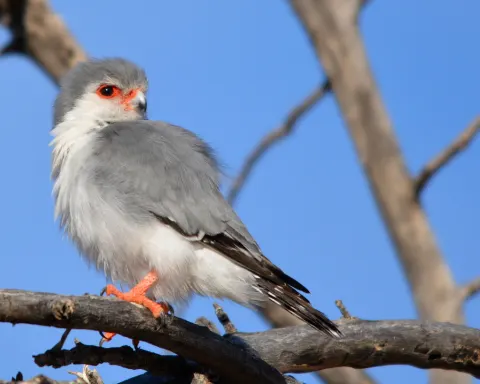
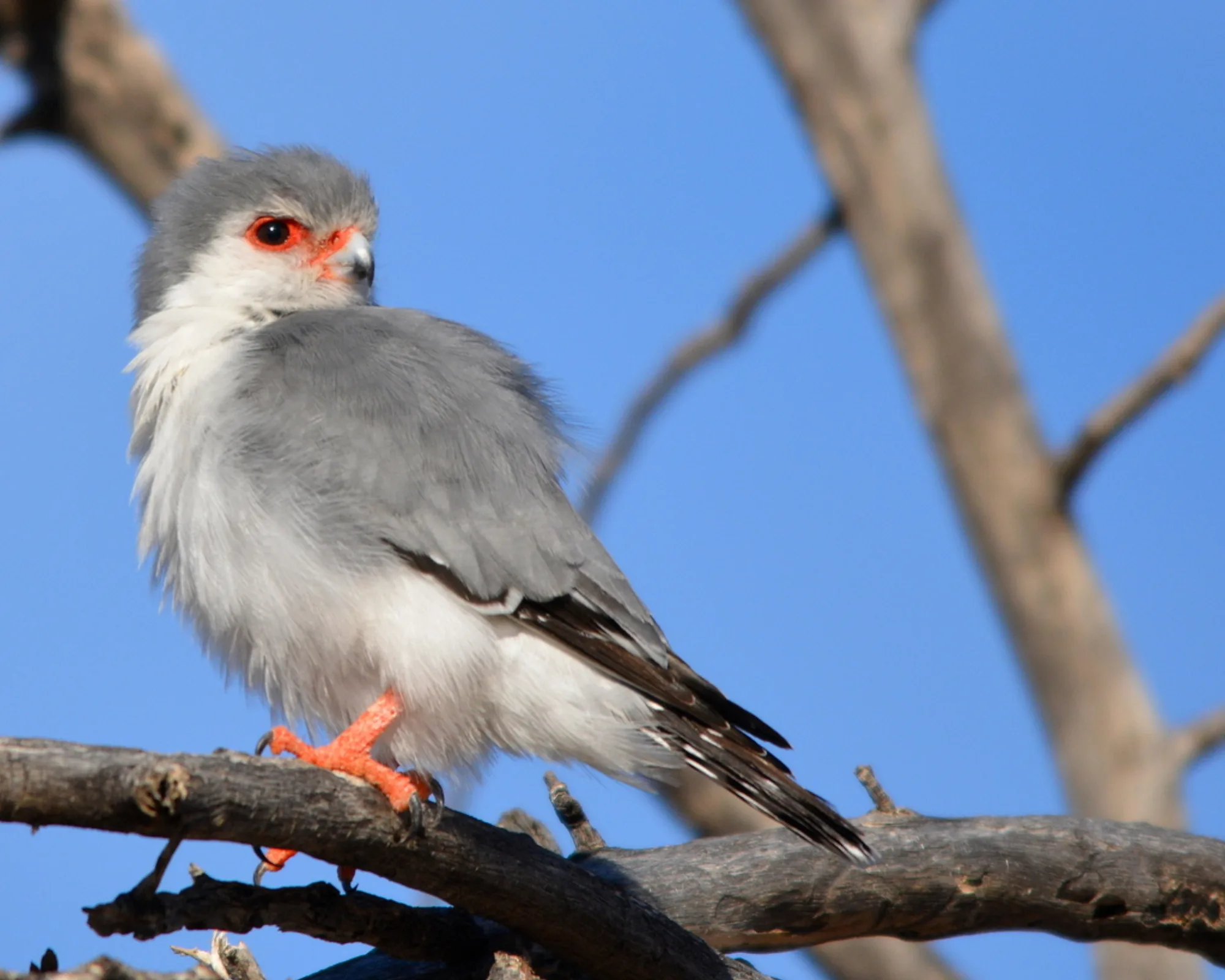
Africa's smallest bird of prey, the Pygmy Falcon, is a compact raptor with a white belly and face. Adults are 20 cm long and weigh 54 to 76 g. Males have grey backs, while females have chestnut backs; young birds have duller brown backs and a reddish wash on the breast. Look for white spots on the back of the neck, black-and-white spotted wings and a barred black-and-white tail. In flight, it travels low with an undulating motion.
The falcon lives in dry bush in eastern and southern Africa. In the east, its range includes South Sudan, Somalia, Uganda and Tanzania; farther south, it occurs between Angola and northern South Africa. It hunts from a high perch, dropping down to catch reptiles and insects, as well as occasional small birds, rodents and other suitably sized or young small mammals. In Kenya it nests in white-headed buffalo weaver nests; in southern Africa it mainly uses vacant chambers in sociable weaver nests, even when the weavers still occupy the colony. It mostly leaves the sociable weavers alone, although it sometimes eats their nestlings or adults.
Breeding runs from August to February, peaking in September and December, and the most frequent clutch contains three eggs. Some territories hold groups of more than two adults that help tend the nestlings. Roosting together and sheltering in sociable weaver colonies help the falcons regulate their body temperature. The species is described as not threatened.
Written from the English Wikipedia article Pygmy falcon (CC BY-SA 4.0).
- Records
- 11,825
- Countries
- 7
- Atlas places
- 19
- Serengeti National Park· Tanzania
- Kgalagadi Transfrontier Park· South Africa
- Tsavo West National Park· Kenya
- Ngorongoro Conservation Area· Tanzania
- Namib-Naukluft· Namibia
- Tsavo East National Park· Kenya
- Maasai Mara National Reserve· Kenya
- Tarangire National Park· Tanzania
- Amboseli National Park· Kenya
- Kilimanjaro National Park· Tanzania
- Lake Manyara National Park· Tanzania
- Mkomazi National Park· Tanzania
- Samburu National Reserve· Kenya
- Augrabies Falls National Park· South Africa
- Etosha National Park· Namibia
- Meru National Park· Kenya
- Ruaha National Park· Tanzania
- Arusha National Park· Tanzania
- Tsau ǁKhaeb (Sperrgebiet) National Park· Namibia
These are open occurrence records, so they show where people looked for and recorded the Pygmy Falcon as much as where it lives. Cells are up to 25 km across, and every location is generalised to its cell.
Generalised encounter areas, not exact locations. Each shape is a grid cell coloured by how likely the species is there.
- Very likelySouth Africa25 km zone · high confidence · 3629 records · updated 80 days ago
- Very likelyKenya25 km zone · medium confidence · 3273 records · updated 80 days ago
- Very likelyTanzania25 km zone · high confidence · 3002 records · updated 80 days ago
- Very likelyNamibia25 km zone · high confidence · 690 records · updated 80 days ago
- Very likelyEthiopia25 km zone · medium confidence · 613 records · updated 80 days ago
- Very likelyBotswana25 km zone · high confidence · 547 records · updated 80 days ago
- LikelyUganda25 km zone · medium confidence · 71 records · updated 80 days ago
Conservation status not assessed here yet, so every location is generalised to its grid cell.