Central Bearded Dragon
Pogona vitticeps
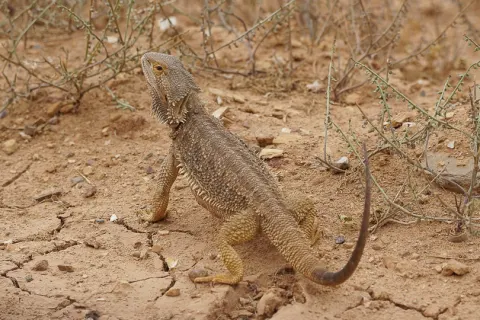
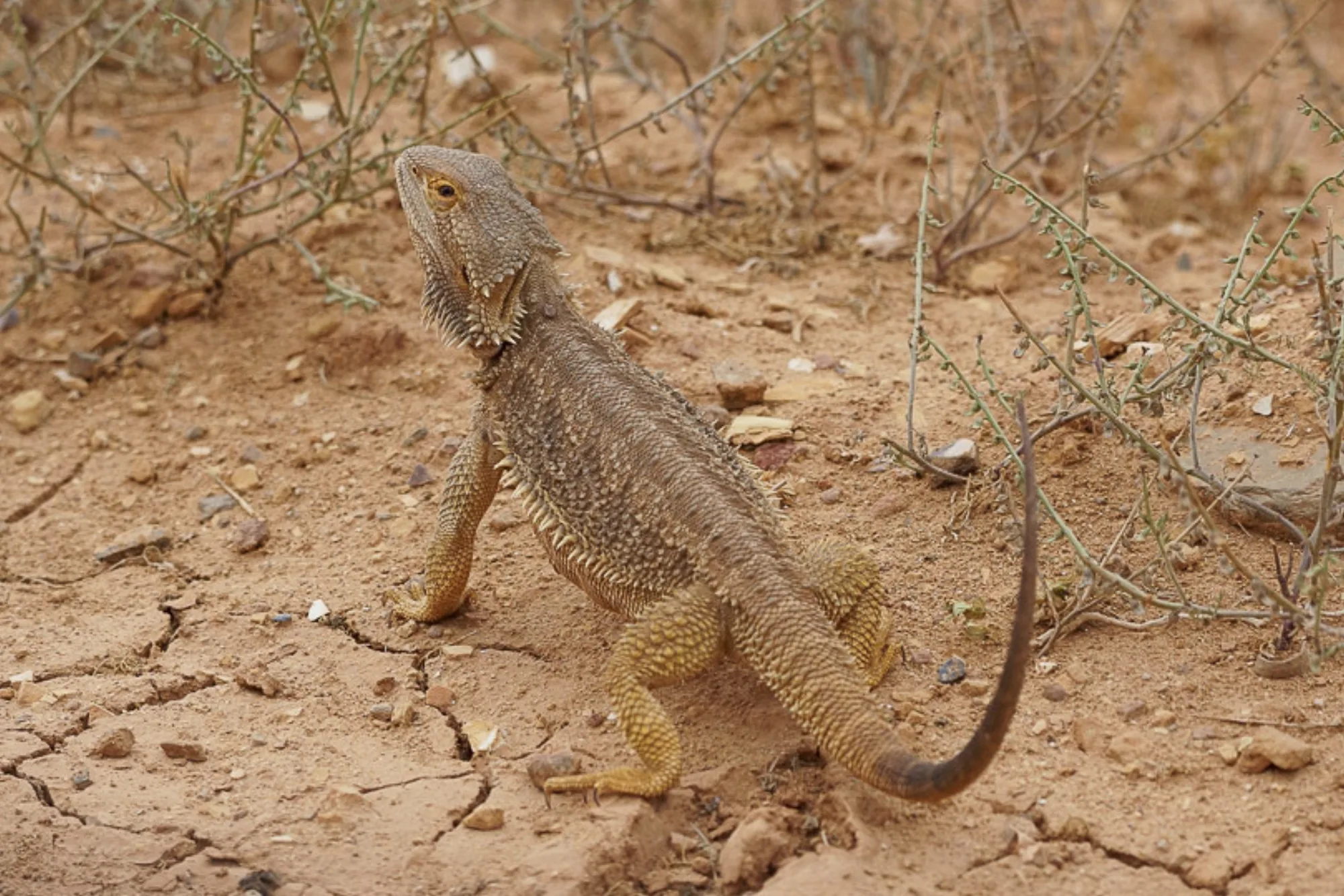
With a broad body and a pouch beneath its chin, the Central Bearded Dragon is a lizard native to eastern and central Australia. Its colours range from light brown and reddish-brown to red, yellow, white and orange. It can reach around 60 cm from head to tail tip, with the tail making up more than half its length. The pouch can inflate and darken, while pointed scales along the throat, head and body can be raised to make the animal look larger.
In Central Australia, it inhabits dry and semiarid woodland and rocky desert, mainly away from the coast in New South Wales, the Northern Territory, Queensland and South Australia. A skilled climber, it perches on tree limbs and fence posts and shelters among bushes as well as spending time on the ground. Look for it basking on exposed branches or rocks in the morning and early evening. During the hottest part of the afternoon, it retreats into shade or burrows. Its varied diet includes vegetation, fruit, insects and worms, as well as occasional small rodents or lizards. Although these dragons are not social, they sometimes gather at feeding or basking spots, where dominant animals claim the highest or sunniest perches. They communicate through colour, posture and gestures, including head bobbing and arm waving.
Breeding usually takes place in early spring. A female lays 11 to 30 eggs in a shallow nest dug in sand, then buries them and leaves them unattended. Birds of prey, foxes, feral dogs and dingos are among their predators. In captivity, dragons are susceptible to a virus that can be fatal to juveniles or stressed animals, and inadequate UVB lighting and dietary calcium can cause bone disease.
Written from the English Wikipedia article Central bearded dragon (CC BY-SA 4.0).
- Records
- 4,523
- Countries
- 1
- Atlas places
- 1
These are open occurrence records, so they show where people looked for and recorded the Central Bearded Dragon as much as where it lives. Cells are up to 25 km across, and every location is generalised to its cell.
Generalised encounter areas, not exact locations. Each shape is a grid cell coloured by how likely the species is there.
- Very likelyAustralia25 km zone · medium confidence · 4523 records · updated 80 days ago
Conservation status not assessed here yet, so every location is generalised to its grid cell.