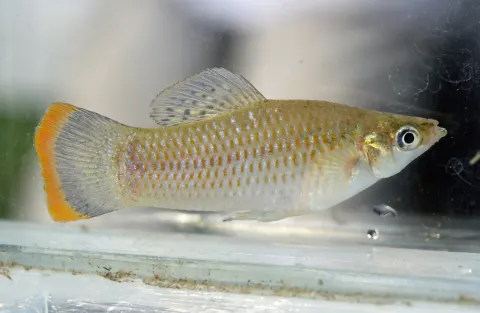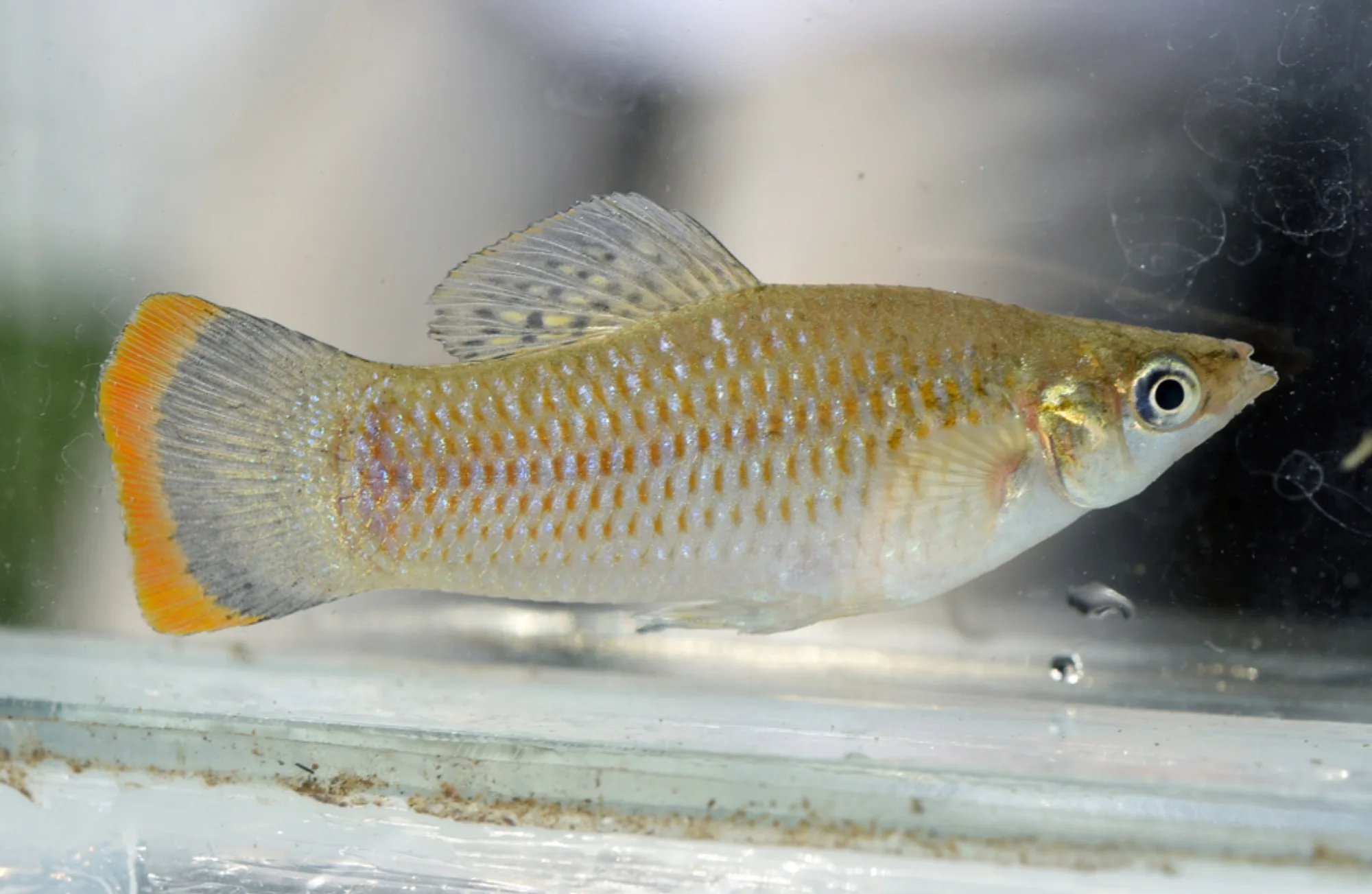
Molly
Poecilia sphenops
Native to Mexico, Guatemala and Honduras, the Molly is a small Central American fish also known as the Mexican molly. It can reach 10 cm in total length, though most are smaller. Females grow about 1 cm longer than males, while males have stronger colouring. The Molly occurs on both the Atlantic and Pacific slopes, including river basins in Mexico and parts of northern Central America. In short coastal streams where it shares the water with P. mexicana, the Molly tends to occupy the upstream stretches. It is especially widespread in creeks, but also lives in rivers, ponds, lagoons and roadside ditches, in lowlands and uplands alike. Its freshwater and brackish habitats range from still water to places with a slight or moderate current. The water can be clear, turbid or muddy, and is typically no more than 1 m deep. Some sites have no vegetation, while others hold abundant algae and aquatic plants.
In rivers, adults gather near the banks, while their young stay in very shallow water. The Molly makes use of different foods across its habitats, with algae and diatoms forming a significant part of its diet. Depending on the population, it may browse on filamentous algae, filter tiny organisms from the water, hunt insect larvae or feed mainly on detritus. It gives birth to live young, producing up to 150 after a month of gestation. Young have been caught from January to August, suggesting that breeding takes place through much of the year. Populations tend to have more females than males. Males are more vulnerable to stress and adverse environmental conditions, and their smaller size and more conspicuous colours make them easier prey.
Written from the English Wikipedia article Poecilia sphenops (CC BY-SA 4.0).
- Records
- 287
- Countries
- 6
- Atlas places
- 1
These are open occurrence records, so they show where people looked for and recorded the Molly as much as where it lives. Cells are up to 25 km across, and every location is generalised to its cell.
Generalised encounter areas, not exact locations. Each shape is a grid cell coloured by how likely the species is there.
- Very likelyJapan25 km zone · high confidence · 113 records · updated 81 days ago
- Very likelyUnited States25 km zone · high confidence · 93 records · updated 81 days ago
- Very likelyMexico25 km zone · medium confidence · 67 records · updated 81 days ago
- Very likelyColombia25 km zone · medium confidence · 9 records · updated 81 days ago
- PossibleHonduras25 km zone · medium confidence · 3 records · updated 81 days ago
- UncommonSingapore25 km zone · medium confidence · 2 records · updated 81 days ago
Conservation status not assessed here yet, so every location is generalised to its grid cell.