Guppy
Poecilia reticulata
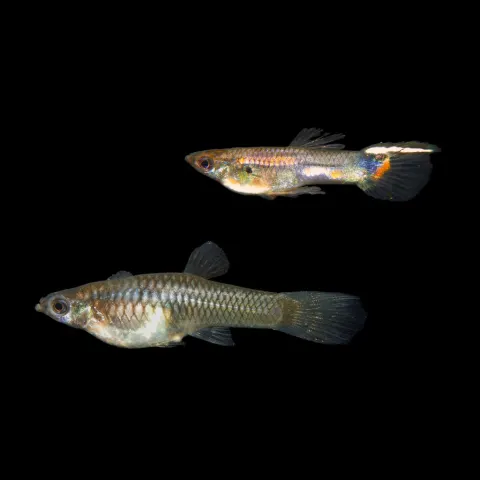
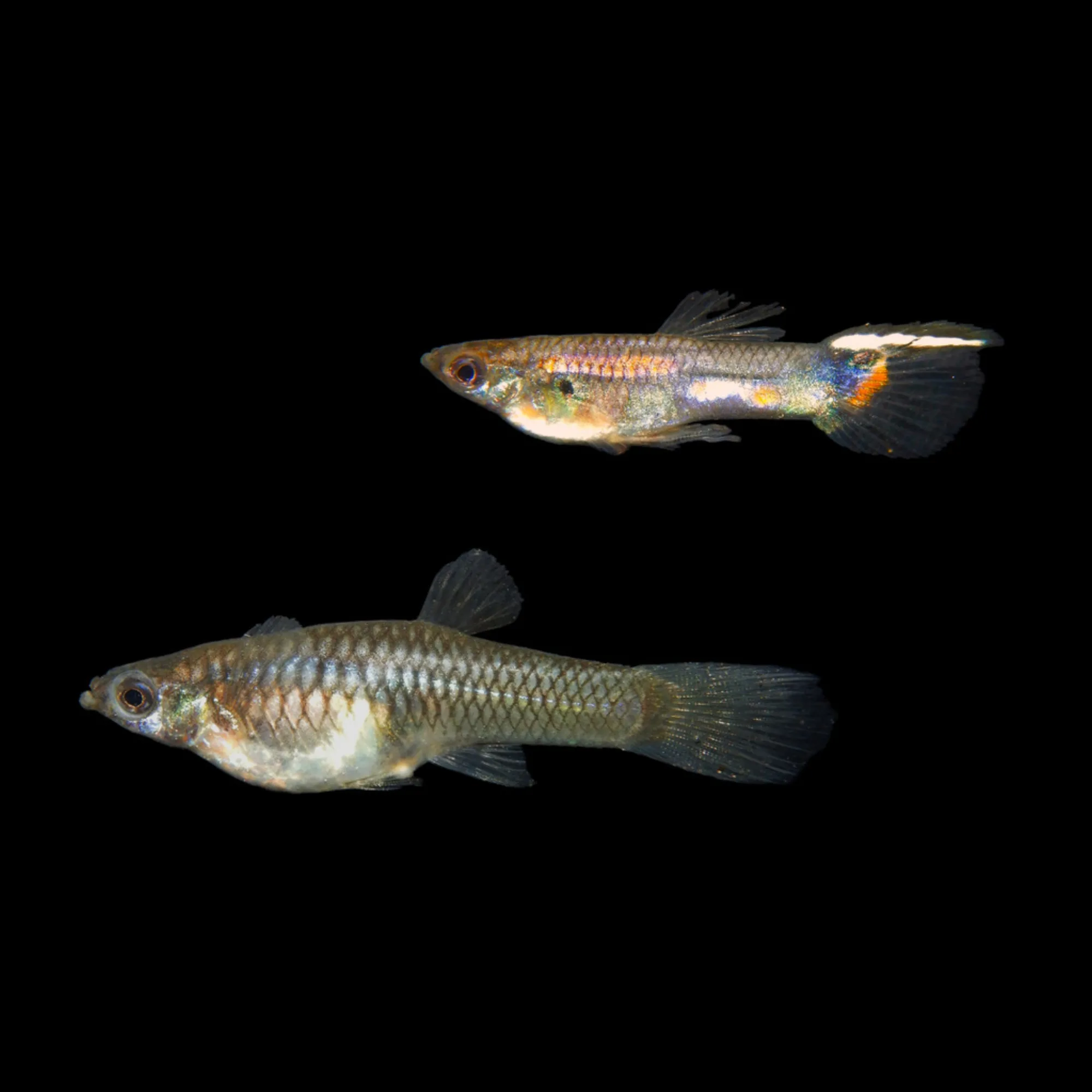
Small and adaptable, the Guppy (Poecilia reticulata) is a freshwater fish with several other names, including rainbow fish. Wild females are grey, while the smaller males can have splashes, spots or stripes in a wide range of colours, as well as ornamental fins. Males are typically 1.5 to 4 cm long and females 3 to 7 cm. Native to northeast South America and several Caribbean islands, Guppies have been introduced around the world, often for mosquito control. Within their natural range they have spread through nearly every freshwater body they can reach, particularly streams near the mainland coast of South America. They tend to be more numerous in small pools and streams, compared with large, deep or fast-flowing rivers, and have also colonised some brackish habitats.
Guppies often forage in groups, which makes food easier to find and leaves more time for feeding. Their diet changes with local food availability and can include algae, aquatic insect larvae, tiny drifting animals and plant fragments. Larger fish and birds prey on Guppies, and their small size and the males' bright colours make them easy to spot. Guppies often school together to avoid predators, while some approach a potential predator to assess the danger. Parasites also affect them, and exposure to chronic human-made noise alongside a particular flatworm can reduce their survival. Guppies give birth to live young, which can fend for themselves without further parental care and school together. Breeding generally continues throughout the year, with two generations occurring annually in the wild. Food scarcity can reduce reproduction, while abundant food can lead to larger broods.
Written from the English Wikipedia article Guppy (CC BY-SA 4.0).
- Records
- 4,102
- Countries
- 39
- Atlas places
- 6
These are open occurrence records, so they show where people looked for and recorded the Guppy as much as where it lives. Cells are up to 25 km across, and every location is generalised to its cell.
Generalised encounter areas, not exact locations. Each shape is a grid cell coloured by how likely the species is there.
- Very likelyJapan25 km zone · medium confidence · 1605 records · updated 80 days ago
- Very likelyTaiwan25 km zone · medium confidence · 996 records · updated 80 days ago
- Very likelyColombia25 km zone · high confidence · 553 records · updated 80 days ago
- Very likelyBrazil25 km zone · medium confidence · 313 records · updated 80 days ago
- Very likelyUnited States25 km zone · medium confidence · 102 records · updated 80 days ago
- Very likelyVenezuela25 km zone · medium confidence · 96 records · updated 80 days ago
- Very likelySouth Africa25 km zone · medium confidence · 93 records · updated 80 days ago
- Very likelyGermany25 km zone · high confidence · 77 records · updated 80 days ago
- Very likelyMexico25 km zone · medium confidence · 40 records · updated 80 days ago
- Very likelyRéunion25 km zone · medium confidence · 28 records · updated 80 days ago
Conservation status not assessed here yet, so every location is generalised to its grid cell.