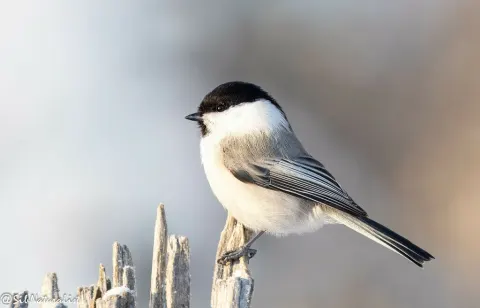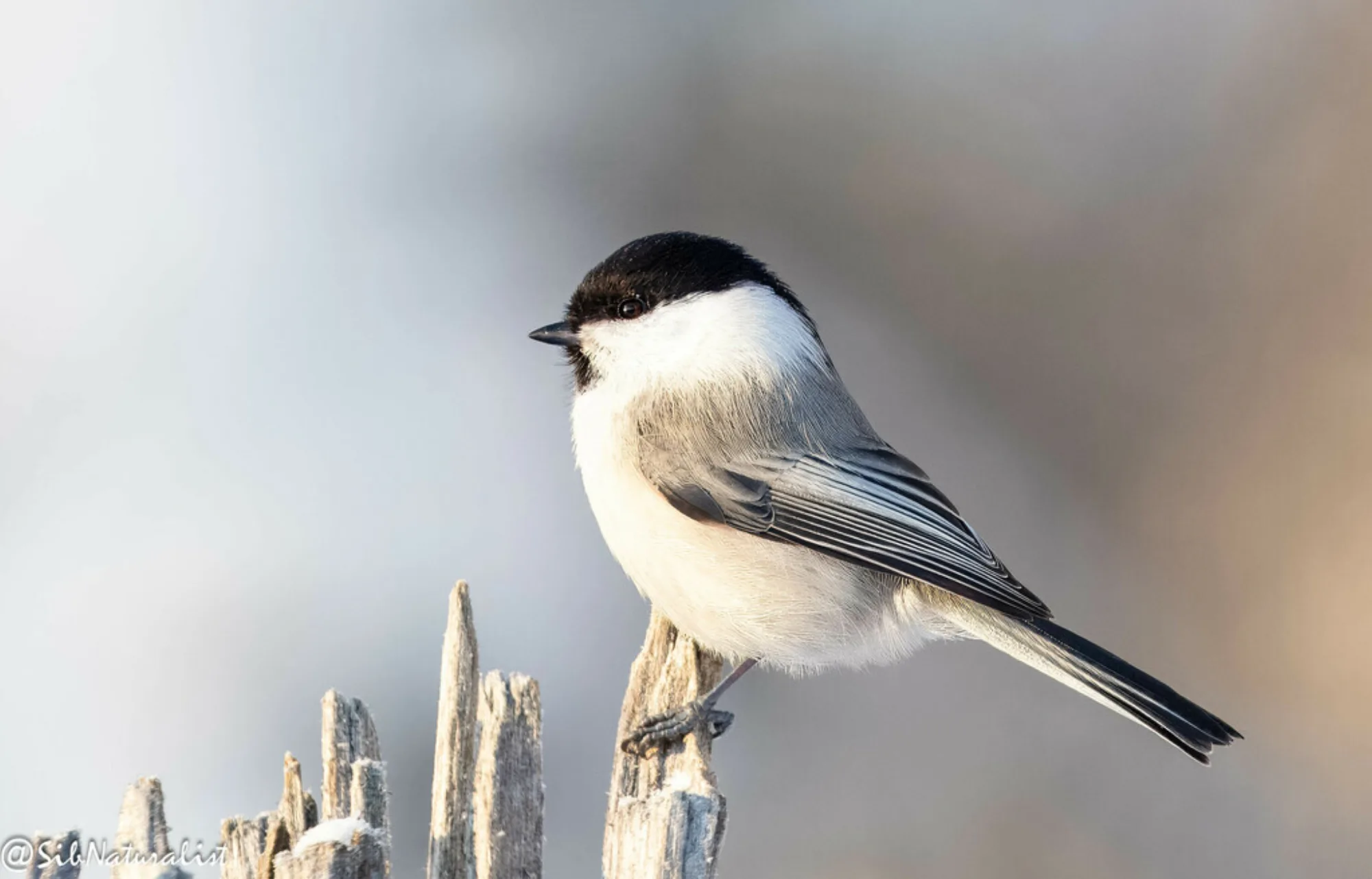
Willow Tit
Poecile montanus
Look for the Willow Tit's dull black cap and bib, white cheeks, grey-brown back and buff underparts. This small member of the tit family has a large head and a thin bill, and the sexes look alike. It measures 11.5 cm in length and weighs around 11 g. Its cap is sooty brown rather than the glossy blue-black of the similar marsh tit, while pale buff feather edges make a light patch on the closed wing. Its most common call is a nasal "zee, zee, zee", although its notes vary considerably.
Willow Tits breed across temperate and subarctic Europe and much of the Palearctic. They favour conifers more than marsh tits do, and breed much farther north. Most remain in their range throughout the year rather than migrating. They eat insects, caterpillars and seeds. For nesting, a bird digs its own hole, usually in a rotten stump or a decaying tree, and can even pierce hard bark. The nest is generally a cup made from felted fur, hair or wood chips, sometimes with feathers. A clutch usually contains six to nine eggs, which the female incubates alone for 13 to 15 days. Both parents feed and care for the chicks, which leave the nest after 17 to 20 days; one brood is raised each season.
Although the population is large, it appears to be decreasing slowly. In the United Kingdom, numbers fell by 83% between 1995 and 2017, and the range contracted. Habitat loss, competition from other tits for nest holes, and predation of nests by great spotted woodpeckers are believed to be behind the rapid decline there.
Written from the English Wikipedia article Willow tit (CC BY-SA 4.0).
- Records
- 381,172
- Countries
- 44
No atlas park has a record of the Willow Tit in or around it yet.
These are open occurrence records, so they show where people looked for and recorded the Willow Tit as much as where it lives. Cells are up to 25 km across, and every location is generalised to its cell.
Generalised encounter areas, not exact locations. Each shape is a grid cell coloured by how likely the species is there.
- Very likelyFinland25 km zone · high confidence · 195314 records · updated 86 days ago
- Very likelyNorway25 km zone · high confidence · 102057 records · updated 86 days ago
- Very likelyBelgium25 km zone · high confidence · 24973 records · updated 86 days ago
- Very likelyFrance25 km zone · high confidence · 18753 records · updated 86 days ago
- Very likelySweden25 km zone · high confidence · 11613 records · updated 86 days ago
- Very likelyUnited Kingdom25 km zone · high confidence · 5910 records · updated 86 days ago
- Very likelyRussia25 km zone · high confidence · 2791 records · updated 86 days ago
- Very likelyJapan25 km zone · high confidence · 2042 records · updated 86 days ago
- Very likelyPoland25 km zone · high confidence · 1921 records · updated 86 days ago
- Very likelyGermany25 km zone · high confidence · 1764 records · updated today
Conservation status not assessed here yet, so every location is generalised to its grid cell.