Carolina Chickadee
Poecile carolinensis
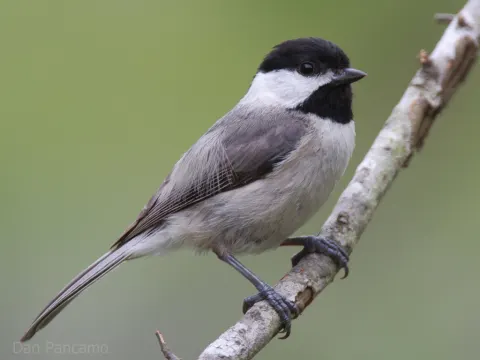
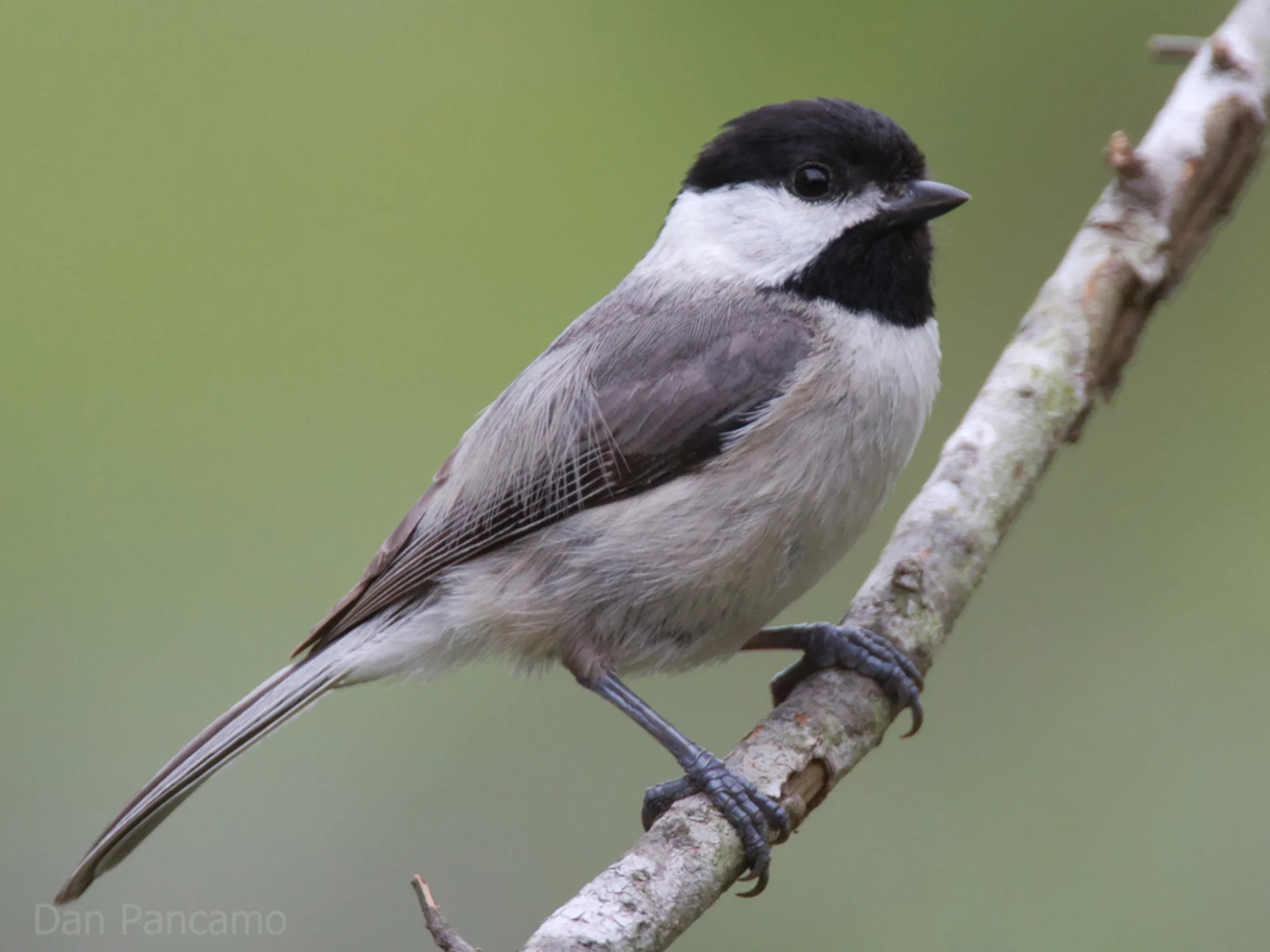
A black cap and bib, white cheeks and a grey back help identify the Carolina Chickadee, a small bird in the tit family. Its white underparts have rusty brown flanks, and it has a short dark bill and a moderately long tail. Adults measure 10 to 12 cm in length. It closely resembles the black-capped chickadee, and telling the two apart by sight is difficult even with an excellent view. Its call has a higher pitch and quicker rhythm than its relative's, although the birds can mimic each other's songs where their habitats overlap.
This resident of the southeastern and central United States breeds in mixed or deciduous forests. Its breeding range reaches New Jersey and Pennsylvania in the northeast, southern Kansas in the west, and Florida and Texas in the south. In winter, Carolina Chickadees often gather in flocks that can also include titmice, nuthatches and warblers. They call when they find a good food source, helping the flock stay together. Look for them hopping along branches in search of insects, sometimes hanging upside down or hovering. Insects make up much of their diet, particularly in summer, with berries and seeds taking on greater importance during winter. They also visit feeders and store seeds for later.
Pairs nest in tree holes, using natural cavities or sometimes old woodpecker nests. The female builds a nest of moss and bark strips, lined with hair or plant fibres, and usually lays 3 to 10 eggs. Where the ranges overlap, Carolina and black-capped chickadees can interbreed; offspring of hybrid pairs have lower hatching success. In extreme cold, Carolina Chickadees shelter in cavities and enter torpor to conserve energy. While in this state they are awake but unresponsive, and the stress of being handled may kill them.
Written from the English Wikipedia article Carolina chickadee (CC BY-SA 4.0).
- Records
- 4,378,757
- Countries
- 2
- Atlas places
- 2
These are open occurrence records, so they show where people looked for and recorded the Carolina Chickadee as much as where it lives. Cells are up to 25 km across, and every location is generalised to its cell.
Generalised encounter areas, not exact locations. Each shape is a grid cell coloured by how likely the species is there.
- Very likelyUnited States25 km zone · high confidence · 4378727 records · updated 86 days ago
- UncommonCanada25 km zone · medium confidence · 30 records · updated today
Conservation status not assessed here yet, so every location is generalised to its grid cell.