Black-capped Chickadee
Poecile atricapillus
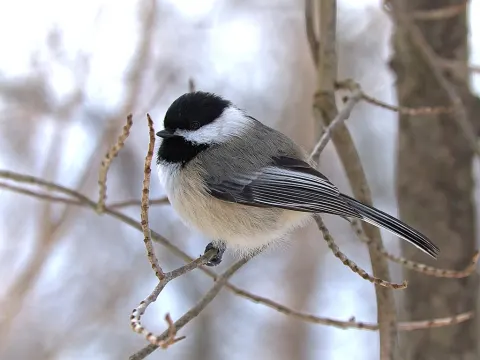
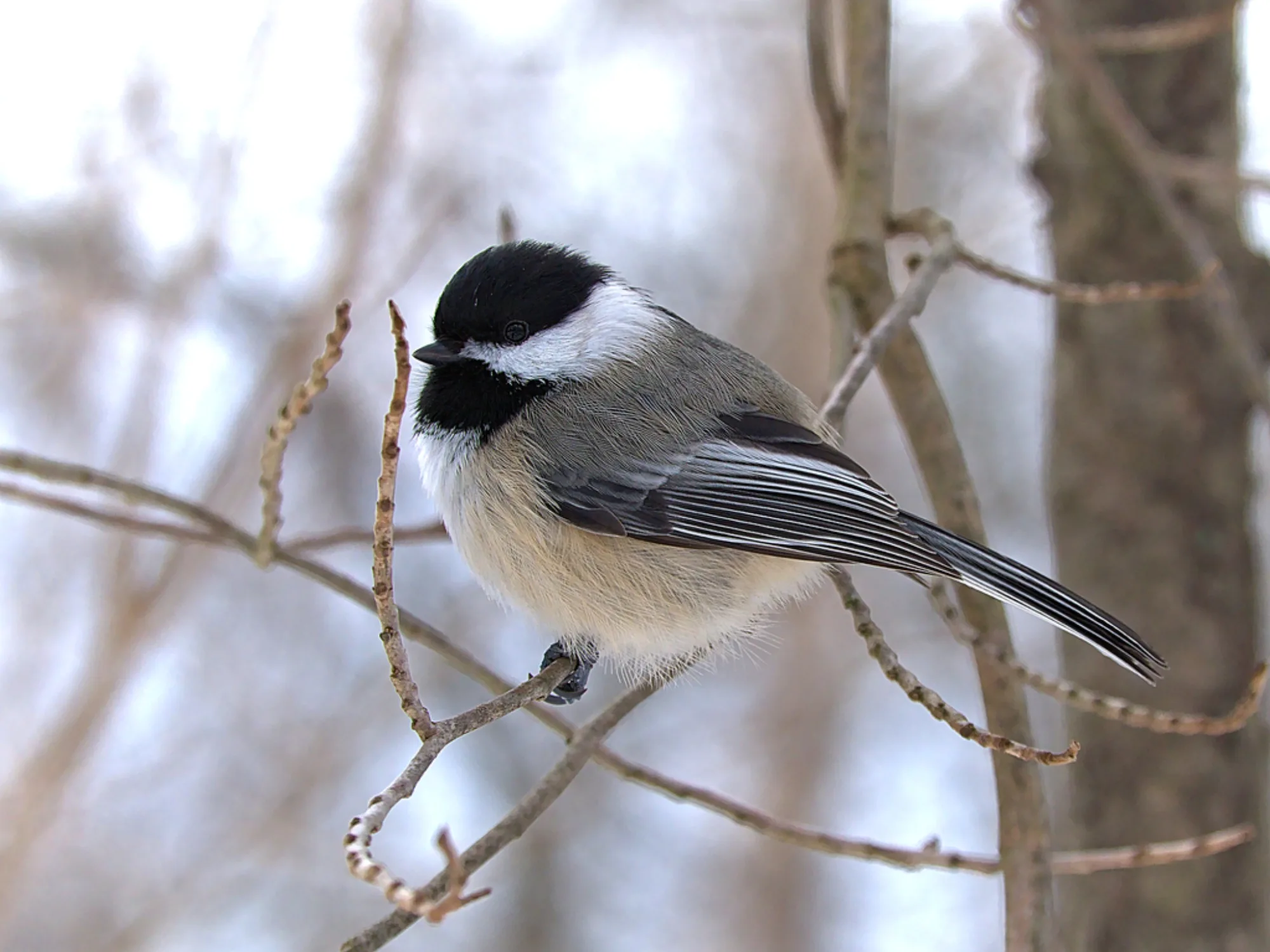
Look for a small bird with a black cap and bib, white cheeks and buff sides: the Black-capped Chickadee. Its back is greenish grey, while its wings and tail are slate grey. Listen, too, for its clear, two-note fee-bee whistle and the chick-a-dee-dee-dee call that gave the bird its name. The similar Carolina chickadee can be difficult to tell apart by sight, but its calls differ.
This year-round resident ranges across much of North America, from Alaska and Canada south into the United States. It lives in coniferous and deciduous woods, as well as willow thickets, urban parks and suburban areas. Watch for it hopping along branches, hanging upside down or hovering as it searches for food. Caterpillars and other insects make up much of its summer diet; in winter, it relies more on berries and seeds. It also hides individual seeds and insects in places such as bark and dead leaves. Winter flocks may include nuthatches, woodpeckers and other birds, which respond to chickadee alarm calls.
From late April through June, pairs nest in tree cavities or nest boxes. The female builds a nest with a coarse base and a softer lining, and both parents feed the young. A clutch usually holds six to eight eggs; the young leave the nest 12 to 16 days after hatching. Owls, hawks and shrikes prey on chickadees, while mammals and snakes can raid their nests. Window collisions, pesticides and pet cats also cause deaths. In areas with very cold winters, access to extra food can affect survival.
Written from the English Wikipedia article Black-capped chickadee (CC BY-SA 4.0).
- Records
- 7,741,221
- Countries
- 5
- Atlas places
- 2
These are open occurrence records, so they show where people looked for and recorded the Black-capped Chickadee as much as where it lives. Cells are up to 25 km across, and every location is generalised to its cell.
Generalised encounter areas, not exact locations. Each shape is a grid cell coloured by how likely the species is there.
- Very likelyUnited States25 km zone · high confidence · 5361271 records · updated 86 days ago
- Very likelyCanada25 km zone · high confidence · 2379770 records · updated 86 days ago
- PossibleFrance25 km zone · medium confidence · 135 records · updated today
- PossibleSt. Pierre & Miquelon25 km zone · medium confidence · 45 records · updated today
- RareUnited Kingdom25 km zone · low confidence · 0 records · updated today
Conservation status not assessed here yet, so every location is generalised to its grid cell.