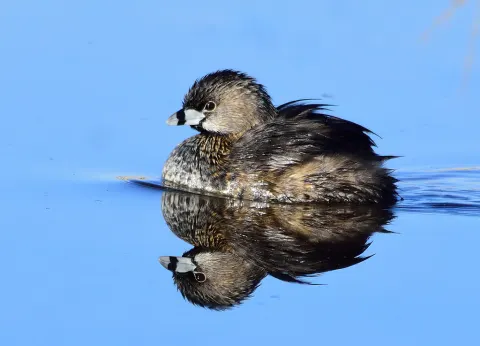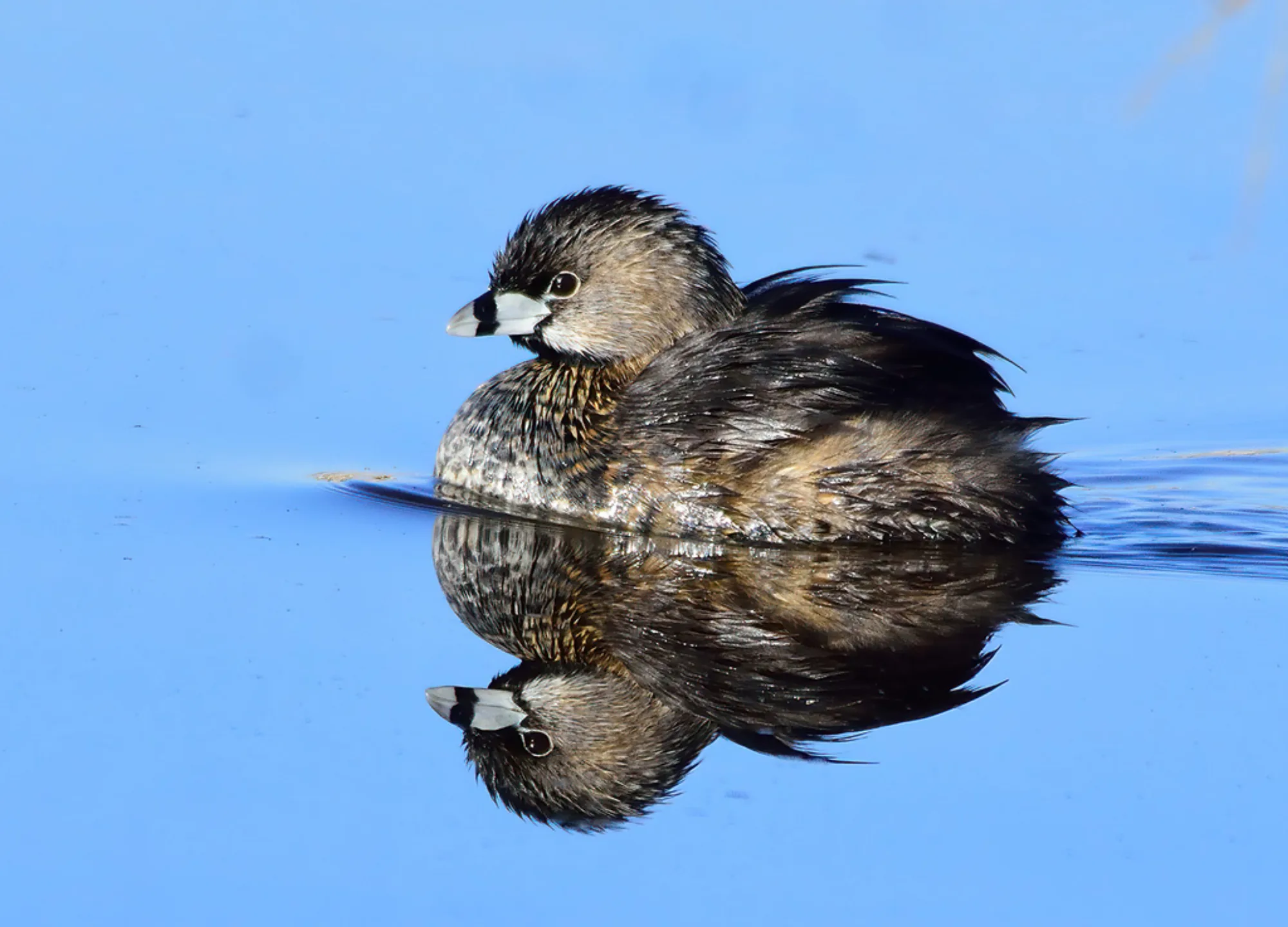
Pied-billed Grebe
Podilymbus podiceps
Look for a small, stocky waterbird with a short neck and mostly brown plumage, darker on the crown and back. The Pied-billed Grebe has a short, blunt, pale grey bill that gains a broad black band in summer, when its throat also turns black. Its white undertail stands out against the brown that helps conceal it in marshes. A loud, whooping call may also draw attention to it.
Pied-billed Grebes live throughout the year across much of the Americas, including the Caribbean. They favour still water and freshwater wetlands with plants such as cattails rising above the surface. During the breeding season they use vegetation near open water, while in winter they are mainly found on open water. Birds in places where water freezes migrate at night. Often solitary and rarely seen flying, they dive slowly and frequently, especially when alarmed. A bird may surface in a more secluded spot with only its head showing. They dive for food, eating mainly aquatic invertebrates as well as small fish and amphibians; they can crush crustaceans with their bills.
Nests float on the water among vegetation, and both parents incubate the eggs and care for the young. Chicks can leave the nest within a day of hatching and sleep on their parents' backs. Wetland loss is the greatest threat, as draining, filling and destruction remove breeding habitat. These birds are sensitive to human disturbance: frightened adults may leave nests, while boat waves can destroy them. In New England, populations are declining for reasons that remain unknown.
Written from the English Wikipedia article Pied-billed grebe (CC BY-SA 4.0).
- Records
- 1,973,202
- Countries
- 4
No atlas park has a record of the Pied-billed Grebe in or around it yet.
These are open occurrence records, so they show where people looked for and recorded the Pied-billed Grebe as much as where it lives. Cells are up to 25 km across, and every location is generalised to its cell.
Generalised encounter areas, not exact locations. Each shape is a grid cell coloured by how likely the species is there.
- Very likelyUnited States25 km zone · high confidence · 1776619 records · updated 80 days ago
- Very likelyCanada25 km zone · high confidence · 151840 records · updated 80 days ago
- Very likelyMexico25 km zone · high confidence · 37317 records · updated 80 days ago
- Very likelyArgentina25 km zone · high confidence · 7426 records · updated 80 days ago
Conservation status not assessed here yet, so every location is generalised to its grid cell.