Tawny Frogmouth
Podargus strigoides
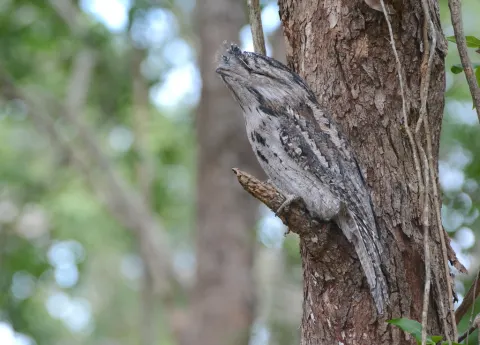
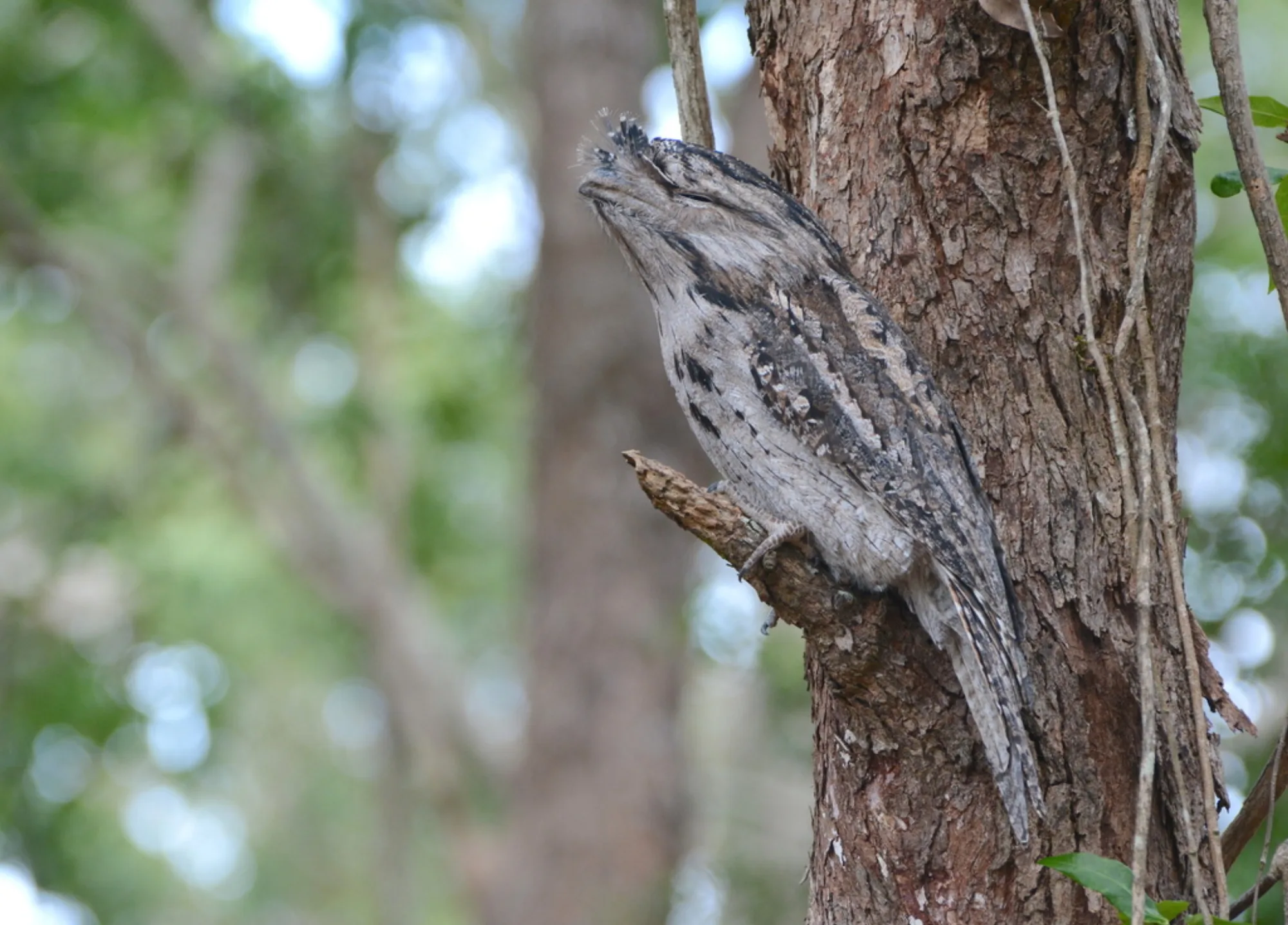
By day, a Tawny Frogmouth can be surprisingly hard to spot, even when it is resting in the open. This stocky, big-headed bird has large yellow eyes and a broad, heavy bill, and its colouring and nocturnal habits often lead people to mistake it for an owl. Its most common plumage is grey, patterned with streaks and mottling that help it resemble a broken branch. It often perches on a low branch with its head tilted upwards, sometimes beside its partner.
Tawny frogmouths occur across much of the Australian mainland and in Tasmania, including forests, woodlands, scrub, heathland and savannah. They are seldom seen in dense rainforest or treeless desert, but can live in residential suburbs and nest in parks and gardens with trees. At dusk they begin to hunt, often dropping from a perch to seize insects or small vertebrates on the ground. Moths, spiders, worms, slugs and snails make up much of their diet, though they also eat small mammals, reptiles, frogs and birds. At night, a deep, repeated oom-oom-oom may give away their presence.
Pairs form lifelong bonds and usually remain in one territory for a decade or more. Breeding generally runs from August to December, although birds in arid areas may breed after heavy rain. Both partners build a fragile nest of sticks in a tree fork, and both feed the young. Land clearing and intense bushfires threaten the birds, while cats, dogs and foxes can catch them on the ground. Road traffic, pesticides and poisoned prey also take a toll.
Written from the English Wikipedia article Tawny frogmouth (CC BY-SA 4.0).
- Records
- 114,194
- Countries
- 1
- Atlas places
- 5
These are open occurrence records, so they show where people looked for and recorded the Tawny Frogmouth as much as where it lives. Cells are up to 25 km across, and every location is generalised to its cell.
Generalised encounter areas, not exact locations. Each shape is a grid cell coloured by how likely the species is there.
- Very likelyAustralia25 km zone · high confidence · 114194 records · updated 80 days ago
Conservation status not assessed here yet, so every location is generalised to its grid cell.