Italian Wall Lizard
Podarcis siculus
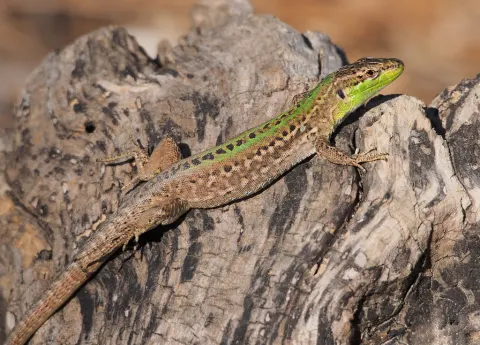
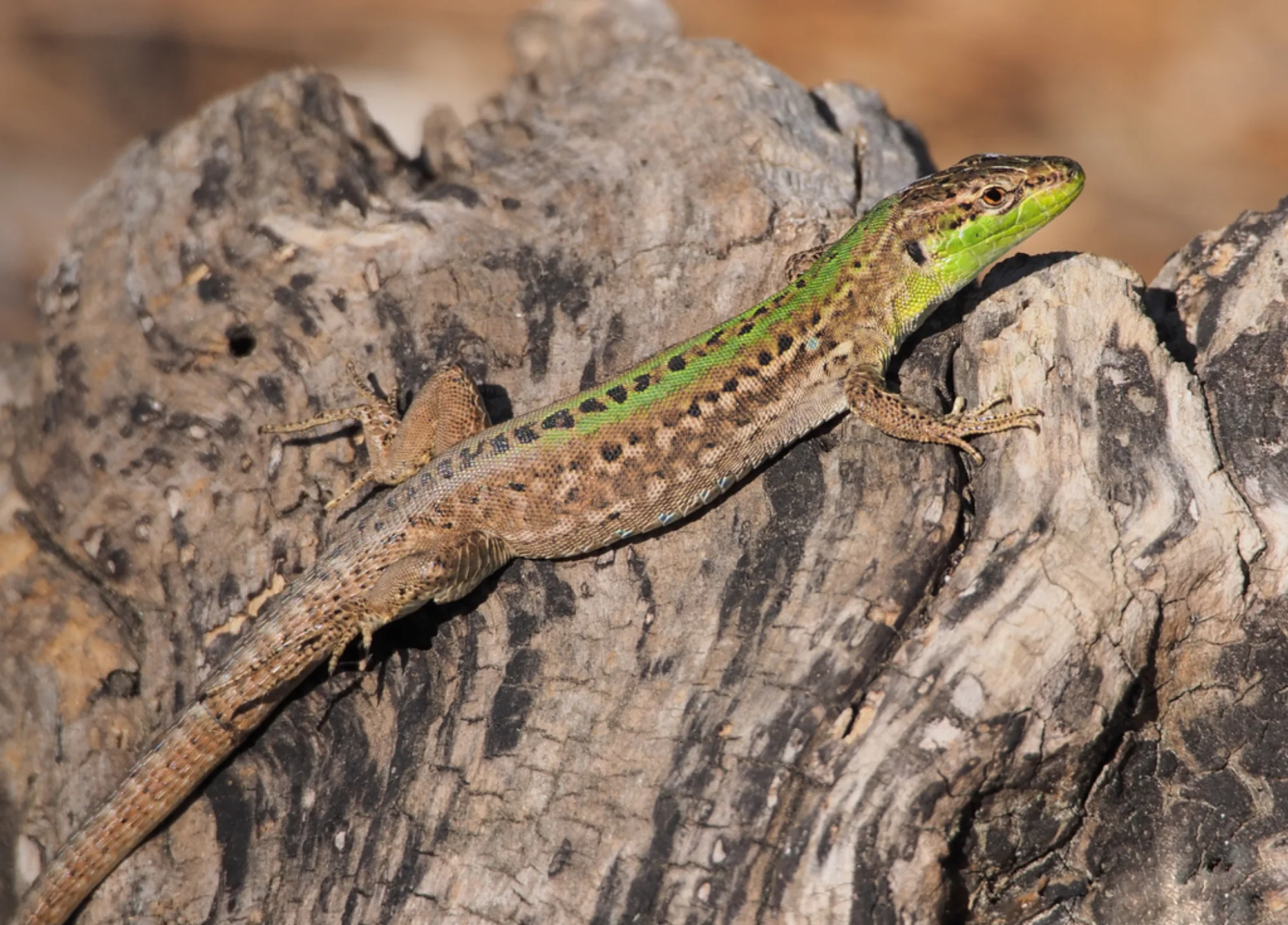
A green or brown back and a white or green belly are typical of the Italian Wall Lizard, although its colour and length vary across populations. Some island populations have hints of blue on parts of the back and belly. Males have larger heads than females. Native to southern and southeastern Europe, this lizard is common in Italy and also occurs in countries including Croatia, France and Switzerland. It has been introduced elsewhere, including Spain, the United States and Canada.
Travellers may encounter it in forests, grasslands, shrublands, rocky places and farmland. It can thrive in both natural landscapes and places altered by people, and tolerates high temperatures in open habitats. In Rome, the lizards are active throughout the year, while an introduced population on Long Island is active from April through October. Italian Wall Lizards eat a wide range of invertebrates, mainly arthropods, as well as small vertebrates and plant matter. Island populations eat a greater proportion of plant matter, and males have a more varied diet than females. Individuals may bask together, and females carrying eggs bask more than other females.
The breeding season runs from May to July, with females laying 3 or 4 clutches each year, each containing 4 to 7 eggs. Clutch size varies between populations, with lizards on small Croatian islands laying fewer eggs that produce larger young. Snakes, birds and feral cats prey on these lizards, and ticks can be common on those living in human-made habitats. Pesticide exposure in agricultural areas is also a concern: a study found greater free radical damage in exposed lizards, while exposed females carrying eggs laid larger eggs of poorer quality.
Written from the English Wikipedia article Italian wall lizard (CC BY-SA 4.0).
- Records
- 2,705
- Countries
- 10
No atlas park has a record of the Italian Wall Lizard in or around it yet.
These are open occurrence records, so they show where people looked for and recorded the Italian Wall Lizard as much as where it lives. Cells are up to 25 km across, and every location is generalised to its cell.
Generalised encounter areas, not exact locations. Each shape is a grid cell coloured by how likely the species is there.
- Very likelyItaly25 km zone · medium confidence · 1320 records · updated 80 days ago
- Very likelyUnited States25 km zone · medium confidence · 440 records · updated 80 days ago
- Very likelyFrance25 km zone · medium confidence · 364 records · updated 80 days ago
- Very likelyCroatia25 km zone · medium confidence · 315 records · updated 80 days ago
- Very likelyTürkiye25 km zone · medium confidence · 112 records · updated 80 days ago
- Very likelyAustria25 km zone · high confidence · 64 records · updated 80 days ago
- Very likelySpain25 km zone · medium confidence · 52 records · updated 80 days ago
- Very likelySlovenia25 km zone · medium confidence · 18 records · updated 80 days ago
- LikelyGermany25 km zone · medium confidence · 14 records · updated 80 days ago
- LikelyPortugal25 km zone · medium confidence · 6 records · updated 80 days ago
Conservation status not assessed here yet, so every location is generalised to its grid cell.