Common Wall Lizard
Podarcis muralis
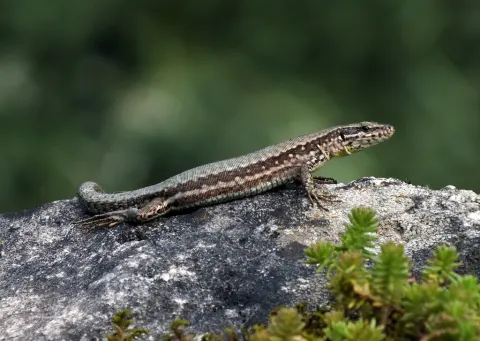
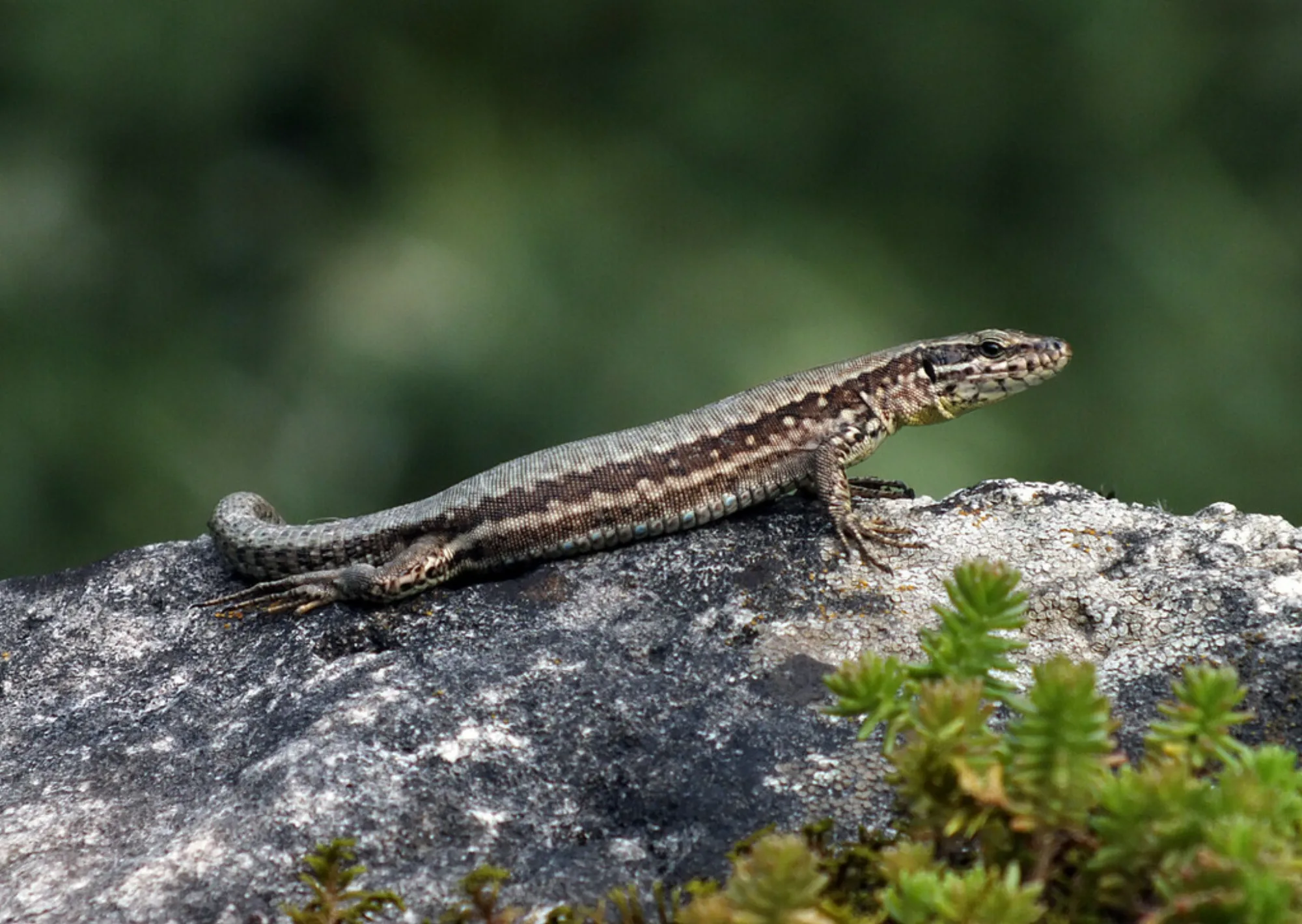
Small and slender, the Common Wall Lizard can grow to about 20 cm in total length. Its colouring and pattern vary widely, though it is generally brownish or greyish, sometimes with a hint of green. Spots along the back may merge into a line, while some lizards have a net-like pattern, dark spots on the sides and scattered white spots that can appear blue near the shoulders. The tail may be brown, grey or rust-coloured, sometimes with pale bars along its sides, and dark marks can appear on the throat.
Its natural range covers much of mainland Europe, apart from the north and far south, and reaches Turkey. Introduced populations live in southern Britain and North America, including one at Ventnor on the Isle of Wight. Look for it in rocky places, including towns, where it darts between buildings and loose stones. In the south, it tends to inhabit damp or partly damp places, while northern habitats tend to be drier. Around the Ohio River basin, it is commonly seen on limestone outcrops, rock walls and rubble.
These lizards communicate with one another through visual and chemical signals, and males use scent to mark territories and attract potential mates. Older individuals tend to be more territorial, while younger ones are more likely to roam. Females of different colour forms have different breeding strategies: yellow females produce more, smaller eggs, while white females produce fewer, larger ones. A haemogregarine parasite is common in these lizards, and susceptibility to infection varies among the colour forms.
Written from the English Wikipedia article Podarcis muralis (CC BY-SA 4.0).
- Records
- 75,300
- Countries
- 11
No atlas park has a record of the Common Wall Lizard in or around it yet.
These are open occurrence records, so they show where people looked for and recorded the Common Wall Lizard as much as where it lives. Cells are up to 25 km across, and every location is generalised to its cell.
Generalised encounter areas, not exact locations. Each shape is a grid cell coloured by how likely the species is there.
- Very likelyFrance25 km zone · high confidence · 64314 records · updated 80 days ago
- Very likelyGermany25 km zone · high confidence · 4993 records · updated 80 days ago
- Very likelySpain25 km zone · high confidence · 1864 records · updated 80 days ago
- Very likelyLuxembourg25 km zone · high confidence · 1342 records · updated 80 days ago
- Very likelyBelgium25 km zone · high confidence · 939 records · updated 80 days ago
- Very likelyItaly25 km zone · high confidence · 859 records · updated 80 days ago
- Very likelyAustria25 km zone · high confidence · 396 records · updated 80 days ago
- Very likelyCanada25 km zone · high confidence · 358 records · updated 80 days ago
- Very likelySwitzerland25 km zone · high confidence · 235 records · updated 80 days ago
Conservation status not assessed here yet, so every location is generalised to its grid cell.