Egyptian Plover
Pluvianus aegyptius
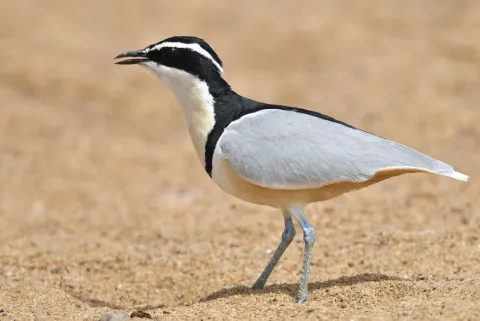
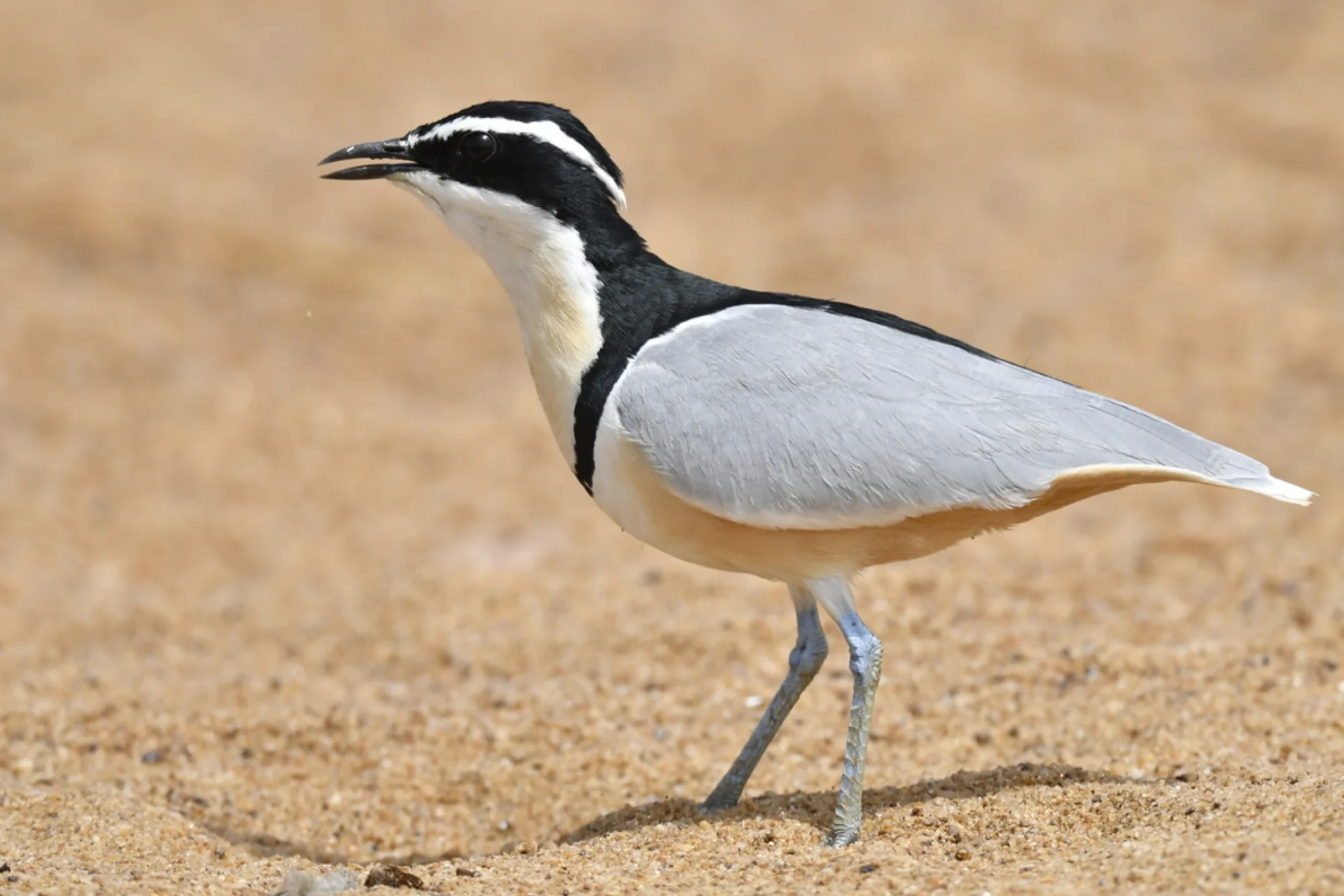
Look for the Egyptian Plover near water, where this relatively tame wader appears in pairs or small groups. Adults measure 19 to 21 cm, with black across the crown and back, a dark eye mask and a band on the breast; the rest of the head is white. Blue-grey upperparts and legs meet buff underparts, while young birds are duller, with brown mixed into their black markings. In flight, the white feathers and black wing bar stand out, and the tail ends in a white band. Listen for its frequent, high-pitched call, rendered as krrr-krrr-krrr.
The species lives locally across tropical Sub-Saharan Africa, ranging eastwards from Senegal to Ethiopia and southwards into the Democratic Republic of the Congo. It avoids forest and breeds on sandbars in large rivers, but no longer occurs in Egypt. It searches for worms, molluscs, aquatic insects and small flies, picking food from the surface or probing damp sand with its bill. Sometimes it catches insects in the air. After landing, the birds in a pair greet one another by raising their wings, displaying their black and white markings.
From early January until the end of March, the birds breed in shallow nests scraped into loose sand on river islands. Both parents incubate the usually 3 to 4 eggs, which hatch after 28 to 31 days. When leaving the nest, a parent covers the eggs with sand; during the heat of the day, the parents wet their feathers and use the water to soak the eggs and surrounding sand. Both care for the chicks, which can feed themselves at around 1 week old and fledge after around 35 days.
Written from the English Wikipedia article Egyptian plover (CC BY-SA 4.0).
- Records
- 2,208
- Countries
- 25
- Atlas places
- 1
These are open occurrence records, so they show where people looked for and recorded the Egyptian Plover as much as where it lives. Cells are up to 25 km across, and every location is generalised to its cell.
Generalised encounter areas, not exact locations. Each shape is a grid cell coloured by how likely the species is there.
- Very likelySenegal25 km zone · medium confidence · 635 records · updated 80 days ago
- Very likelyGhana25 km zone · high confidence · 475 records · updated 80 days ago
- Very likelyGambia25 km zone · medium confidence · 414 records · updated 80 days ago
- Very likelyNigeria25 km zone · medium confidence · 143 records · updated 80 days ago
- Very likelyCameroon25 km zone · high confidence · 104 records · updated 80 days ago
- Very likelySudan25 km zone · medium confidence · 92 records · updated 80 days ago
- Very likelyEthiopia25 km zone · medium confidence · 83 records · updated 80 days ago
- Very likelyNiger25 km zone · medium confidence · 45 records · updated 80 days ago
- Very likelyChad25 km zone · medium confidence · 35 records · updated 80 days ago
- LikelyMali25 km zone · medium confidence · 68 records · updated 80 days ago
Conservation status not assessed here yet, so every location is generalised to its grid cell.