Baya Weaver
Ploceus philippinus
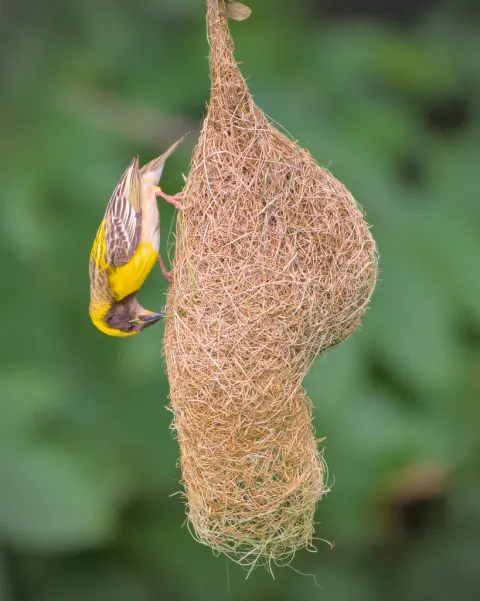
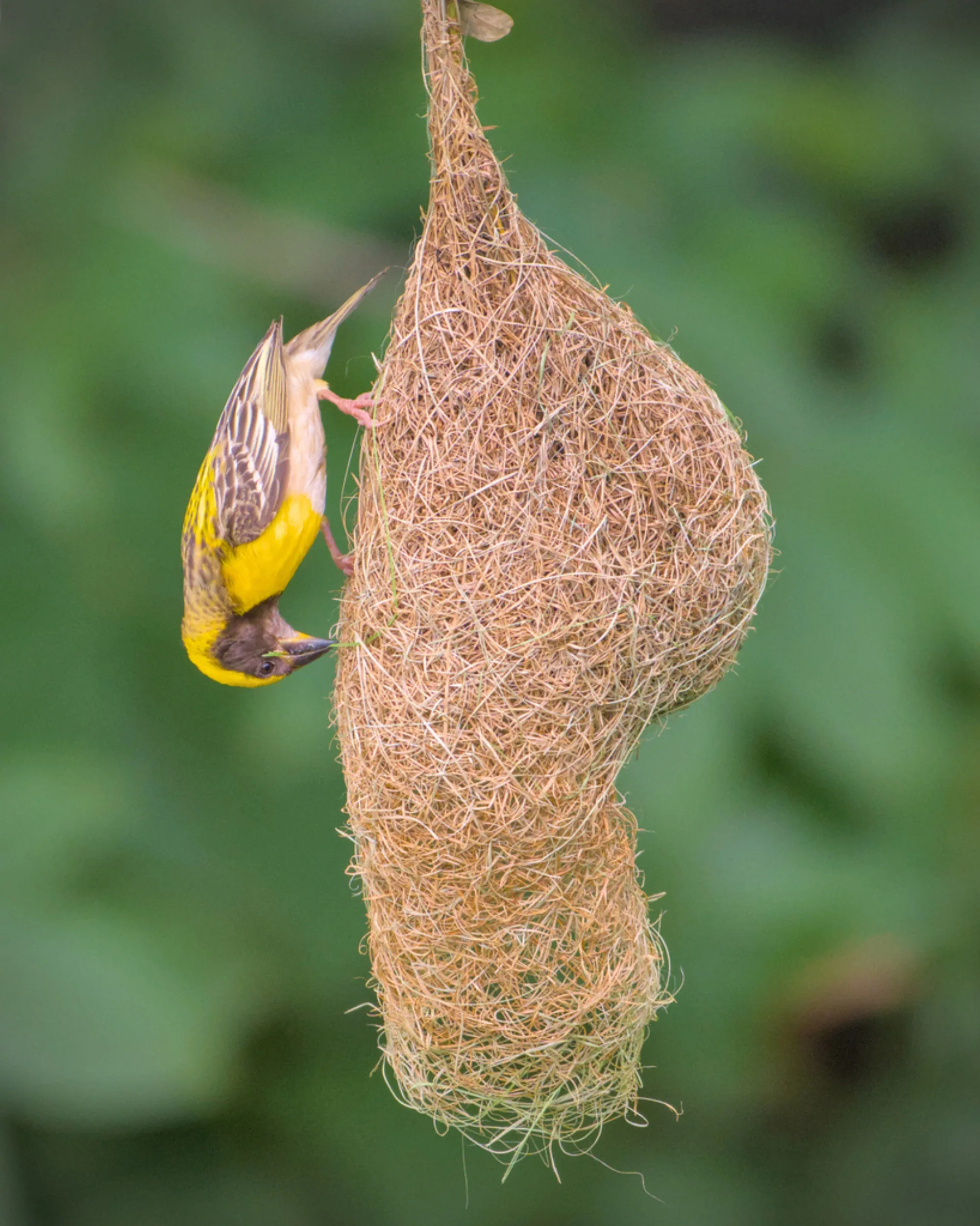
Across the Indian subcontinent and Southeast Asia, the Baya Weaver gathers in flocks among grasslands, cultivated land, scrub and secondary growth. This sparrow-sized weaverbird measures 15 cm, with a stout, cone-shaped bill and a short, square tail. Outside the breeding season, males and females look much alike, with brown streaks above, pale underparts and a long buff eyebrow. Breeding males are more conspicuous, with a bright yellow crown and breast, a dark brown mask and yellow streaks across their darker upperparts. Flocks fly close together, sometimes making complicated manoeuvres, and search for seeds on plants and on the ground. They feed on wild grasses and crops such as rice, and also take insects, including butterflies. Small frogs, geckos and molluscs are sometimes eaten, especially when the birds are feeding young. At night they roost in reed-beds beside water, and their movements vary locally with rain and the availability of food.
Breeding takes place during the monsoons, when the birds usually nest in colonies close to food, water and nesting material. Males weave hanging, retort-shaped nests from strips of leaves and grasses, with a long tube leading to the nesting chamber. Look for these structures suspended from thorny trees or palms, often over water, although in towns and cities they may also hang from roadside trees or telephone wires. A female incubates her clutch of about two to four white eggs for approximately 14 to 17 days, and the young depart roughly 17 days after hatching. Even with thorns and water around them, nests are vulnerable to crows, while lizards and rodents can also destroy broods.
Written from the English Wikipedia article Baya weaver (CC BY-SA 4.0).
- Records
- 123,484
- Countries
- 8
- Atlas places
- 8
These are open occurrence records, so they show where people looked for and recorded the Baya Weaver as much as where it lives. Cells are up to 25 km across, and every location is generalised to its cell.
Generalised encounter areas, not exact locations. Each shape is a grid cell coloured by how likely the species is there.
- Very likelyIndia25 km zone · high confidence · 107913 records · updated 80 days ago
- Very likelyThailand25 km zone · high confidence · 6688 records · updated 80 days ago
- Very likelyMalaysia25 km zone · high confidence · 4099 records · updated 80 days ago
- Very likelyNepal25 km zone · high confidence · 1455 records · updated 80 days ago
- Very likelyCambodia25 km zone · high confidence · 1388 records · updated 80 days ago
- Very likelySri Lanka25 km zone · high confidence · 1359 records · updated 80 days ago
- Very likelyBangladesh25 km zone · high confidence · 362 records · updated 80 days ago
- Very likelySingapore25 km zone · high confidence · 220 records · updated 80 days ago
Conservation status not assessed here yet, so every location is generalised to its grid cell.