Plaice
Pleuronectes platessa
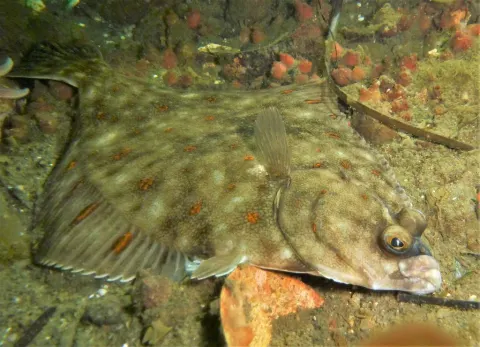
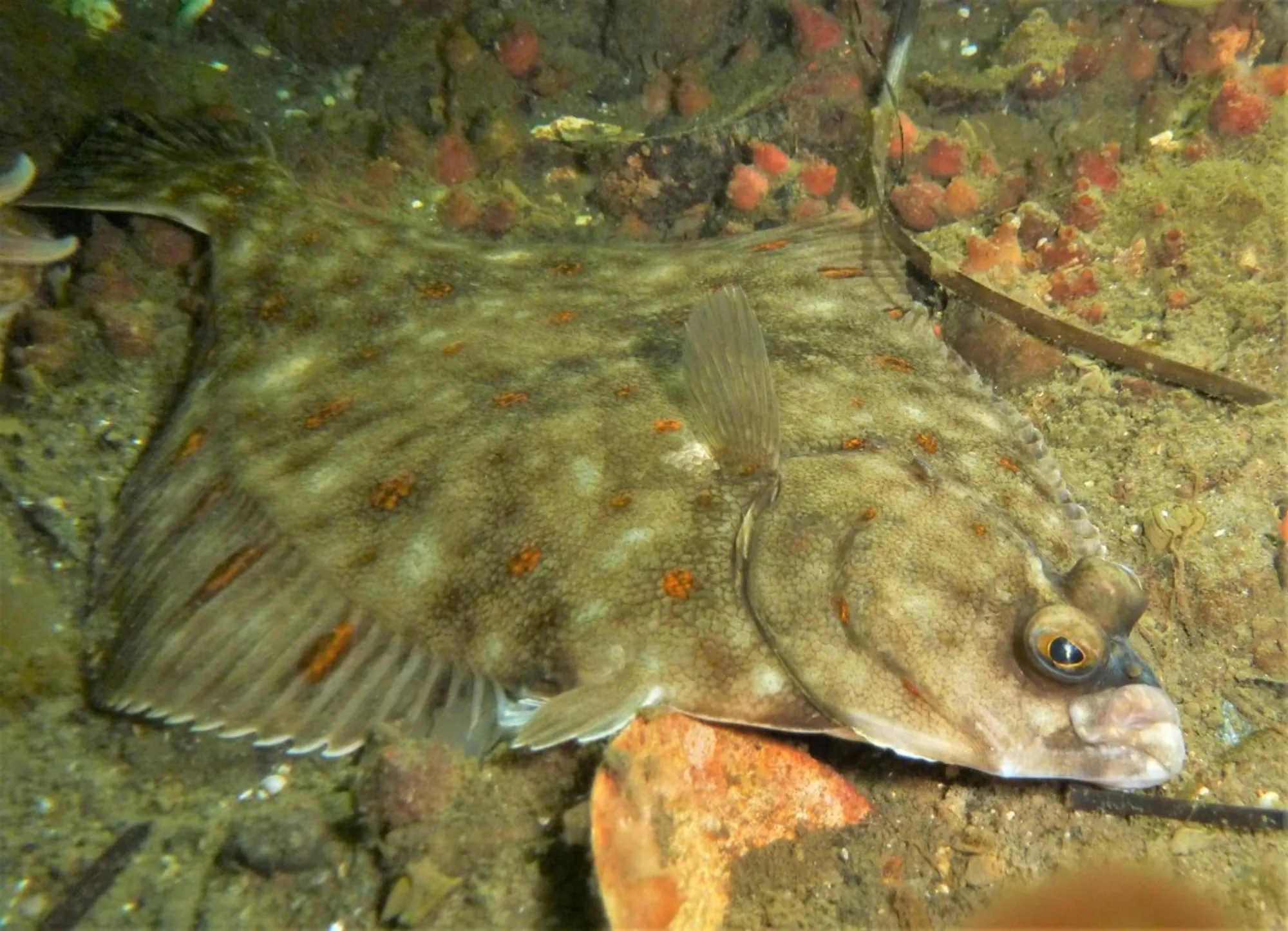
Orange spots give the Plaice away against its dark green to dark brown upper side, even when it changes colour to match its surroundings. This marine flatfish has a smooth skin, an oval outline as an adult and both eyes on the right side of its body. Its underside is pearly white, and individuals have been recorded at up to 78 cm long and 5.7 kg. Plaice live on sandy and muddy seabeds across the European shelf, usually at depths of 10 to 200 m. Their range extends from the Barents Sea to the Iberian peninsula, and includes waters around Iceland and the Faroe Islands. Adults generally favour deeper water, while young fish live in shallows such as estuaries and sandy coasts.
During the day, plaice tend to bury themselves in sediment and stay still for long periods, avoiding predators and lying in wait for prey. At night they become active and eat worms, crustaceans and bivalves, while young plaice between 1 and 2 years old mainly eat shrimps. In the North Sea, the main spawning grounds lie in the Southern Bight and the eastern English Channel, with spawning taking place from December to May. After hatching, the young drift in the plankton before settling on sandy beaches, using the tides to help them reach suitable habitat. Juveniles spend time in shallow intertidal areas before moving into deeper water, and most do not return after their first migration. Plaice are caught in mixed flatfish and other groundfish fisheries, although fishing pressure has fallen after catches exceeded management advice for several stocks in the 1980s and 1990s.
Written from the English Wikipedia article European plaice (CC BY-SA 4.0).
- Records
- 41,134
- Countries
- 10
No atlas park has a record of the Plaice in or around it yet.
These are open occurrence records, so they show where people looked for and recorded the Plaice as much as where it lives. Cells are up to 25 km across, and every location is generalised to its cell.
Generalised encounter areas, not exact locations. Each shape is a grid cell coloured by how likely the species is there.
- Very likelyNetherlands25 km zone · high confidence · 27055 records · updated 80 days ago
- Very likelyUnited Kingdom25 km zone · high confidence · 4056 records · updated 80 days ago
- Very likelySweden25 km zone · high confidence · 3568 records · updated 80 days ago
- Very likelyFrance25 km zone · high confidence · 1942 records · updated 80 days ago
- Very likelyNorway25 km zone · medium confidence · 1629 records · updated 80 days ago
- Very likelyGermany25 km zone · medium confidence · 1135 records · updated 80 days ago
- Very likelyBelgium25 km zone · high confidence · 699 records · updated 80 days ago
- Very likelyDenmark25 km zone · medium confidence · 698 records · updated 80 days ago
- Very likelyIreland25 km zone · high confidence · 240 records · updated 80 days ago
- Very likelyIsle of Man25 km zone · high confidence · 112 records · updated 80 days ago
Conservation status not assessed here yet, so every location is generalised to its grid cell.