Five-lined Skink
Plestiodon fasciatus
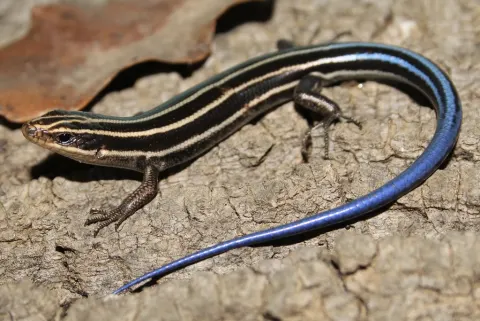
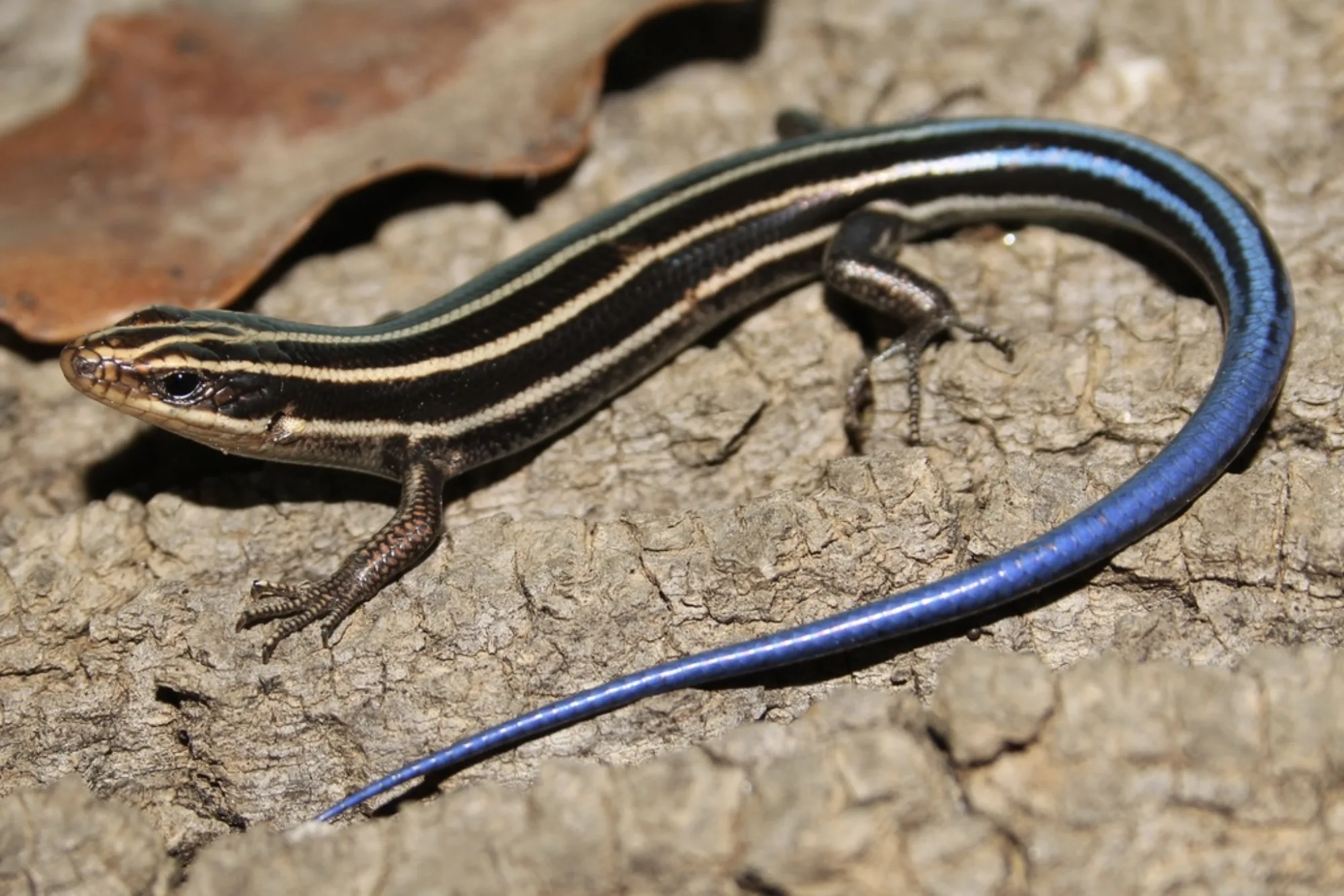
A flash of blue may reveal a young Five-lined Skink among the leaves and rocks. This small to medium-sized North American lizard reaches 12.5 to 21.5 centimetres in total length, tail included. Youngsters are dark brown to black, with five white to yellowish stripes and a bright blue tail. With age, the blue fades, the stripes may disappear and the body often becomes brownish. Females are more likely than males to keep their blue tail colour as they grow older. Similar skinks share parts of its range and can be difficult to tell apart.
The species reaches southern Ontario, Michigan and eastern New York in the north, and is especially abundant on the southeastern United States coastal plain and along the Gulf Coast. A ground-dweller, it favours moist hardwood areas near permanent water, with places to bask. At the northern edge of its range, it also lives in broken, rocky terrain. It is rarely seen in winter and the surrounding months. Males defend territories against other males, while tolerating females and juveniles. Skinks make short trips in search of food, chiefly spiders, crickets, beetles and other insects, though they have also been reported eating small vertebrates.
A female lays fifteen to eighteen eggs in a sheltered cavity, often choosing large, moderately decayed logs and moist soil. They typically brood the eggs and defend them against smaller predators; the young leave the nest a day or two after hatching. Snakes, birds, mammals and domestic cats prey on these skinks. To escape, a skink may shed its tail and run for shelter while the detached tail twitches. Removal of woody debris can also affect skinks in their northern habitats.
Written from the English Wikipedia article Plestiodon fasciatus (CC BY-SA 4.0).
- Records
- 2,856
- Countries
- 2
- Atlas places
- 2
These are open occurrence records, so they show where people looked for and recorded the Five-lined Skink as much as where it lives. Cells are up to 25 km across, and every location is generalised to its cell.
Generalised encounter areas, not exact locations. Each shape is a grid cell coloured by how likely the species is there.
- Very likelyUnited States25 km zone · medium confidence · 2702 records · updated 80 days ago
- Very likelyCanada25 km zone · medium confidence · 154 records · updated 80 days ago
Conservation status not assessed here yet, so every location is generalised to its grid cell.