Snow Bunting
Plectrophenax nivalis
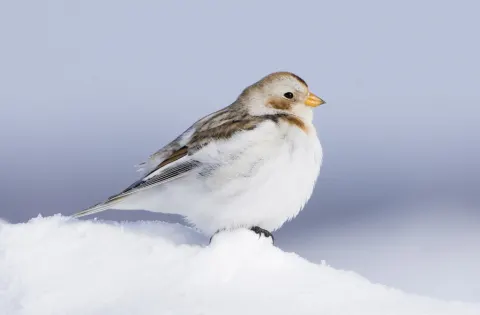
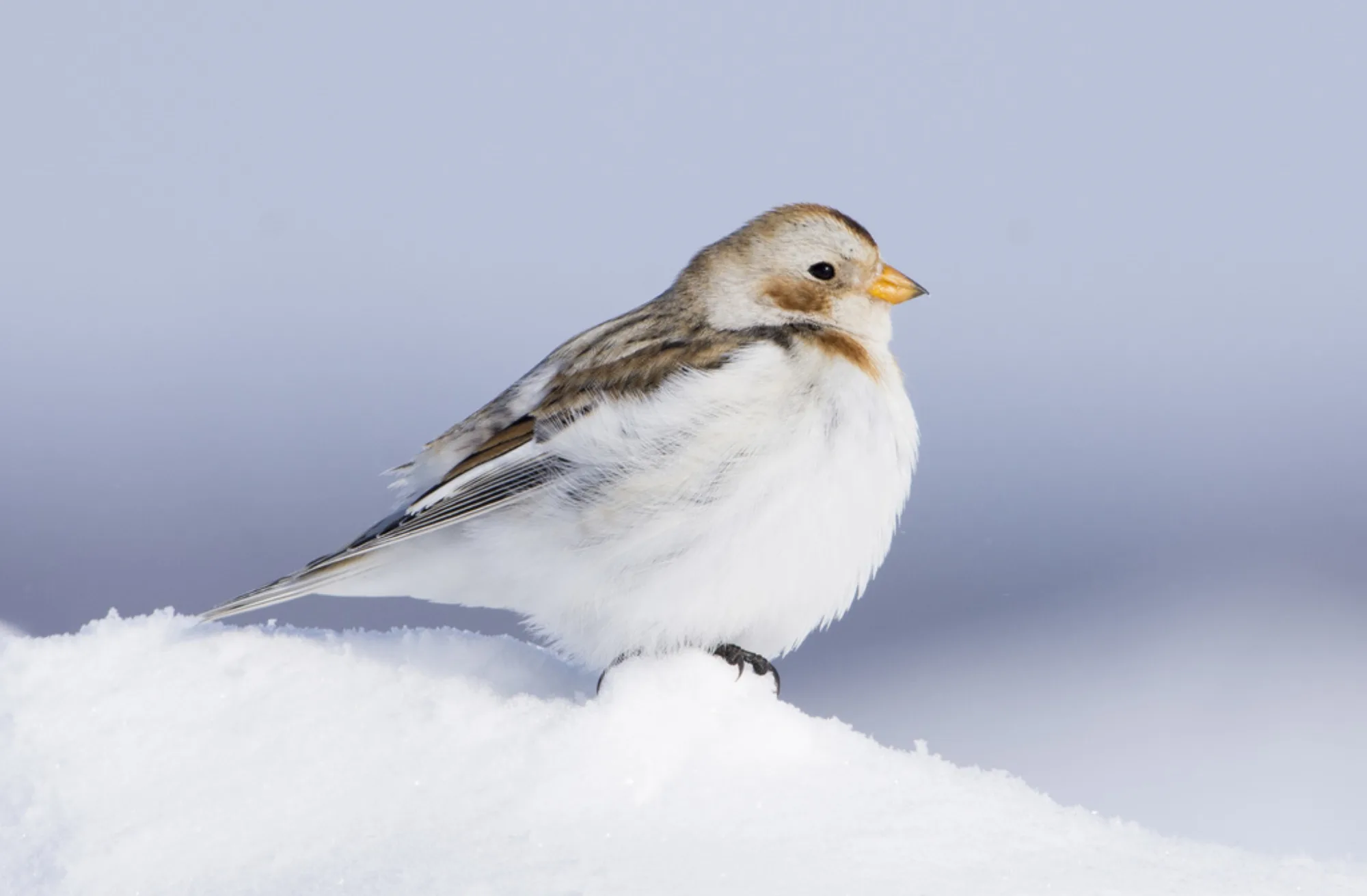
On Arctic tundra, the Snow Bunting moves across the ground on foot, walking, running and sometimes hopping. This long-winged bunting has white underparts and black and white on its back and wings. In the breeding season, males are white with black backs and wingtips, while females have brown fringes on the black feathers of the back. Both sexes develop broad orangey-brown fringes on their back feathers in winter. Listen for a rippling whistle, or a short, loud warble from a male perched or displaying in flight.
Snow Buntings breed around the Arctic and in isolated mountain populations farther south, including Scotland's Cairngorms. In winter they move into northern temperate regions, visiting open farmland, bare fields and lakeshores. They migrate in small flocks, while winter gatherings in open fields can number in the hundreds. From autumn to spring they gather weed and grass seeds, sometimes foraging in snow; in summer they also eat invertebrates. Nestlings receive only invertebrates, and adults sometimes turn over rocks to catch basking spiders.
For breeding, the birds seek rocky ground and places with vegetation, including wet sedge meadows. Nests are tucked into cavities that shelter young from predators, though cold conditions in rock fissures can threaten embryos. The male brings food to the incubating female, allowing her to maintain the nest temperature. Blue-green eggs with brown spots hatch after 12 to 13 days, and the young can fly a further 12 to 14 days later. Warmer springs may bring breeding out of step with peak food supplies, reducing hatching success, while rising temperatures could also bring new competitors north.
Written from the English Wikipedia article Snow bunting (CC BY-SA 4.0).
- Records
- 288,530
- Countries
- 11
- Atlas places
- 2
These are open occurrence records, so they show where people looked for and recorded the Snow Bunting as much as where it lives. Cells are up to 25 km across, and every location is generalised to its cell.
Generalised encounter areas, not exact locations. Each shape is a grid cell coloured by how likely the species is there.
- Very likelyCanada25 km zone · high confidence · 128930 records · updated 80 days ago
- Very likelyUnited States25 km zone · high confidence · 121738 records · updated 80 days ago
- Very likelyNorway25 km zone · high confidence · 13761 records · updated 80 days ago
- Very likelyIceland25 km zone · high confidence · 7179 records · updated 80 days ago
- Very likelyUnited Kingdom25 km zone · high confidence · 4992 records · updated 80 days ago
- Very likelySvalbard & Jan Mayen25 km zone · high confidence · 4717 records · updated 80 days ago
- Very likelyFinland25 km zone · high confidence · 3041 records · updated 80 days ago
- Very likelySweden25 km zone · high confidence · 2311 records · updated 80 days ago
- Very likelyNetherlands25 km zone · high confidence · 1176 records · updated 80 days ago
- Very likelyGermany25 km zone · high confidence · 685 records · updated 80 days ago
Conservation status not assessed here yet, so every location is generalised to its grid cell.