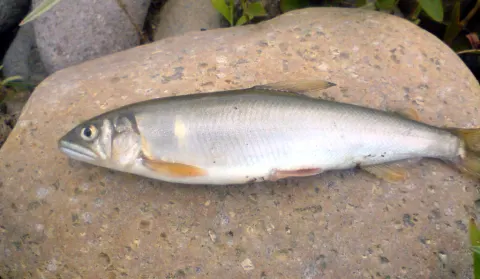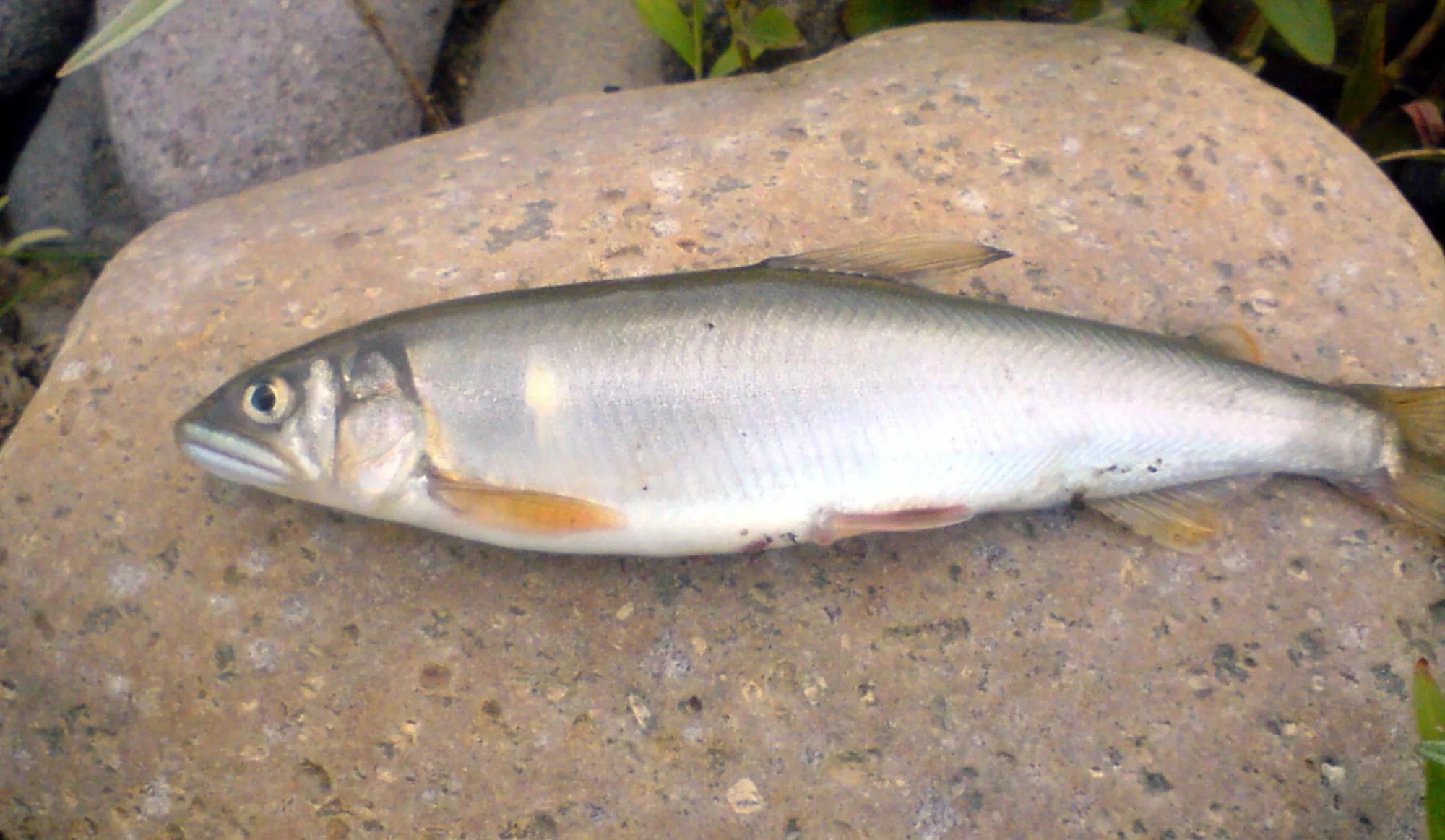
Ayu Sweetfish
Plecoglossus altivelis
Native to East Asia, the Ayu Sweetfish is a bony fish that moves between coastal waters, lakes and rivers. Along the northwestern Pacific, its range extends from Japan's Hokkaidō coast southwards, taking in the Korean Peninsula and the coasts of China, Hong Kong and northern Vietnam. A typical maximum length is about 30 cm, though fish confined to freshwater are considerably smaller. In Japan, some populations are landlocked in lakes, including Lake Biwa, while others are stocked in reservoirs.
Ayu eat algae, crustaceans, insects, sponges and worms, scraping algae from rocks with their teeth. Adults usually defend feeding territories, although fish confined to lakes and their streams form schools. Most populations breed in the lower reaches of rivers in autumn, depositing eggs in small gravel pits. After hatching, the larvae drift downriver to the sea and spend the winter near the coast. In spring, the young typically return to rivers at about 6 cm long, reaching 15 to 30 cm by summer. Some breed and die after one year, while others return to the ocean and may breed up to three times. In Japan, some spend their entire lives in freshwater, moving from lakes into streams to breed in spring, summer or autumn. Their larvae mostly remain in freshwater, though some are carried to the sea and join the populations that move between sea and rivers.
Pollution wiped out Taiwan's original wild populations in 1968; fish were reintroduced from Japan in the 1990s. Ayu are also caught commercially and by anglers, and captive juveniles are released into rivers for sport fishing.
Written from the English Wikipedia article Ayu sweetfish (CC BY-SA 4.0).
- Records
- 86
- Countries
- 3
No atlas park has a record of the Ayu Sweetfish in or around it yet.
These are open occurrence records, so they show where people looked for and recorded the Ayu Sweetfish as much as where it lives. Cells are up to 25 km across, and every location is generalised to its cell.
Generalised encounter areas, not exact locations. Each shape is a grid cell coloured by how likely the species is there.
- Very likelyJapan25 km zone · medium confidence · 46 records · updated 80 days ago
- Very likelySouth Korea25 km zone · medium confidence · 32 records · updated 80 days ago
- Very likelyTaiwan25 km zone · medium confidence · 8 records · updated 80 days ago
Conservation status not assessed here yet, so every location is generalised to its grid cell.