Eastern Rosella
Platycercus eximius
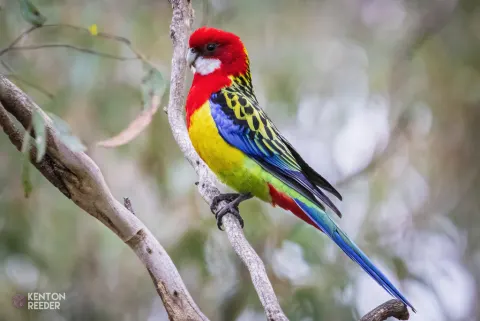
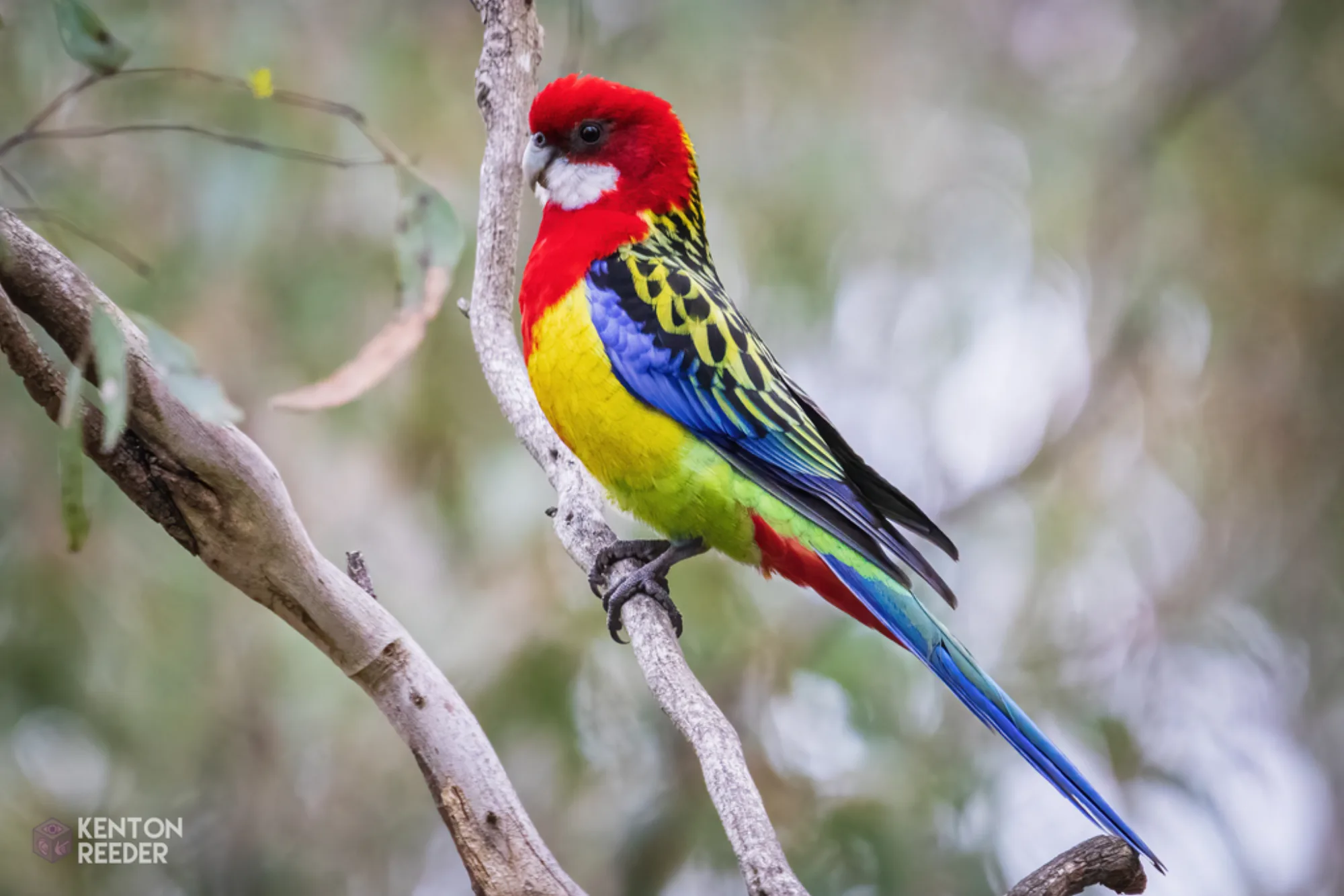
A red head and white cheek patches make the Eastern Rosella a striking parrot to look for in south-eastern Australia, where it is native. About 30 cm long, it has a white beak, a red upper breast and a yellow lower breast that fades to pale green across the belly. Its dark back and shoulder feathers have yellowish and greenish edges, creating a scalloped appearance. The wings and outer tail feathers are bluish, while the tail is dark green. Females are generally duller than males, and young birds are duller still.
The species is also established in New Zealand, across much of the North Island and in the hills around Dunedin on the South Island. It generally prefers lowlands, open country and farmland. In New Zealand, look for it around the edges and remnants of open forest, shelter belts and orchards, as well as in gardens and on golf courses. It feeds on grass seeds, buds, flowers, nectar and fruit, along with insects and their larvae.
In Australia, breeding usually takes place from August to February, with nests in tree hollows or nest boxes and occasionally in cavities in buildings. Females lay an average of 5 to 6 eggs, and the chicks leave the nest about a month after hatching. Eastern Rosellas can defend their nesting territory fiercely, sometimes destroying the eggs of others nesting too close. Around Dunedin, past population declines were attributed to capture for the pet trade and accidental poisoning by strychnine intended for rabbits. In urban areas, disturbance from other cavity-nesting birds can reduce nest visits, contributing to predation and nest failure.
Written from the English Wikipedia article Eastern rosella (CC BY-SA 4.0).
- Records
- 395,146
- Countries
- 2
- Atlas places
- 4
These are open occurrence records, so they show where people looked for and recorded the Eastern Rosella as much as where it lives. Cells are up to 25 km across, and every location is generalised to its cell.
Generalised encounter areas, not exact locations. Each shape is a grid cell coloured by how likely the species is there.
- Very likelyAustralia25 km zone · high confidence · 361351 records · updated 80 days ago
- Very likelyNew Zealand25 km zone · high confidence · 33795 records · updated 80 days ago
Conservation status not assessed here yet, so every location is generalised to its grid cell.