Indus River Dolphin
Platanista minor
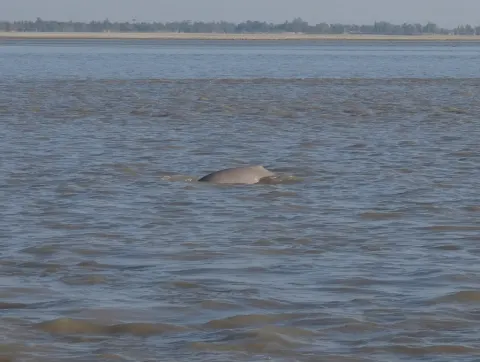
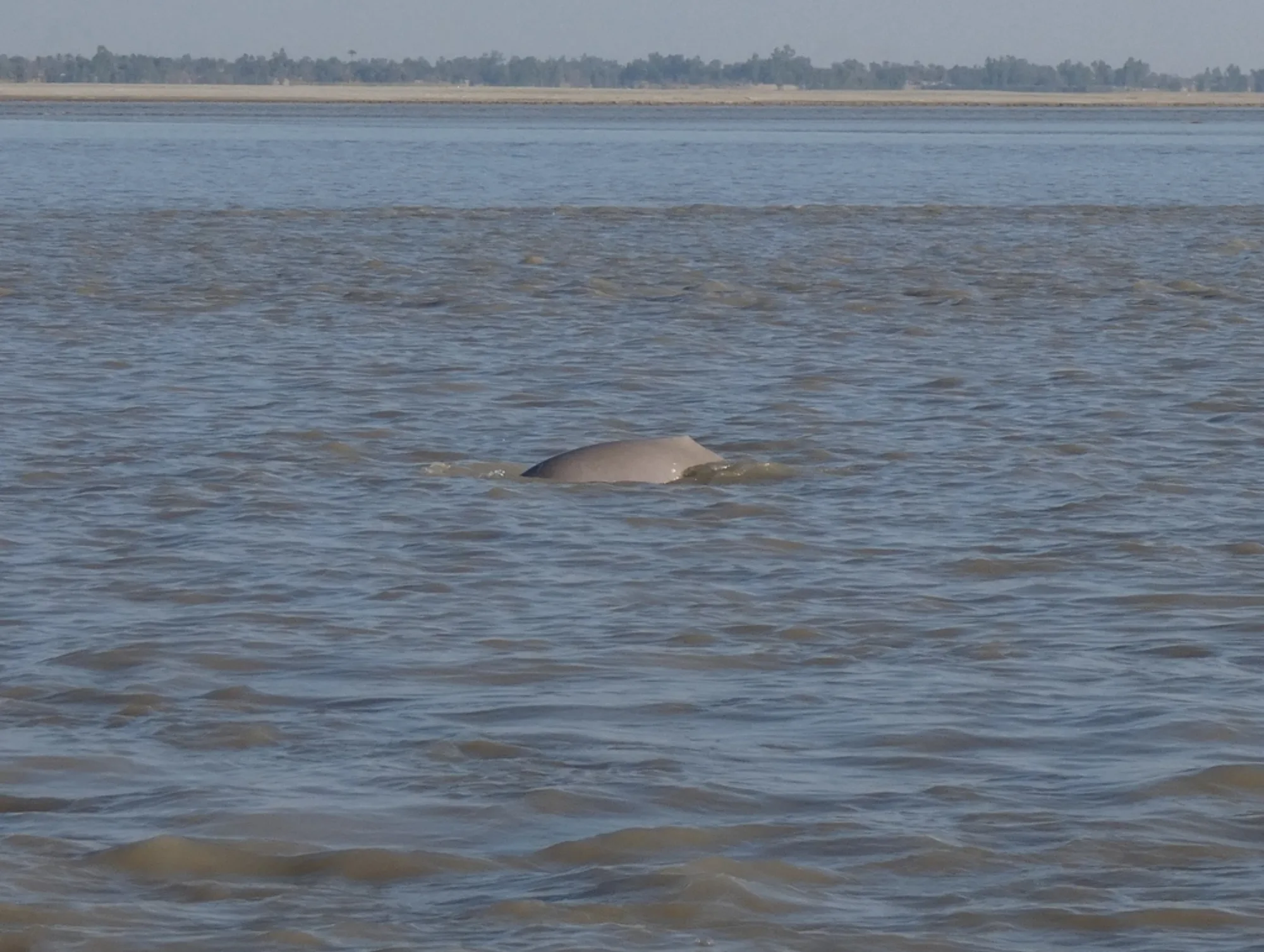
A long, pointed snout and a stocky, brownish body help distinguish the Indus River Dolphin, Platanista minor. Its teeth remain visible even when its mouth is shut, and its snout thickens towards the tip. Instead of a dorsal fin, it has a small triangular lump, while its flippers and tail are large and thin in proportion to its body. Males measure about 2 to 2.2 m, and females about 2.4 to 2.6 m. Effectively blind, the dolphin navigates and hunts using echolocation, although it may still be able to sense the direction and intensity of light.
This freshwater dolphin lives in the Indus basin of Pakistan and northwestern India. In Pakistan, five small populations in the Indus River are separated by irrigation barrages. A very small, isolated population also lives in India's Beas River, with a remnant population recorded in the Beas and Harike Wetland in Punjab. Its range in the Indus River system has contracted from about 3,400 km to about 690 km, and it is no longer present in the tributaries. During the dry season, it is thought to swim on its side to move efficiently through shallow water.
Fishing nets can injure or kill dolphins, and extensive fishing in the Beas also reduces their available prey. Some dolphins are caught for their oil and meat, which are used for purposes including catfish bait. Irrigation has lowered water levels, while industrial and agricultural pollution may have contributed to population decline. Dams divide populations and restrict the gene pool available for breeding.
Written from the English Wikipedia article Indus river dolphin (CC BY-SA 4.0).
- Records
- 0
- Countries
- 1
No atlas park has a record of the Indus River Dolphin in or around it yet.
These are open occurrence records, so they show where people looked for and recorded the Indus River Dolphin as much as where it lives. Cells are up to 25 km across, and every location is generalised to its cell.
Generalised encounter areas, not exact locations. Each shape is a grid cell coloured by how likely the species is there.
- Very likelyPakistan25 km zone · low confidence · 0 records · updated 81 days ago
Conservation status not assessed here yet, so every location is generalised to its grid cell.