Ganges River Dolphin
Platanista gangetica
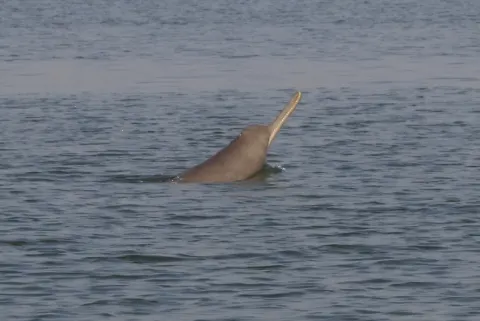
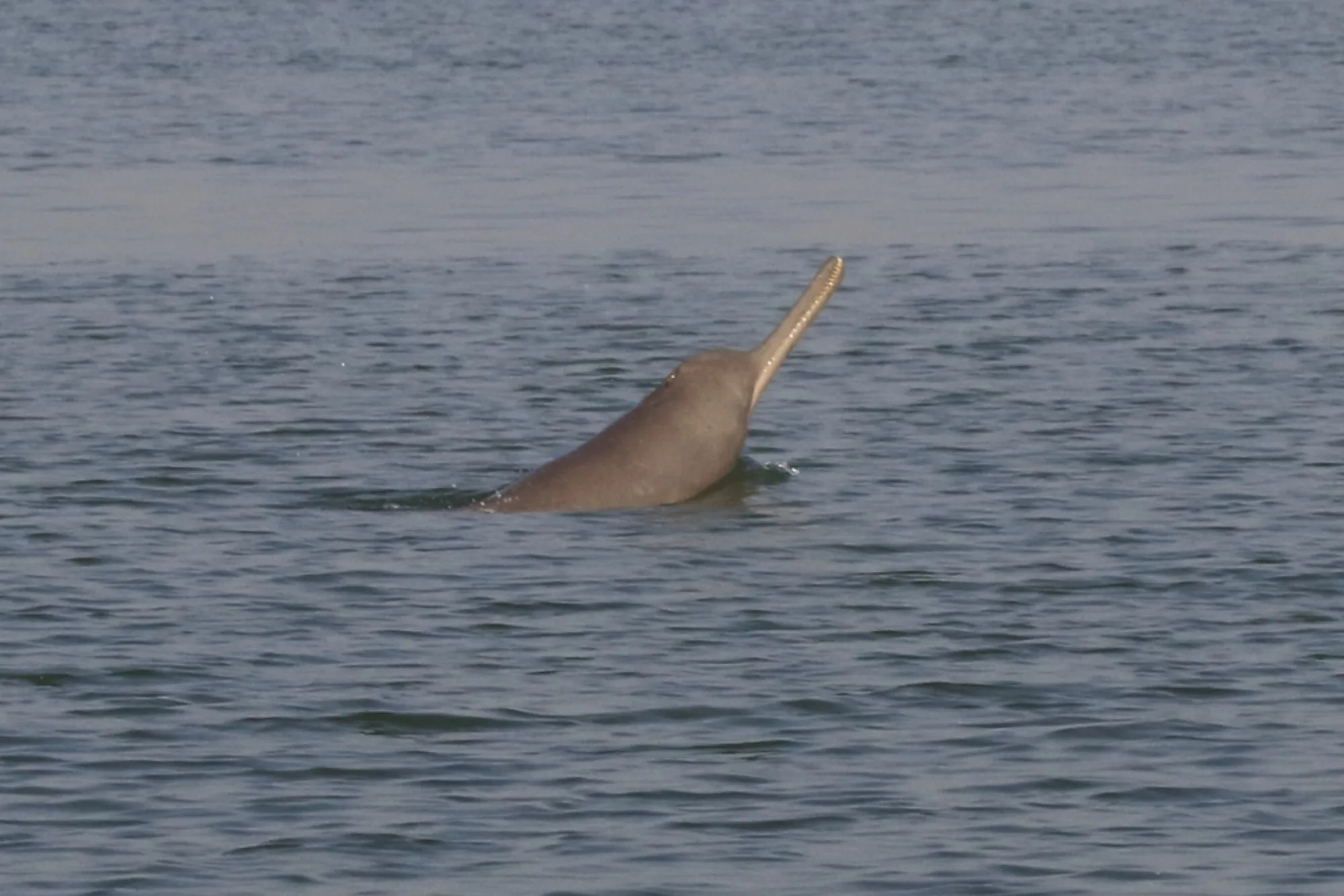
A long, slender snout and a stocky outline distinguish the Ganges River Dolphin, a freshwater dolphin found in South Asia. Its rounded belly and rectangular, ridge-like dorsal fin add to that sturdy appearance, while its flippers and tail are broad. Its colour ranges from tan and chocolate brown to dark grey or light blue, with females generally larger than males. The dolphin usually measures 2.2 to 2.6 metres long and has small eyes suited to a life in cloudy water.
In India and Bangladesh, it lives in the Ganges-Brahmaputra-Meghna system and the Karnaphuli-Sangu system; in Nepal, it inhabits the Karnali and Sapta Koshi rivers. It favours deep pools and currents below river junctions and sharp bends, and around islands in midstream. Usually seen alone or in pairs, it rarely breaches and tends to be shy around boats, making it difficult to observe. With poor eyesight, it uses echolocation to navigate and find prey, producing sounds that include clicks, bursts and twitters. Its varied diet includes prawns, carp, mahseer, sharks, birds and turtles. There is no fixed mating season, and a calf stays with its mother for one year after a pregnancy of 8 to 12 months.
Reduced river flows in the dry season fragment its habitat, while dams and hydroelectric plants have also contributed to the loss of range and population. Dolphins can become entangled in fishing gear, and hunters take them for their meat and oil. River pollution, boat traffic and noise add to the pressures, while climate change may affect the movement of water through its habitat.
Written from the English Wikipedia article Ganges river dolphin (CC BY-SA 4.0).
- Records
- 7
- Countries
- 3
No atlas park has a record of the Ganges River Dolphin in or around it yet.
These are open occurrence records, so they show where people looked for and recorded the Ganges River Dolphin as much as where it lives. Cells are up to 25 km across, and every location is generalised to its cell.
Generalised encounter areas, not exact locations. Each shape is a grid cell coloured by how likely the species is there.
- Very likelyBangladesh25 km zone · medium confidence · 6 records · updated 80 days ago
- LikelyIndia25 km zone · medium confidence · 1 record · updated 80 days ago
- LikelyNepal25 km zone · low confidence · 0 records · updated 80 days ago
Conservation status not assessed here yet, so every location is generalised to its grid cell.