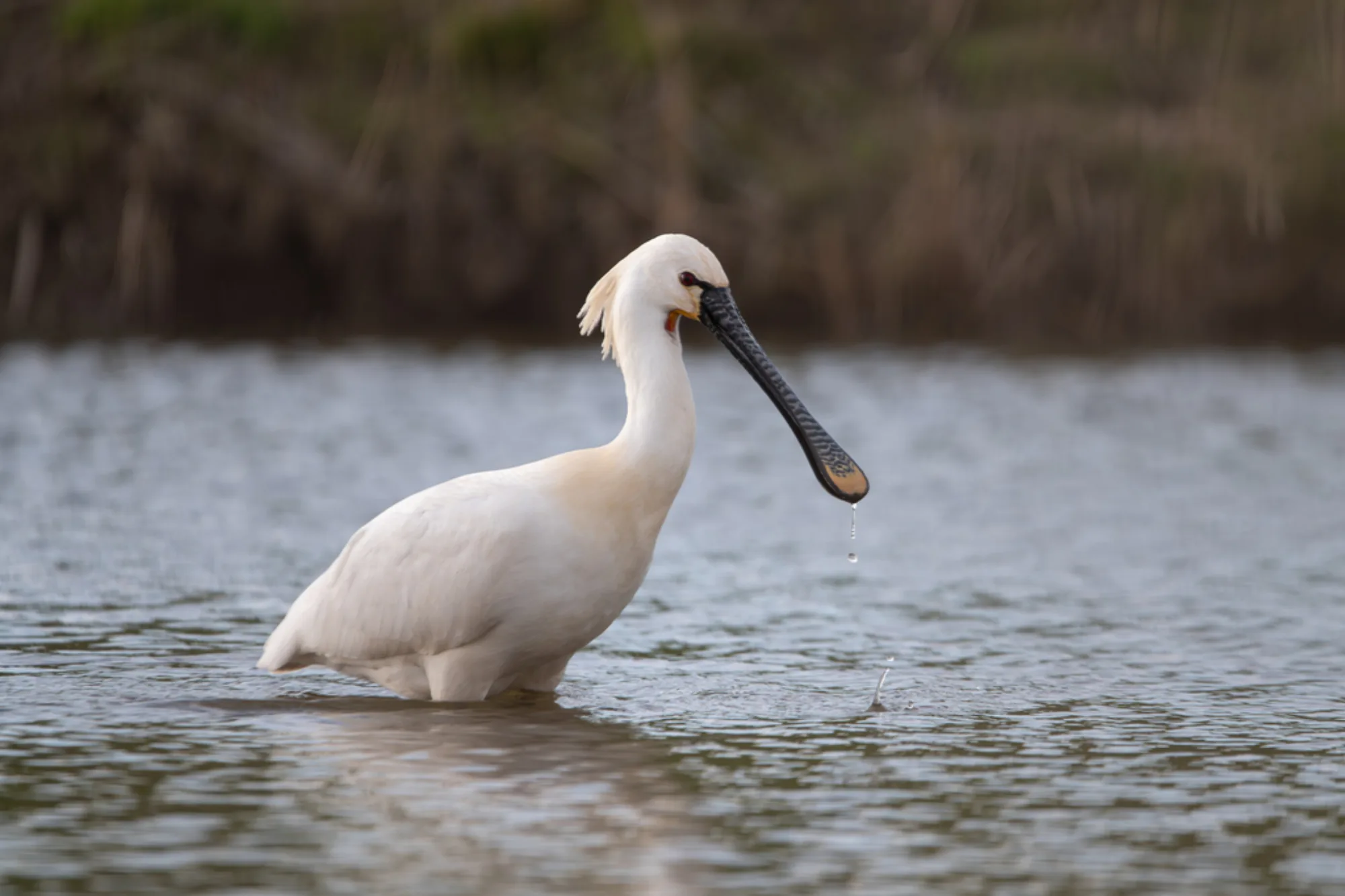
Eurasian Spoonbill
Platalea leucorodia
With its long, spoon-shaped bill and white plumage, the Eurasian Spoonbill is a distinctive wading bird of Europe, Asia and Africa. In breeding plumage it has dark legs, a black bill tipped with yellow, a yellow breast patch and a crest. Outside the breeding season it lacks the crest and breast patch, while young birds have pale bills and black-tipped primary flight feathers. Look for its outstretched neck in flight, or listen for bill snapping and occasional grunts and trumpet-like calls at a colony.
Spoonbills favour broad, shallow wetlands with muddy or fine sandy beds, including marshes, rivers, lakes, floodplains and mangrove swamps. They use fresh, brackish and saline water, and may visit sheltered estuaries and coastal lagoons in winter. Northern breeders generally travel south for winter, while birds breeding in warmer parts of Asia, Africa and the Iberian Peninsula tend to stay put or move locally. Migration usually takes place in flocks, with birds stopping along the way.
Most activity comes in the morning and evening, though coastal feeding follows the tides. Sweeping their bills from side to side, spoonbills catch small fish and shrimps; their diet also includes aquatic insects, molluscs, worms, frogs and other small animals. They usually breed in colonies, building stick and vegetation platforms on islands or among reeds, bushes and trees. Drainage and pollution damage or remove habitat, and the loss of reed swamps is especially harmful. Breeding colonies are vulnerable to disturbance and predators such as red foxes.
Written from the English Wikipedia article Eurasian spoonbill (CC BY-SA 4.0).
- Records
- 379,914
- Countries
- 26
- Atlas places
- 1
These are open occurrence records, so they show where people looked for and recorded the Eurasian Spoonbill as much as where it lives. Cells are up to 25 km across, and every location is generalised to its cell.
Generalised encounter areas, not exact locations. Each shape is a grid cell coloured by how likely the species is there.
- Very likelySpain25 km zone · high confidence · 97245 records · updated 80 days ago
- Very likelyFrance25 km zone · high confidence · 67751 records · updated 80 days ago
- Very likelyBelgium25 km zone · high confidence · 51580 records · updated 80 days ago
- Very likelyPortugal25 km zone · high confidence · 43286 records · updated 80 days ago
- Very likelyNetherlands25 km zone · high confidence · 34431 records · updated 80 days ago
- Very likelyIndia25 km zone · high confidence · 27375 records · updated 80 days ago
- Very likelyUnited Kingdom25 km zone · high confidence · 22253 records · updated 80 days ago
- Very likelyIsrael25 km zone · high confidence · 7767 records · updated 80 days ago
- Very likelyTaiwan25 km zone · high confidence · 7681 records · updated 80 days ago
- Very likelyHungary25 km zone · high confidence · 3027 records · updated 80 days ago
Conservation status not assessed here yet, so every location is generalised to its grid cell.