Hooded Pitohui
Pitohui dichrous
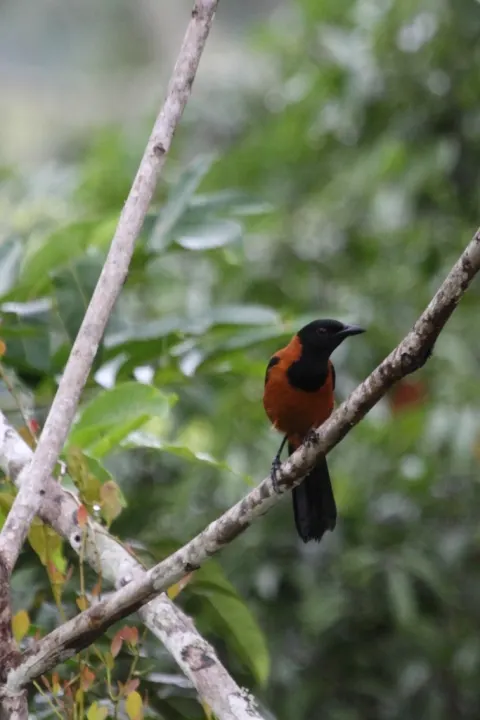
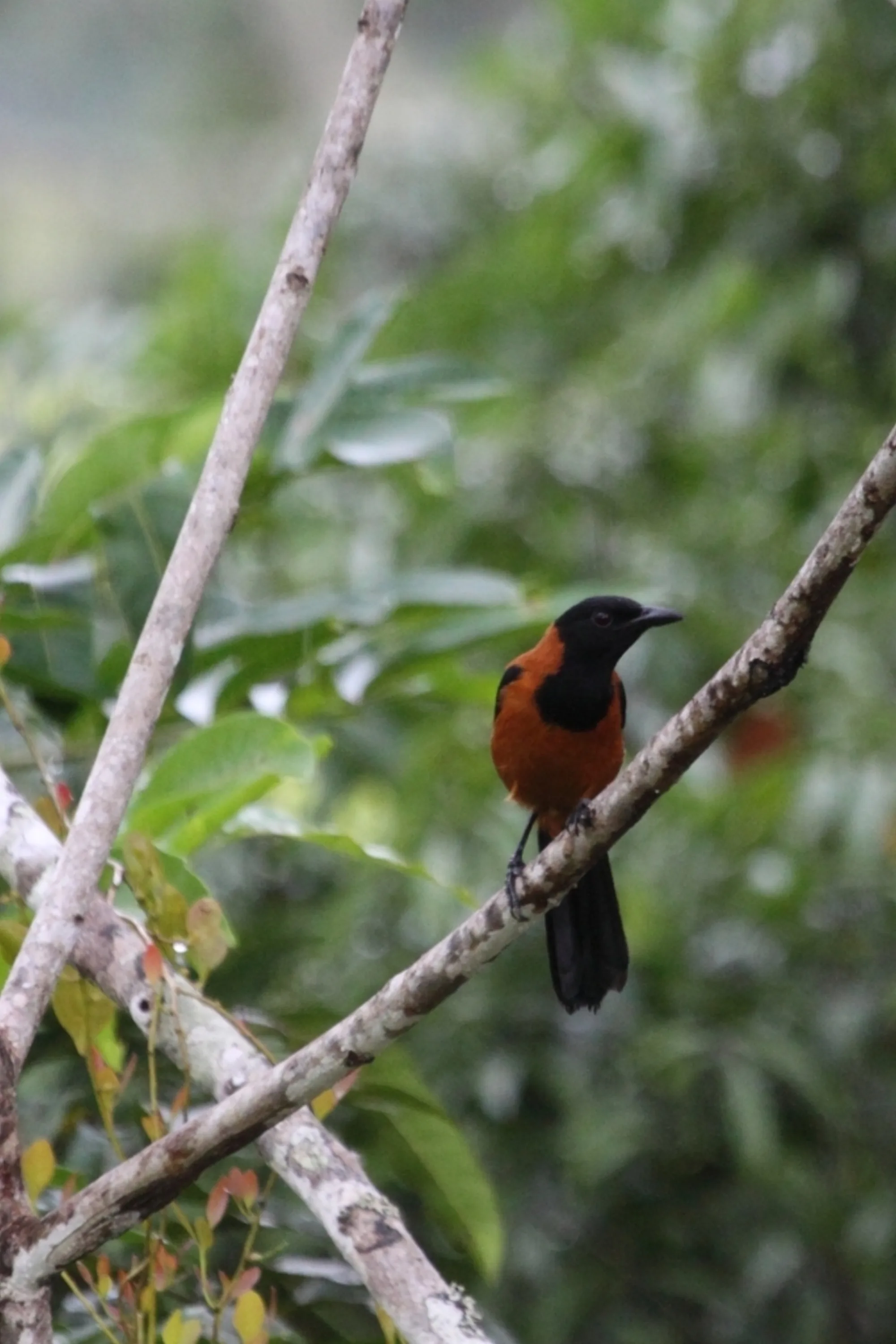
Black and reddish brown, the Hooded Pitohui is a medium-sized songbird of New Guinea's forests. Its head, throat, upper breast, upper wings and tail are black, while the rest of its plumage is reddish brown. Males and females look alike, and the bird measures 22 to 23 cm in length. Its skin and feathers contain toxins thought to come from its diet, although toxicity varies between individuals and places. Local hunters know the bird is poisonous and avoid it.
The species occurs widely across the main island of New Guinea and on nearby Yapen. Look for it in rainforest, at forest edges and in secondary growth, and sometimes in mangroves. Hills and low mountains at 350 to 1,700 m are its usual haunts, though it can also occur locally at elevations as low as sea level and as high as 2,000 m. Its varied song consists of three to seven whistles, sometimes slurring up or down with hesitant pauses. Family groups forage from the forest floor to the canopy, eating mainly fruit, especially figs, as well as grass seeds and invertebrates. The birds regularly join mixed-species feeding flocks and sometimes lead them, though this behaviour varies across their range.
Nests with eggs have been found from October to February. One described nest hung from slender branches, with a cup made of vine tendrils and a lining of finer vines. More than two birds have been seen defending a nest and feeding young, suggesting that family members help raise the brood. A study found fewer birds in disturbed lowland farmland than in undisturbed forest, although their numbers rose in disturbed areas at higher mountain elevations.
Written from the English Wikipedia article Hooded pitohui (CC BY-SA 4.0).
- Records
- 2,756
- Countries
- 2
No atlas park has a record of the Hooded Pitohui in or around it yet.
These are open occurrence records, so they show where people looked for and recorded the Hooded Pitohui as much as where it lives. Cells are up to 25 km across, and every location is generalised to its cell.
Generalised encounter areas, not exact locations. Each shape is a grid cell coloured by how likely the species is there.
- Very likelyPapua New Guinea25 km zone · high confidence · 2383 records · updated 80 days ago
- Very likelyIndonesia25 km zone · high confidence · 373 records · updated 80 days ago
Conservation status not assessed here yet, so every location is generalised to its grid cell.