Scarlet Tanager
Piranga olivacea
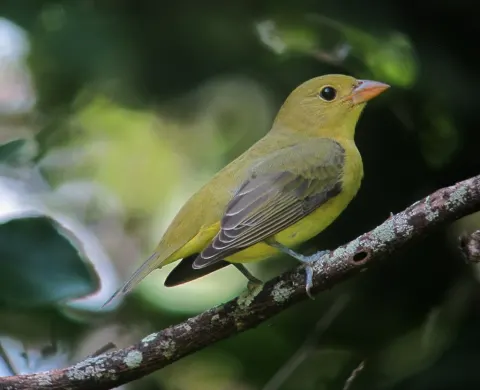
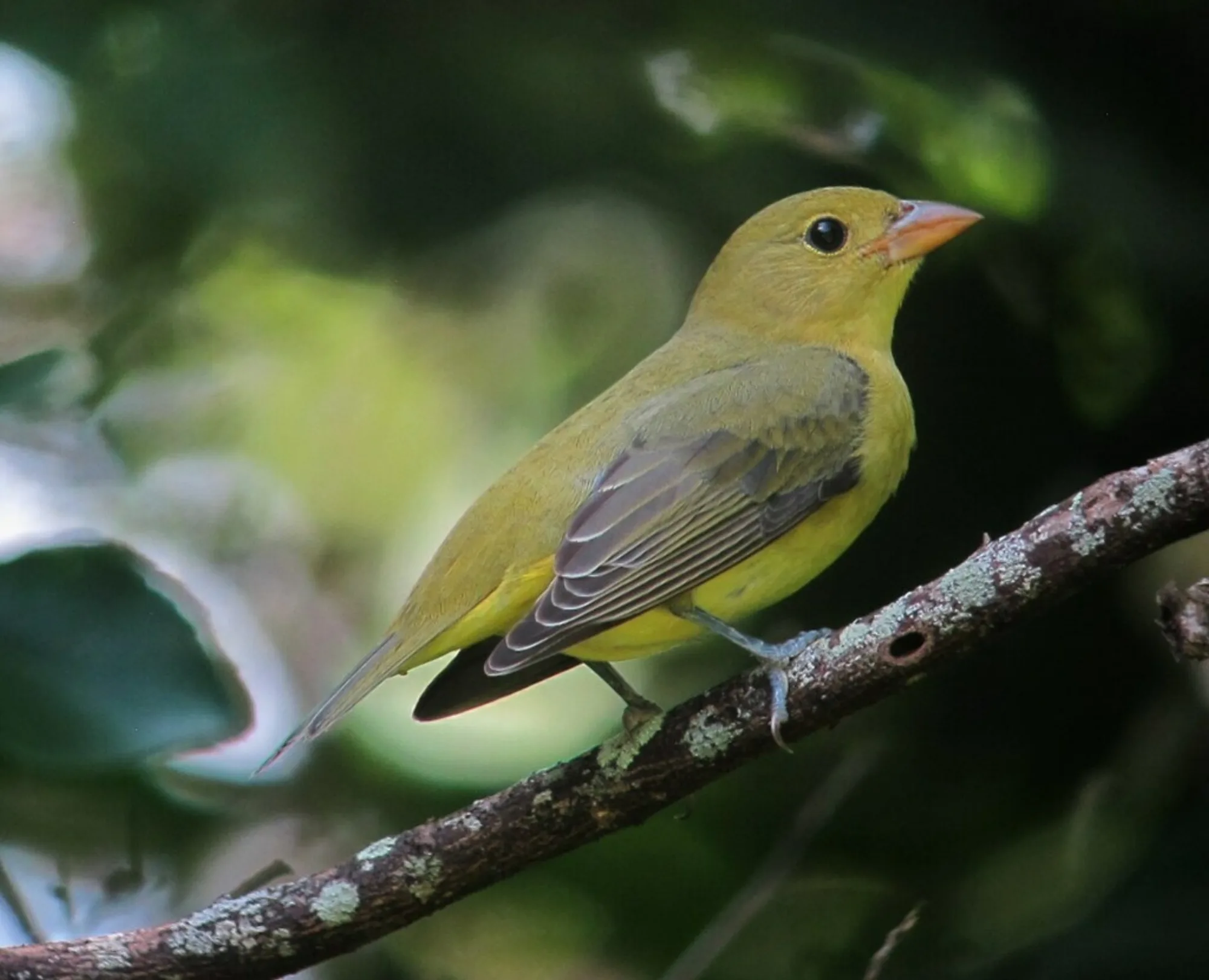
In the breeding season, a male Scarlet Tanager stands out in crimson red, with black wings and tail. Females are olive above and yellowish below, while males in winter resemble females but retain darker wings and tails. This medium-sized American songbird measures 16 to 19 cm long. Its song recalls a hoarser American robin, and its distinctive call sounds like chip-burr or chip-churr.
Look for scarlet tanagers in large deciduous forests across eastern North America, especially where oaks grow. They can also occur in young woodland and occasionally among extensive shade-tree plantings in parks, suburban areas and cemeteries. They pass through Central America around April and October, wintering in mountain forests in northwestern South America, on the lower slopes of the Andes. Often hidden high in the trees, they fly out to catch insects and return to a nearby perch, though they also hunt on the forest floor. Insects make up most of their diet; they also take spiders, snails and earthworms, as well as fruit when it is plentiful.
They usually place their nests on level branches in trees, and the usual clutch contains four light blue eggs. The young leave the nest at 9 to 12 days old and can fly capably when a few weeks old. Large areas of forest offer better shelter from nest predators and brood parasitism by brown-headed cowbirds; in fragmented woodland, both threats increase. Collisions with buildings, vehicles and broadcast towers also kill scarlet tanagers, while unusual cold can leave them exposed and short of insect prey.
Written from the English Wikipedia article Scarlet tanager (CC BY-SA 4.0).
- Records
- 728,165
- Countries
- 3
- Atlas places
- 1
These are open occurrence records, so they show where people looked for and recorded the Scarlet Tanager as much as where it lives. Cells are up to 25 km across, and every location is generalised to its cell.
Generalised encounter areas, not exact locations. Each shape is a grid cell coloured by how likely the species is there.
- Very likelyUnited States25 km zone · high confidence · 665659 records · updated 81 days ago
- Very likelyCanada25 km zone · high confidence · 59645 records · updated 81 days ago
- Very likelyEcuador25 km zone · high confidence · 2861 records · updated 81 days ago
Conservation status not assessed here yet, so every location is generalised to its grid cell.