Common Pipistrelle
Pipistrellus pipistrellus
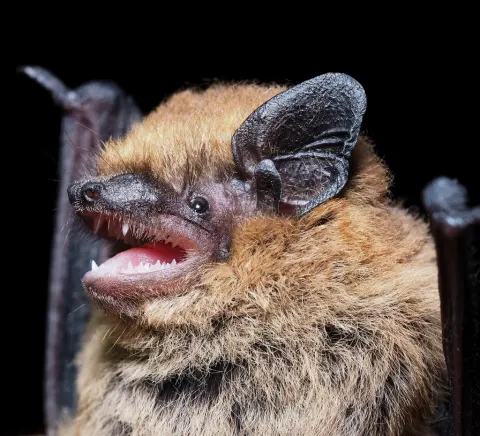
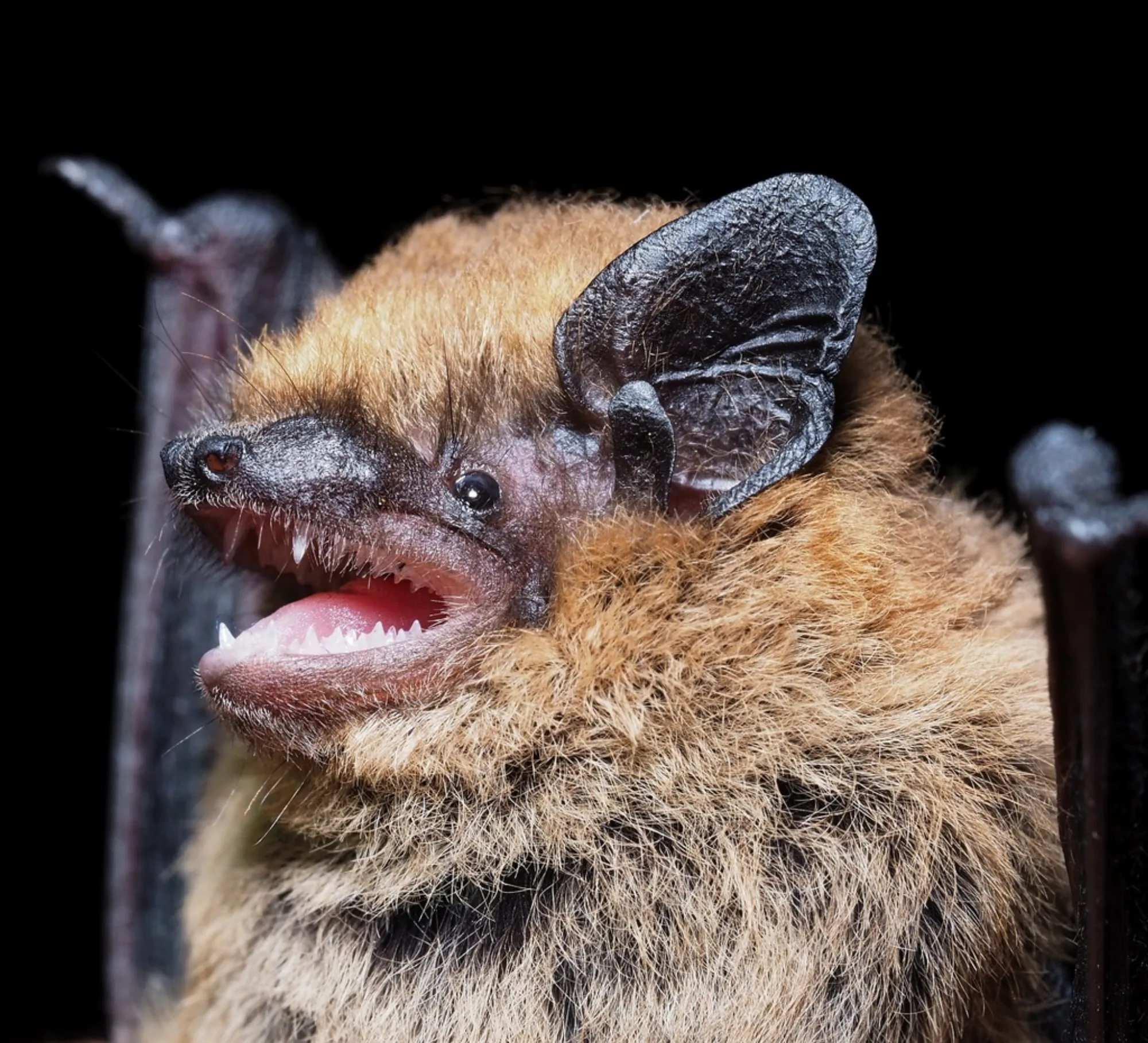
Small enough to weigh just 3.5 to 8.5 g, the Common Pipistrelle has brown fur that varies in tone and a short muzzle. Its head and body measure 3.5 to 5.2 cm, with a tail of 2.3 to 3.6 cm and a wingspan of 18 to 25 cm. It is among the most common bats in the British Isles, and occurs across North Africa, central South Asia and much of Europe, perhaps reaching Korea. Records also come from India, China and Myanmar.
Look for it around woodland and farmland, as well as in suburban areas, where females use lofts and other buildings as roosts while raising young. It favours woodland edges and isolated lines of trees when hunting. Its insect diet includes flies, caddisflies, lacewings, mayflies and moths, with mosquitoes, midges and gnats especially favoured. In Coimbra, Portugal, a colony is allowed to hunt inside the Biblioteca Joanina, helping protect manuscripts from insects that might eat the paper. Females gather in maternity colonies during pregnancy in May and June, sometimes with dozens or hundreds of bats sharing a roost. Birth usually takes place in June, and a female normally has one pup, although twins occur regularly in some populations. The young nurse through July and are weaned by August.
In the United Kingdom, the bat's decline has been linked to the loss of feeding habitat as agriculture has intensified. Sticky insect traps in Mediterranean olive groves pose another threat: bats investigating insects caught on the traps can become stuck themselves.
Written from the English Wikipedia article Common pipistrelle (CC BY-SA 4.0).
- Records
- 1,105,806
- Countries
- 38
No atlas park has a record of the Common Pipistrelle in or around it yet.
These are open occurrence records, so they show where people looked for and recorded the Common Pipistrelle as much as where it lives. Cells are up to 25 km across, and every location is generalised to its cell.
Generalised encounter areas, not exact locations. Each shape is a grid cell coloured by how likely the species is there.
- Very likelyFrance25 km zone · high confidence · 1028347 records · updated 86 days ago
- Very likelySwitzerland25 km zone · high confidence · 54175 records · updated 86 days ago
- Very likelyUnited Kingdom25 km zone · high confidence · 15827 records · updated 86 days ago
- Very likelyBelgium25 km zone · high confidence · 2095 records · updated 86 days ago
- Very likelyGermany25 km zone · high confidence · 1870 records · updated 86 days ago
- Very likelyLuxembourg25 km zone · high confidence · 745 records · updated 86 days ago
- Very likelyIsle of Man25 km zone · high confidence · 679 records · updated today
- LikelyPortugal25 km zone · high confidence · 1281 records · updated today
- LikelySpain25 km zone · high confidence · 201 records · updated today
- PossibleDenmark25 km zone · medium confidence · 232 records · updated today
Conservation status not assessed here yet, so every location is generalised to its grid cell.