Spotted Towhee
Pipilo maculatus
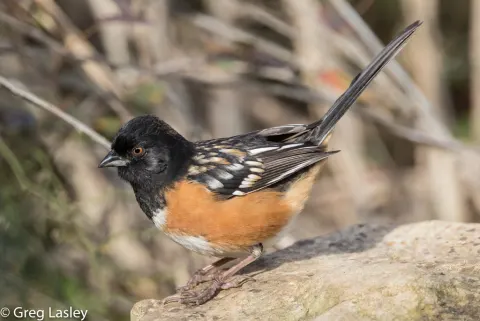
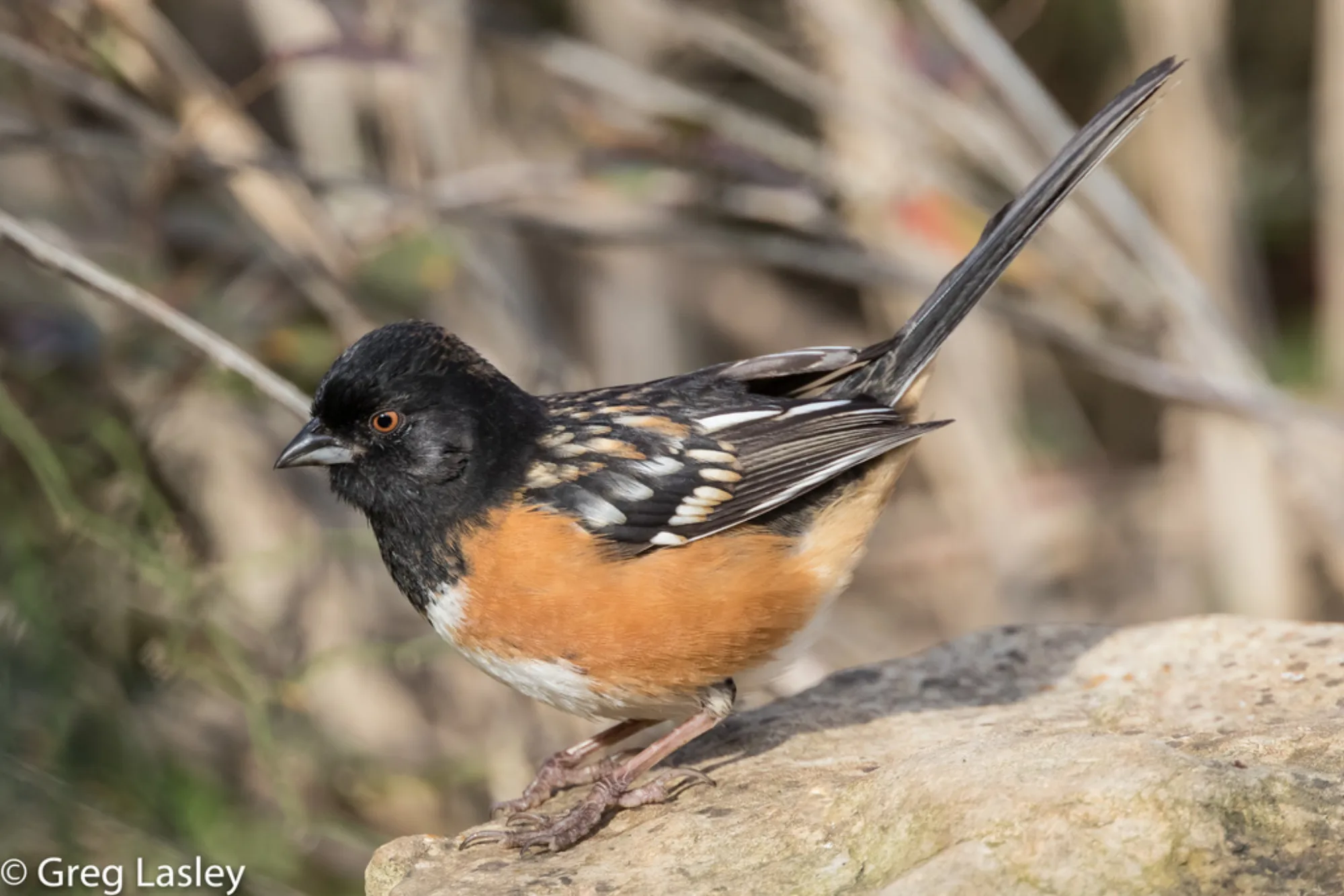
A flash of white in a dark, fanned tail can help identify the Spotted Towhee, a large New World sparrow with bright red eyes. Males have dark heads and upper bodies, white bellies, rufous sides, white spots on their backs and white bars on their wings. Females have similar markings, but their darker feathers are brown and grey. The bird measures 17 to 21 cm long, and its call can be harsh and varied.
Across western North America, look for it in dry upland and open forests, brushy fields and chaparral. It also uses woodland near wetlands and rivers, as well as scrubland, parks and suburban gardens during the breeding season. Some populations move seasonally: northwestern birds travel east to the central plains, while some elsewhere descend to lower elevations in winter. On the ground or among low plants, towhees make a noise as they rummage through dry leaves for food. In spring and summer they mainly eat insects, spiders and other small creatures; in autumn and winter they turn to acorns, seeds, oats and berries.
The female builds a bulky nest on the ground or low in a bush, using leaves, bark, twigs, plant stalks and grasses. She incubates the eggs alone, and the young leave the nest after 10 to 12 days. Cowbirds parasitise towhee nests, while ground-dwelling snakes prey on them in less developed areas and household cats are the main predators near urban development. Fires can reduce populations until vegetation returns, although recovering areas can offer good ground cover and foraging.
Written from the English Wikipedia article Spotted towhee (CC BY-SA 4.0).
- Records
- 3,224,607
- Countries
- 4
- Atlas places
- 3
These are open occurrence records, so they show where people looked for and recorded the Spotted Towhee as much as where it lives. Cells are up to 25 km across, and every location is generalised to its cell.
Generalised encounter areas, not exact locations. Each shape is a grid cell coloured by how likely the species is there.
- Very likelyUnited States25 km zone · high confidence · 2740210 records · updated 86 days ago
- Very likelyCanada25 km zone · high confidence · 470436 records · updated 86 days ago
- Very likelyMexico25 km zone · high confidence · 8450 records · updated today
- Very likelyGuatemala25 km zone · high confidence · 5511 records · updated today
Conservation status not assessed here yet, so every location is generalised to its grid cell.