Fathead Minnow
Pimephales promelas
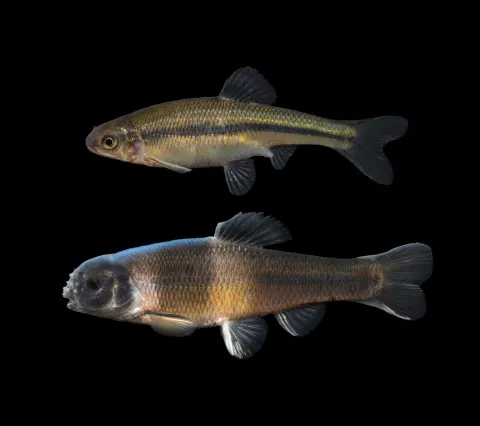
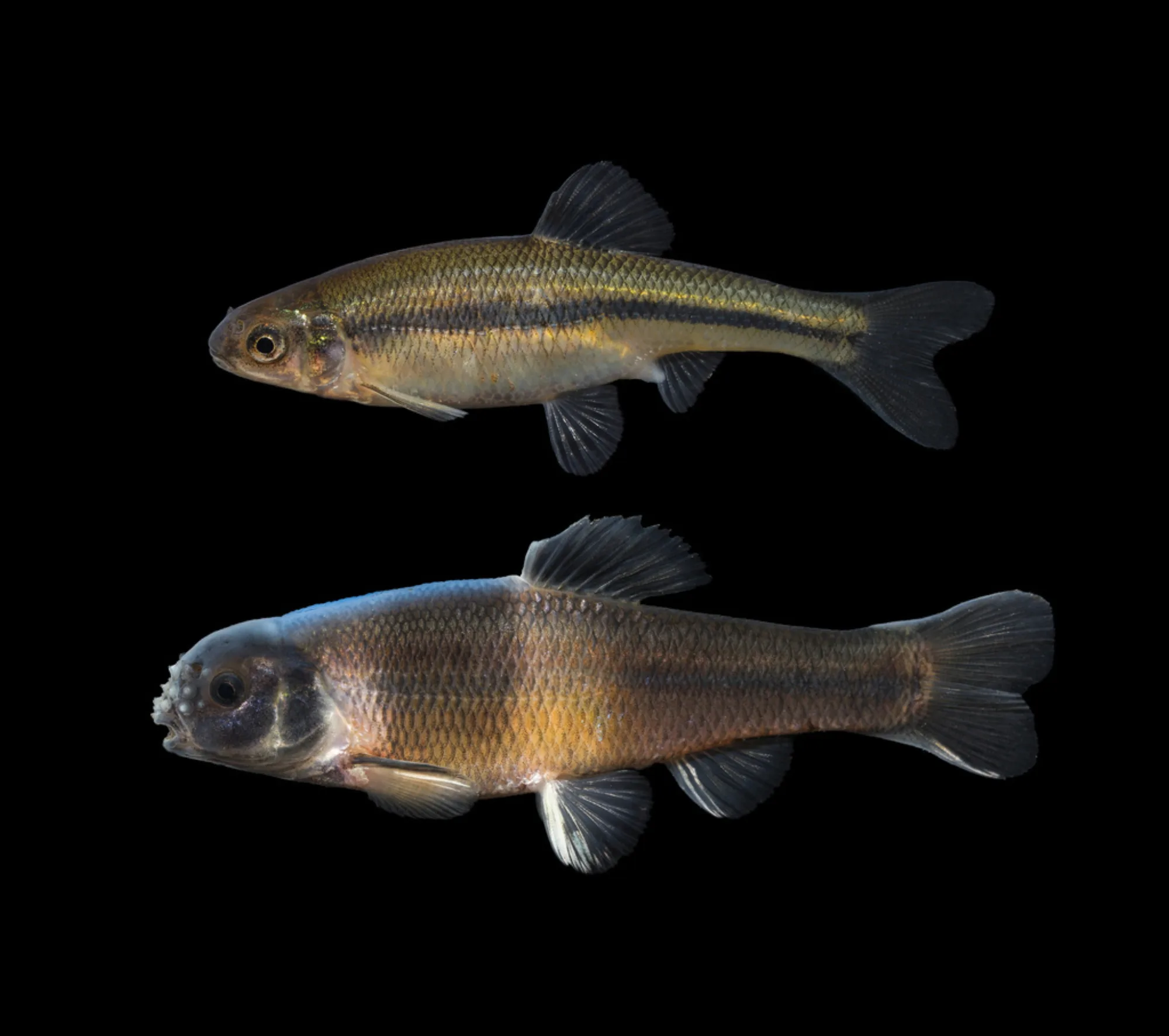
In its wild form, the Fathead Minnow is a small freshwater fish, typically 7 to 10 cm long. Its colouring is usually dull olive-grey, with a dark stripe along the back and side, a lighter belly and a dark patch midway along the dorsal fin. A golden form, known as the rosy-red minnow, has a rosy-golden body and fins, sometimes marked with dark patches.
Across North America, its distribution reaches from Chihuahua in Mexico to the Maritime Provinces and the Great Slave Lake drainage in Canada. It has also been introduced elsewhere, including to coastal river systems on both sides of the United States. Look for it most often in small lakes, ponds and wetlands, although it also lives in larger lakes and streams. It can tolerate cloudy water with little oxygen, as well as harsh conditions in places such as waste drainage sites. Feeding near the bottom, it sifts through dirt and silt for insects, crustaceans and other small aquatic animals, as well as algae and other plant material. It also eats material that has settled on the bottom.
The main spawning season runs from June through July. Males defend nests and care for the eggs until they hatch, removing diseased eggs and protecting the rest from predators such as crayfish. A male may take over an occupied nest and then care for the eggs already there. Larger fish, including northern pike and walleye, prey on fathead minnows. Pollution can also threaten reproduction: in an Ontario lake study, prolonged exposure to an artificial oestrogen reduced spawning and led to a population collapse. Low pH has been associated with abnormal behaviour and fragile eggs that are less likely to hatch.
Written from the English Wikipedia article Fathead minnow (CC BY-SA 4.0).
- Records
- 20,659
- Countries
- 4
- Atlas places
- 2
These are open occurrence records, so they show where people looked for and recorded the Fathead Minnow as much as where it lives. Cells are up to 25 km across, and every location is generalised to its cell.
Generalised encounter areas, not exact locations. Each shape is a grid cell coloured by how likely the species is there.
- Very likelyUnited States25 km zone · high confidence · 20273 records · updated 80 days ago
- Very likelyCanada25 km zone · medium confidence · 336 records · updated 80 days ago
- Very likelyMexico25 km zone · medium confidence · 37 records · updated 80 days ago
- LikelyGermany25 km zone · medium confidence · 13 records · updated 80 days ago
Conservation status not assessed here yet, so every location is generalised to its grid cell.