Oriental Magpie
Pica serica
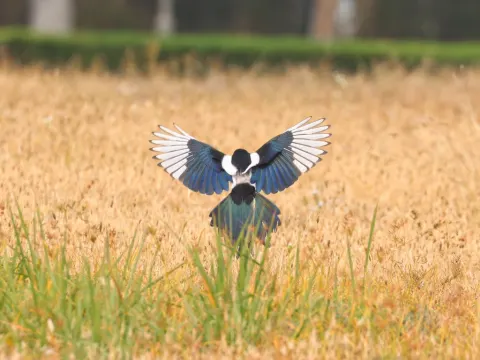
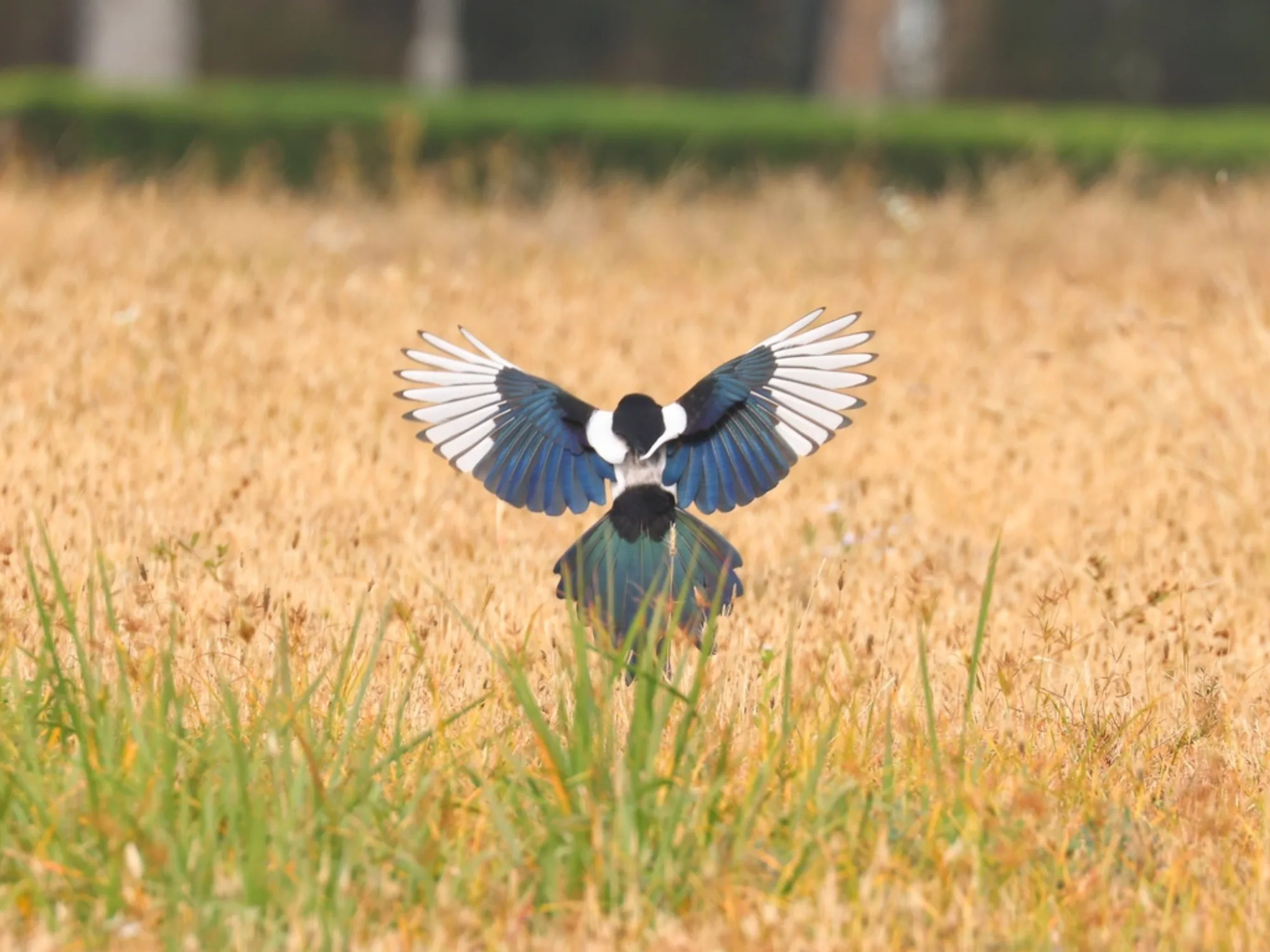
At 45 cm long, the Oriental Magpie has a long tail and a striking black-and-white pattern. Its mostly black rump carries a narrow, often greyish-white band that joins the white patches on its shoulders. The back and tail can show an iridescent sheen, although sources differ on how blue or green it appears. Its call resembles that of the Eurasian Magpie, but is somewhat softer.
The bird ranges from southeastern Russia through eastern China, Korea and Taiwan to northern Indochina and Myanmar. It has also become naturalised in Japan. In northwestern Kyushu, it was introduced by Korean immigrants about 400 years ago. Southern Hokkaido has had a smaller population since the early 1990s, likely descended from birds brought from Primoriye on ships carrying timber. Northern and southern populations look much alike and intergrade extensively; on average, northern birds are a little bigger and paler.
Magpies have a place in the traditions of both China and Korea. In China they are regarded as signs of good fortune, and the bird was known as the official bird of joy during the Qing dynasty. A Chinese folktale associated with the Qixi Festival tells of magpies forming a bridge that reunites two lovers each year. A Korean folktale also tells of magpies making a bridge for separated lovers. Numerous Korean cities, counties and provinces have chosen the magpie as their official bird. The Democratic People’s Republic of Korea also recognises the Oriental Magpie as its national bird.
Written from the English Wikipedia article Oriental magpie (CC BY-SA 4.0).
- Records
- 262,005
- Countries
- 12
No atlas park has a record of the Oriental Magpie in or around it yet.
These are open occurrence records, so they show where people looked for and recorded the Oriental Magpie as much as where it lives. Cells are up to 25 km across, and every location is generalised to its cell.
Generalised encounter areas, not exact locations. Each shape is a grid cell coloured by how likely the species is there.
- Very likelyTaiwan25 km zone · high confidence · 155039 records · updated 86 days ago
- Very likelyChina25 km zone · high confidence · 63526 records · updated 86 days ago
- Very likelySouth Korea25 km zone · high confidence · 37021 records · updated 86 days ago
- Very likelyHong Kong SAR China25 km zone · high confidence · 2472 records · updated 86 days ago
- Very likelyNorth Korea25 km zone · high confidence · 1661 records · updated 86 days ago
- Very likelyRussia25 km zone · high confidence · 1021 records · updated 86 days ago
- Very likelyMacao SAR China25 km zone · high confidence · 691 records · updated 86 days ago
- Very likelyJapan25 km zone · high confidence · 438 records · updated 86 days ago
- LikelyMongolia25 km zone · medium confidence · 83 records · updated today
- LikelySingapore25 km zone · medium confidence · 23 records · updated today
Conservation status not assessed here yet, so every location is generalised to its grid cell.