Eurasian Magpie
Pica pica
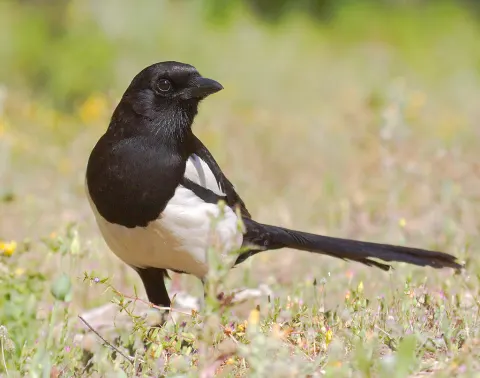
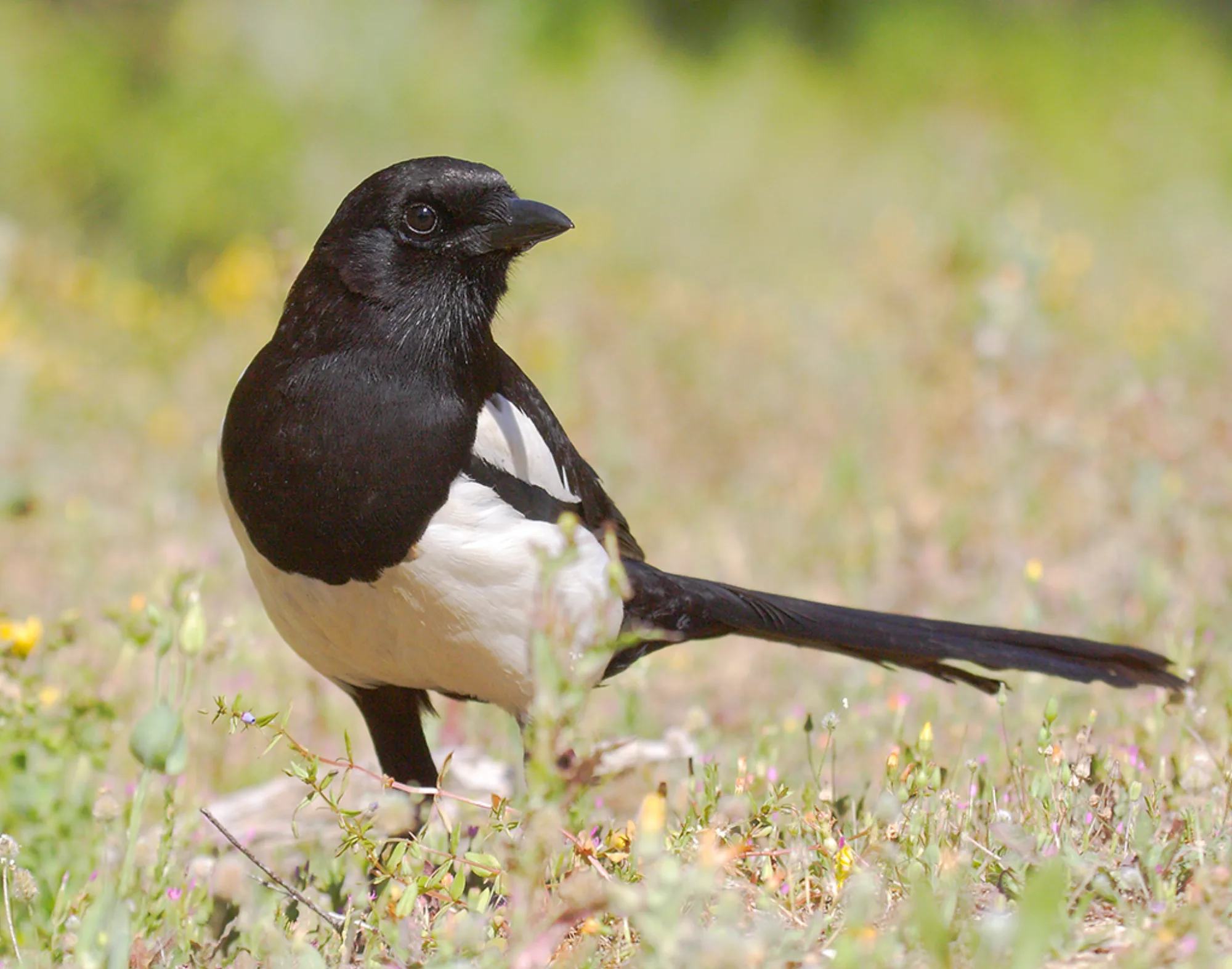
A long tail and bold black-and-white plumage make the Eurasian Magpie a striking bird of the crow family. Its head and breast are glossy black, its belly and shoulders white, and its dark wings and tail can shine green or purple. White patches show clearly when the wings are open, while the black bill and legs complete its contrasting appearance. Listen for a distinctive, chattering call, rendered as “chac-chac” or a longer repetition of the same sound. Young birds resemble adults but have duller plumage and shorter tails.
The magpie ranges from western Europe to the Kamchatka Peninsula, inhabiting temperate parts of Eurasia. Look for it in open countryside dotted with trees, or in suburban parks and gardens, sometimes close to city centres. It usually stays near its nesting territory through winter, although birds at the northern edge of its range may move south in harsh weather. On winter evenings, magpies often gather to roost together, sometimes alongside other birds. Their varied diet includes insects, small mammals, eggs and young birds, as well as scraps, carrion, acorns and grain.
Pairs often stay together between breeding seasons and return to the same territory in successive years. They favour tall trees for their bulky stick nests, which have a dome of prickly branches and a concealed entrance. In Europe, eggs are typically laid in April, and both parents feed the chicks. The young leave the nest at around 27 days but depend on their parents for food and protection for several more weeks. Predators can take nests, but starvation causes more nestling deaths, and the last chicks to hatch are less likely to survive when food is scarce.
Written from the English Wikipedia article Eurasian magpie (CC BY-SA 4.0).
- Records
- 2,029,846
- Countries
- 68
- Atlas places
- 1
These are open occurrence records, so they show where people looked for and recorded the Eurasian Magpie as much as where it lives. Cells are up to 25 km across, and every location is generalised to its cell.
Generalised encounter areas, not exact locations. Each shape is a grid cell coloured by how likely the species is there.
- Very likelyUnited Kingdom25 km zone · high confidence · 728762 records · updated 86 days ago
- Very likelyNorway25 km zone · high confidence · 278958 records · updated 86 days ago
- Very likelySpain25 km zone · high confidence · 229631 records · updated 86 days ago
- Very likelyFrance25 km zone · high confidence · 203577 records · updated 86 days ago
- Very likelyBelgium25 km zone · high confidence · 146098 records · updated 86 days ago
- Very likelyPortugal25 km zone · high confidence · 36144 records · updated 86 days ago
- Very likelyCzechia25 km zone · high confidence · 33490 records · updated 86 days ago
- Very likelySweden25 km zone · high confidence · 32466 records · updated 86 days ago
- Very likelyNetherlands25 km zone · high confidence · 31152 records · updated 86 days ago
- Very likelyFinland25 km zone · high confidence · 28807 records · updated 86 days ago
Conservation status not assessed here yet, so every location is generalised to its grid cell.