Sperm Whale
Physeter macrocephalus
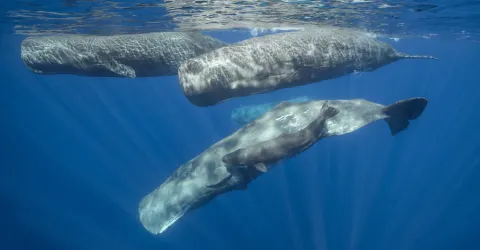
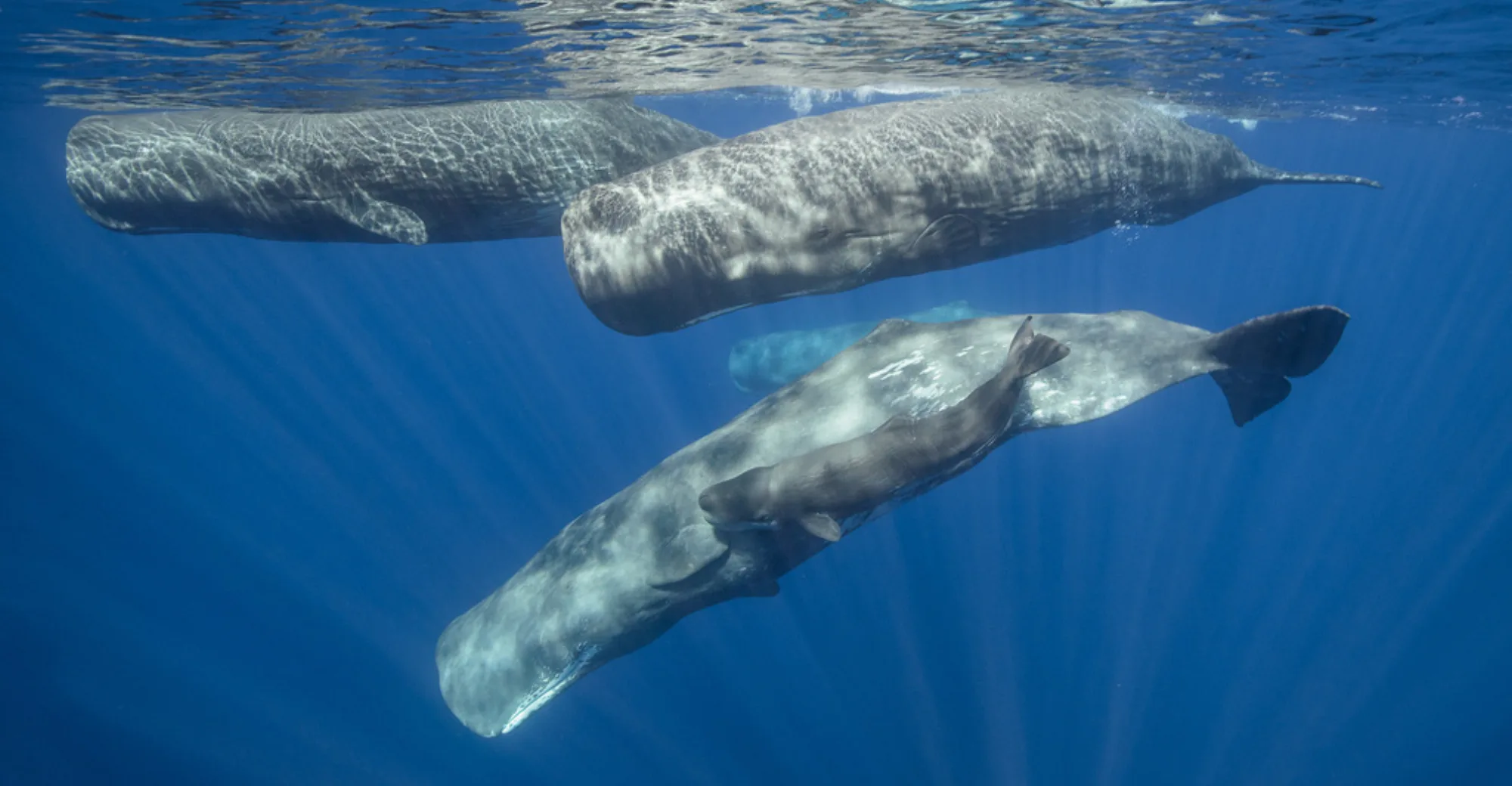
With its enormous square head and bushy blow angled forward, the Sperm Whale is distinctive even among large whales. It is the largest toothed whale, and mature males average 16 metres in length. The head can account for up to a third of that length, while the back is usually wrinkled. As it starts a feeding dive, the whale raises its thick, triangular tail high above the water.
Sperm whales range through oceans worldwide, favouring ice-free water deeper than 1,000 metres. Both sexes occupy tropical and temperate seas, but only adult males travel into higher latitudes. They are most often found far offshore in deep water, though places where the seabed drops steeply can bring them closer to land. Coastal areas with significant populations include the Azores and Dominica. The whales migrate seasonally to feed and breed, and use clicks for communication and echolocation.
Their diet is mainly medium-sized squid, although they also eat larger squid, octopuses and fish. Feeding dives typically reach around 400 metres and last 35 minutes, and the whales spend about eight minutes breathing at the surface between dives. Females and young males form groups, while mature males generally live alone outside the mating season. Females help protect and nurse one another's young, and mothers care for calves for more than a decade. Orcas sometimes prey on calves and weakened adults. Whaling was once a major industry, driven in part by demand for the waxy substance in the whale's head.
Written from the English Wikipedia article Sperm whale (CC BY-SA 4.0).
- Records
- 9,123
- Countries
- 24
- Atlas places
- 1
These are open occurrence records, so they show where people looked for and recorded the Sperm Whale as much as where it lives. Cells are up to 25 km across, and every location is generalised to its cell.
Generalised encounter areas, not exact locations. Each shape is a grid cell coloured by how likely the species is there.
- Very likelyGuadeloupe25 km zone · medium confidence · 2769 records · updated 80 days ago
- Very likelyPortugal25 km zone · high confidence · 2254 records · updated 80 days ago
- Very likelyUnited States25 km zone · high confidence · 2195 records · updated 80 days ago
- Very likelyCanada25 km zone · high confidence · 549 records · updated 80 days ago
- Very likelyIceland25 km zone · high confidence · 237 records · updated 80 days ago
- Very likelyNew Zealand25 km zone · high confidence · 211 records · updated 80 days ago
- Very likelyAustralia25 km zone · medium confidence · 209 records · updated 80 days ago
- Very likelyFrance25 km zone · medium confidence · 173 records · updated 80 days ago
- Very likelyNorway25 km zone · medium confidence · 139 records · updated 80 days ago
- Very likelyIreland25 km zone · medium confidence · 128 records · updated 80 days ago
Conservation status not assessed here yet, so every location is generalised to its grid cell.